
TOR FALCON
SUGAR BEET MOON
An Artist’s Study of the Sky
PRIVATE VIEW
Wednesday 18th September 6 – 8pm
(FULL MOON!)
All works will be illustrated here and for sale to coincide with the start of the exhibition at 6pm on the 18th September. An email will be sent when the exhibition is live. If you would like to join our mailing list CLICK HERE.
The exhibition continues until
Saturday 19th October
Tor Falcon and Tom Edwards will be
IN CONVERSATION
Thursday 10th October 6pm
Please contact the gallery if you would like to attend.
EXHIBITION BOOK
Tor has also published a book documenting this project. CLICK HERE to buy a copy.
Sugar Beet Moon began with some idle wondering – is it fluke that I’m walking down this track in October with the sun setting directly behind me and the full moon rising right in front of me? Does the full moon rise at around 19.00 every month? Or perhaps the full moon rises when the sun sets every month – at 15.30 in December and 21.40 in June?
I was slightly embarrassed that I didn’t know the answers so I decided that I’d go out to draw the full moon as it rose each month. Hopefully by looking and drawing I’d find the answers to my questions and maybe I’d learn more.
It only took a month or so for me to become totally ensnared by our restless, shape shifting celestial neighbour, though, and I quickly realised there was more to drawing the moon than just the moon. For instance I had to learn to draw in the dark and to get to grips with how my eyes worked, I had to learn to recognise the stars and to understand the tilt of the Earth. I’ve seen shooting stars and fireballs and even a rocket burning up in the atmosphere. I’ve spent a lot of time in the company of bats.
Tor Falcon 2024
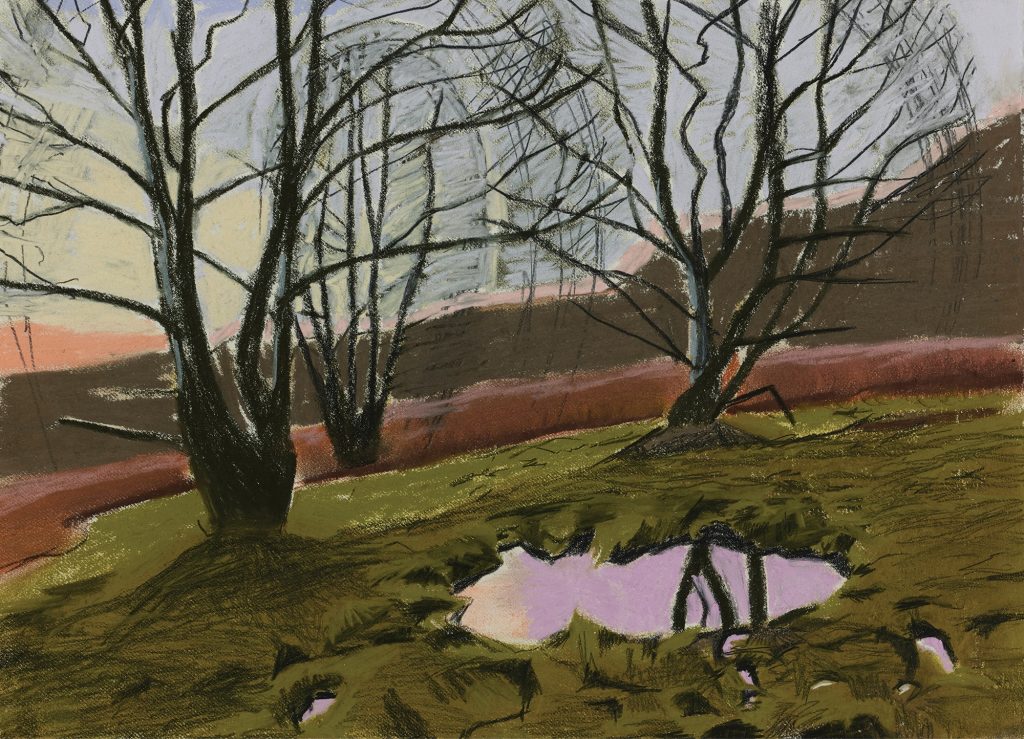
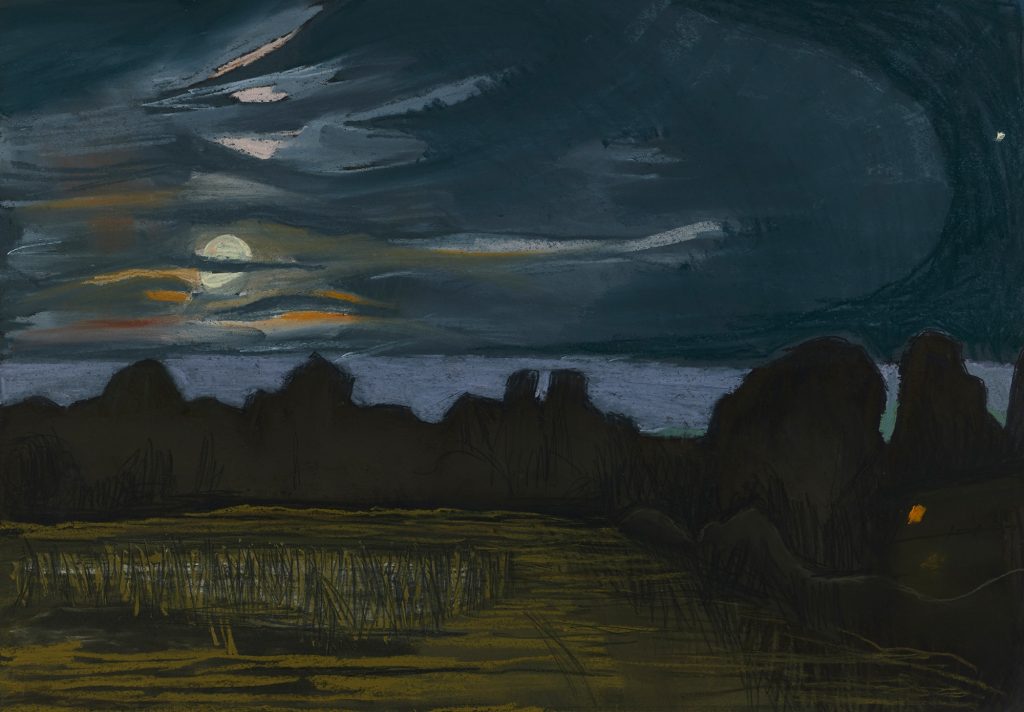
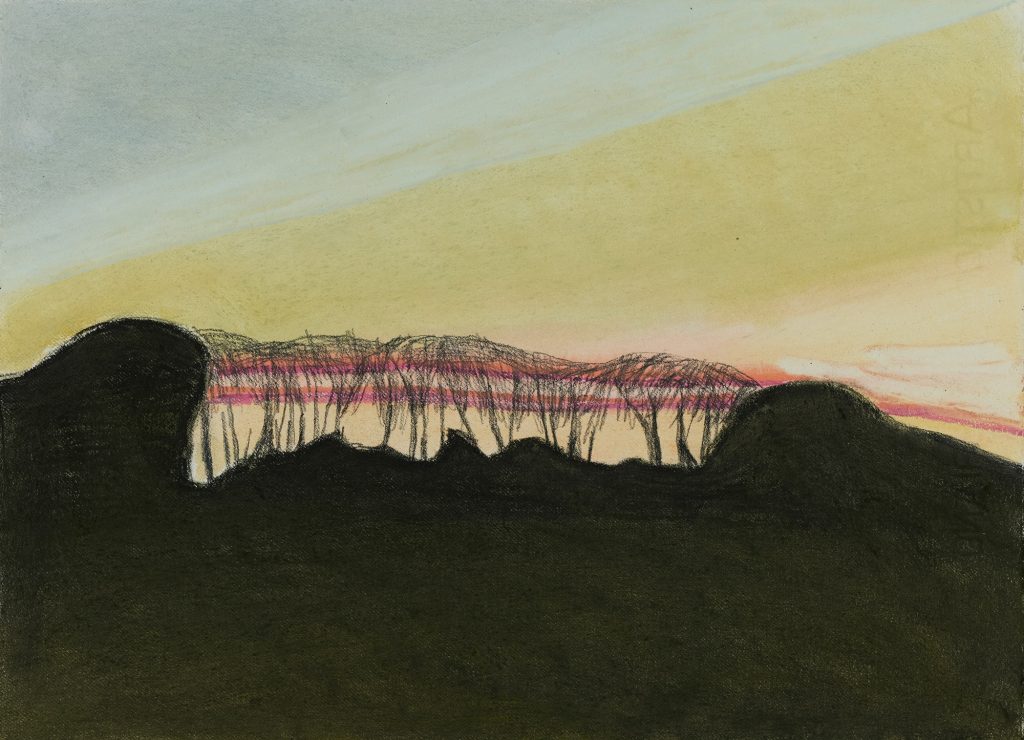
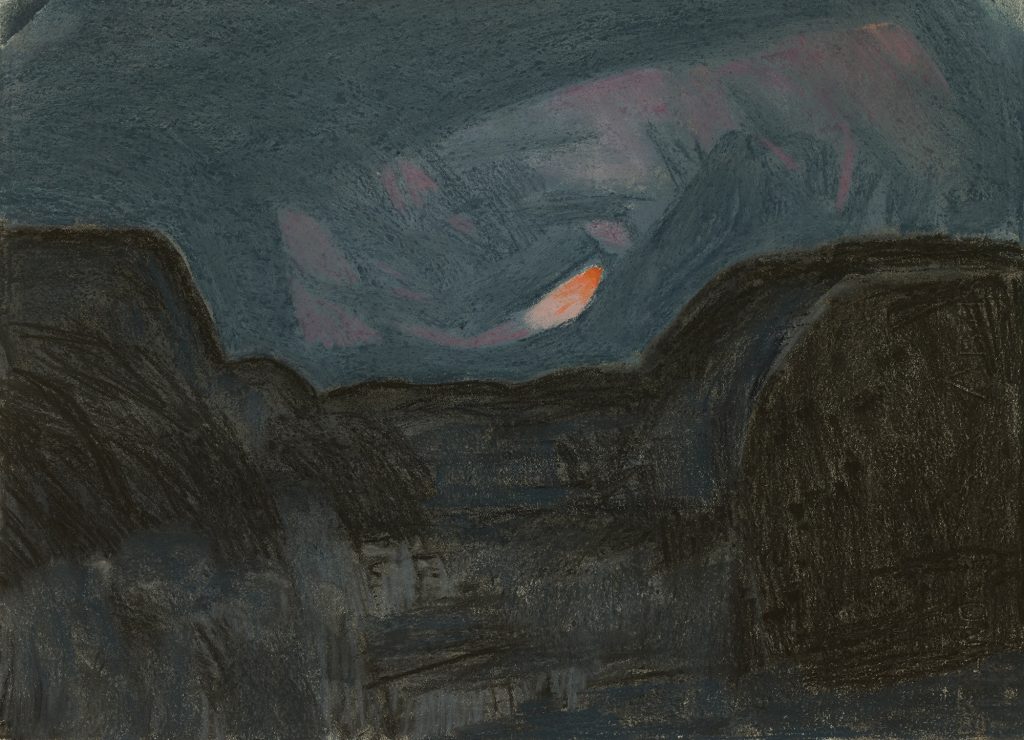
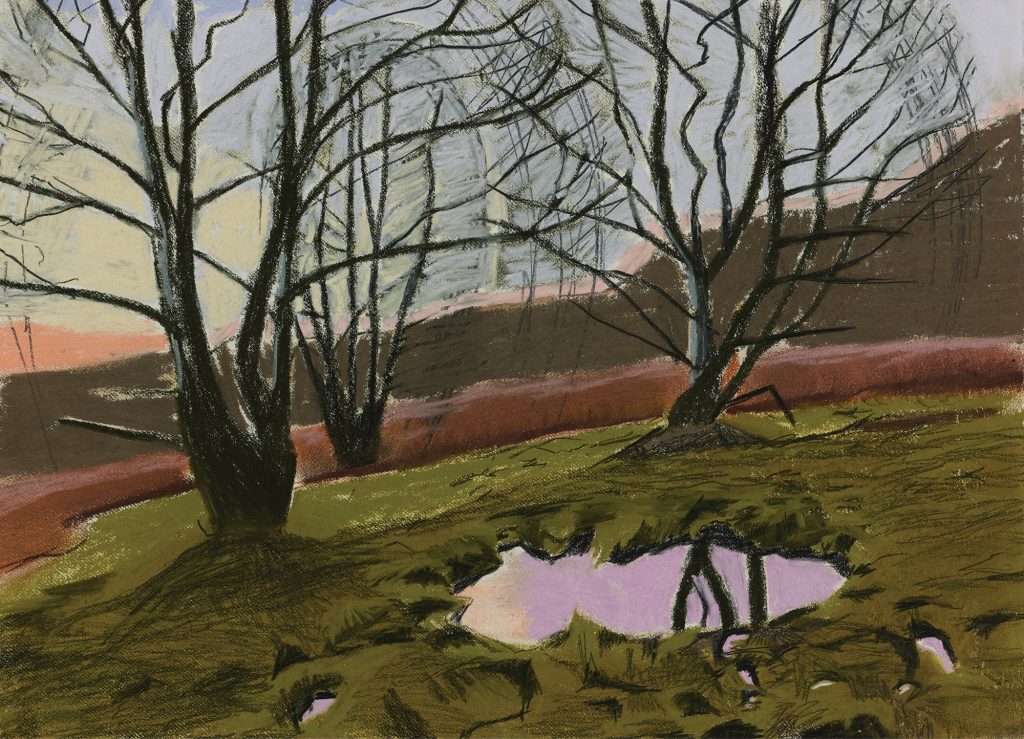
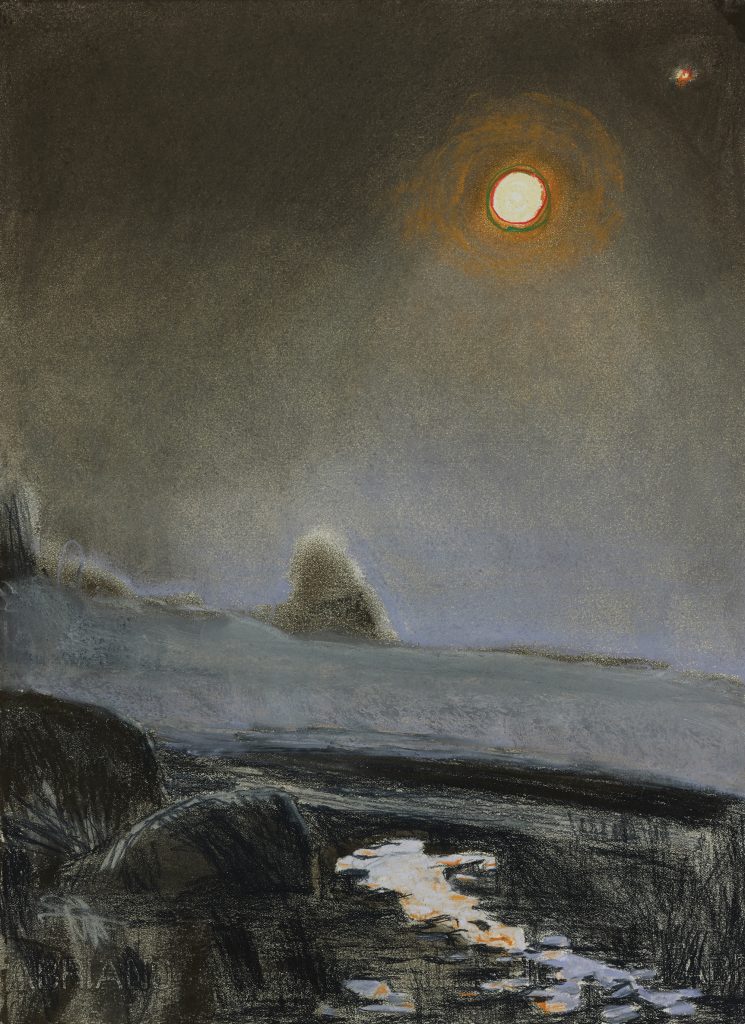
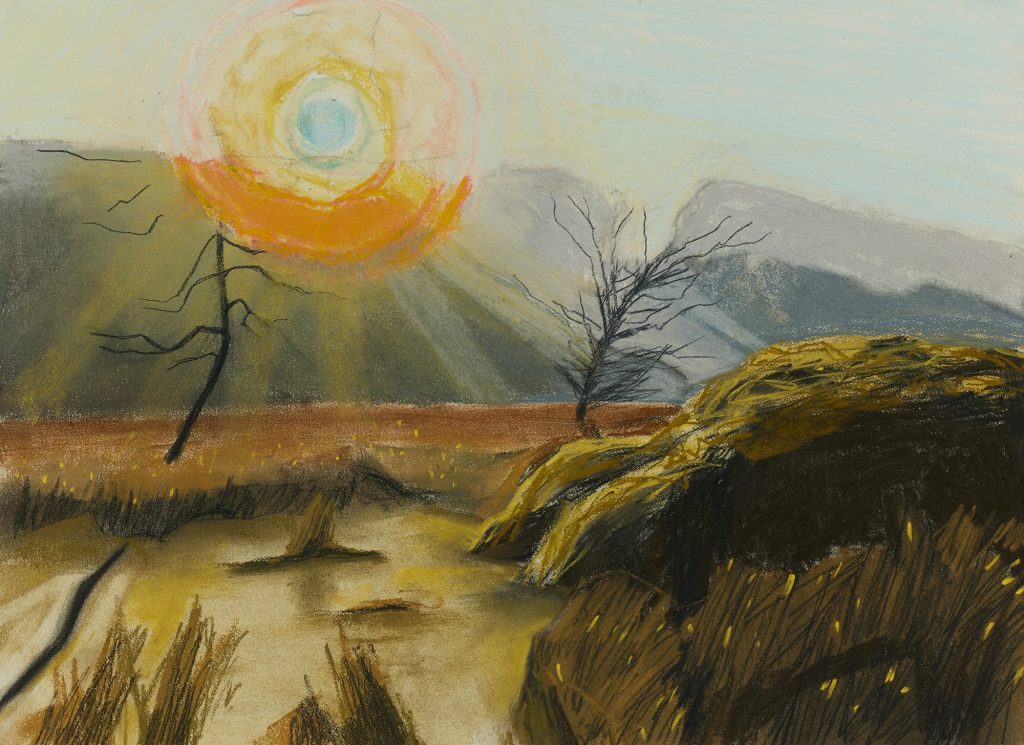
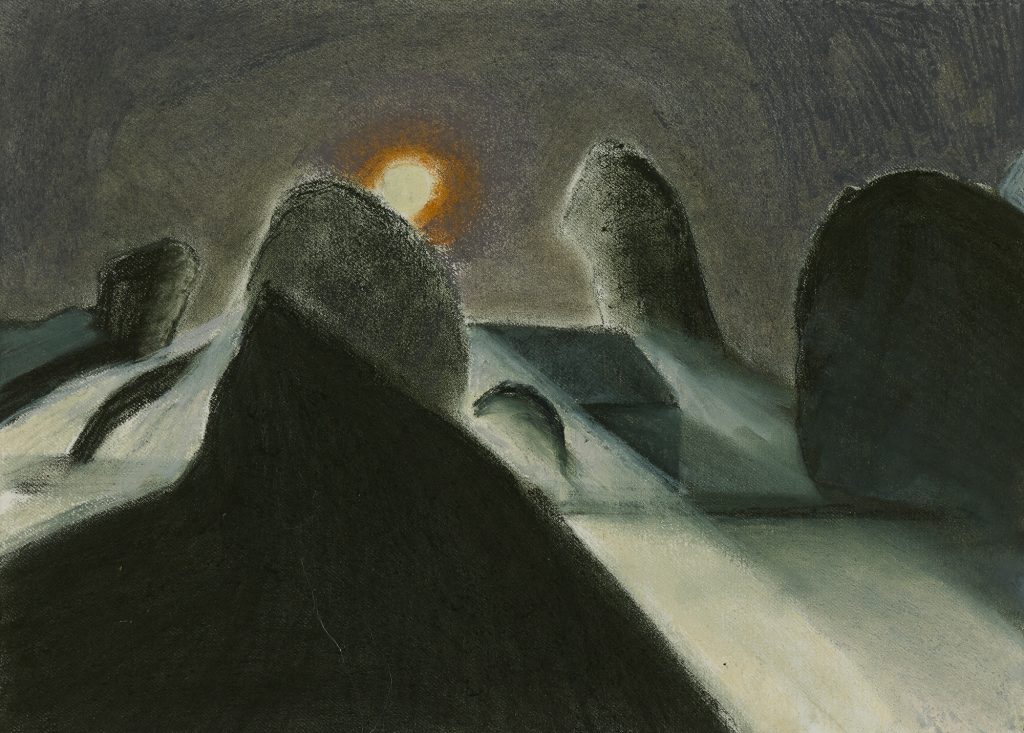
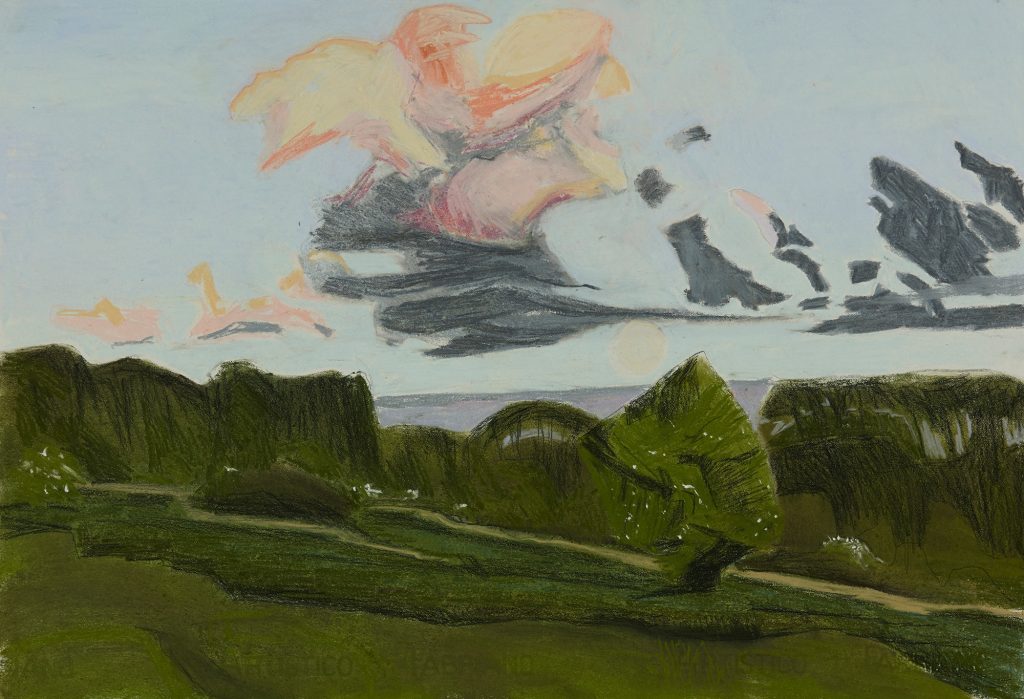
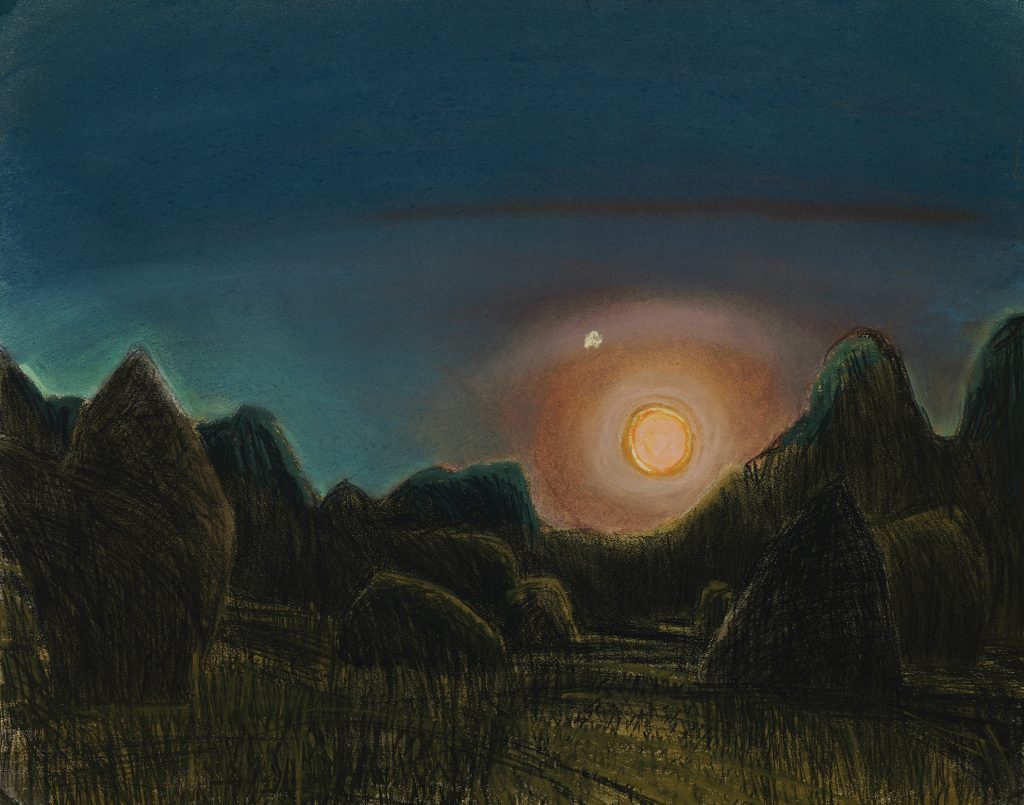
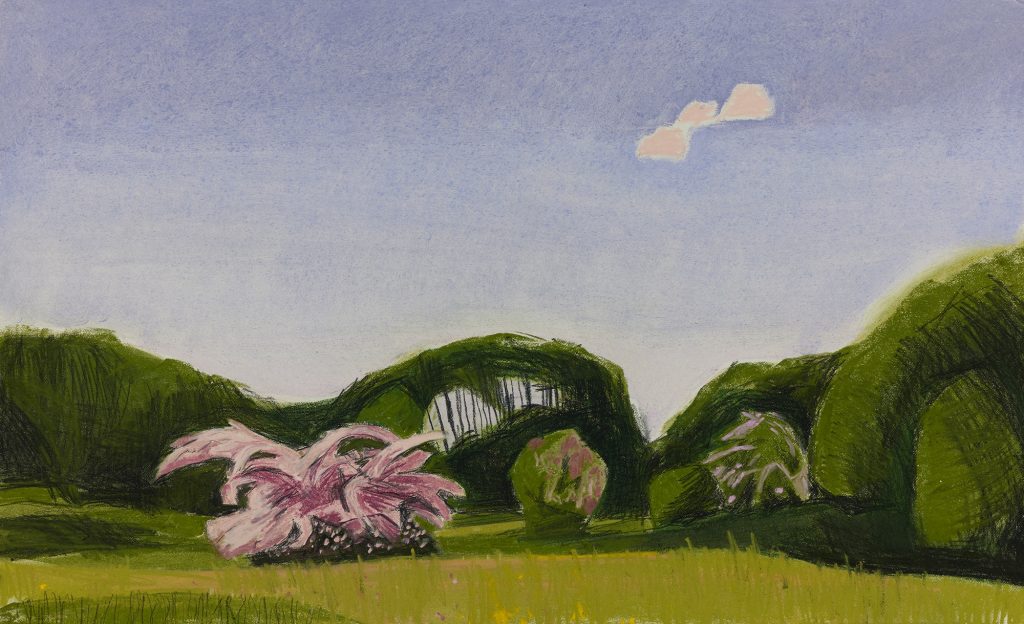
TOR FALCON: MOON WATCHING
An introduction by Andrew Lambirth
‘Part of the moon was falling down the west / Dragging the whole sky with it to the hills.’ (Robert Frost)
The nocturnal world has consistently fascinated artists. Painters as varied as Whistler, van Gogh, Atkinson Grimshaw, Emil Nolde, Caspar David Friedrich and Edvard Munch have invoked the moon in their work to memorable effect. Closer to home, the Romantic tradition of Turner, Blake, Samuel Palmer and Paul Nash has sought out the moon as symbol and guide. The dramatic crash of colour at sunset foreshadows the descent of the world into darkness, before the moon rises and casts its pale glamour over night operations: hunting, love-making, troop manoeuvres, sea voyages. The moon as pilot is but one role among many.
The moon is traditionally associated with fertility and regeneration, resurrection and immortality, occult power, mutability and intuition, and the emotions generally. Despite this emphasis on change, it is also a regulator of time: the cycle of the tides and seasons, crop growth and the lives of women. In itself it makes visible and actual the great cycle of birth, growth, death and rebirth. Today we regulate our lives on the Gregorian calendar, which although a solar calendar system evolved out of the lunar calendar, the earliest way of measuring time. The moon remains central to all our lives, as poetic symbol and actual reference point.
Although some cultures identify a male moon god, the moon is usually more closely allied with the female principle, though even in England we speak of ‘the man in the moon’ — the imagined male face appearing in the great sphere of the full moon. Sexually ambivalent, the moon appeals to all. Alongside scores of other artists, Tor Falcon has been seduced by the lyric moon and the liminal world of dusk. It has been said that daylight reveals, and moonlight mystifies, but nothing is quite so simple. (Think of the ‘Bomber Moon’ that reveals everything.) Each moon is the same and yet different. She says: ‘To watch a moon rise makes you feel euphoric’. It makes her laugh, for her it is a happy, joyous thing to be doing. In her latest work, she wants to achieve on paper some equivalent of the moon’s singular beauty and share it with us.
Tor Falcon’s previous projects have included walking the Peddars Way from Knettishall Heath to Holme-next-the-Sea, and exploring the rivers of Norfolk. In each case a significant body of work has emerged from her investigative peregrinations, the drawings being made along the way in front of the subject. There is a tradition of solitary wanderings in the literature and art of these islands that stretches back to Old English poetry. Falcon brings the peripatetic impulse into line with contemporary issues, writing a commentary on her discoveries (the people she meets as much as the landscape she encounters), which is more picaresque journal than artist’s pattern book.
With her new theme, the moon, she has allowed herself to be pinned down to one place: the garden and surrounding fields of her East Anglian home. This is an enveloping countryside of woods and meadows, without commanding vistas or high viewpoints. She draws the moon while remaining firmly grounded near her studio. This could be oppressive, especially with melancholy night closing in, but it isn’t. Darkness promotes anonymity, and can be frightening and isolating. Instead, the landscape is sympathetic and resonant, full of mystery but not of harm. As the gloaming advances, it might be the setting for Thomas Grey’s Elegy Written in a Country Churchyard:
‘Now fades the glimmering landscape on the sight,
And all the air a solemn stillness holds.’
It is as if the earth and air are waiting for something, and of course what they’re waiting for is moonrise.
The original idea behind these three series of works is that each chalk drawing be completed on the spot in one sitting, and thus become the most direct kind of record that can be achieved. Of course, there is some leeway in this mode of work, and some drawings have to be completed or re-worked in the studio. Sometimes, entirely new works are made from the on-site studies, usually larger and more elaborate. Falcon’s earlier drawings, such as those made in her year-long survey of the Peddars Way, tended towards flat designs on the page, all intriguing and often intricate surface pattern. The latest work has deepened the game and advanced the spatial enquiry, and the forms are much more three-dimensional. In fact, the tendency now is towards the sculptural. Perhaps moonlight, and the deep shadows it creates, accentuates the sculptural presence of things. Certainly her work has grown richer for this increasing solidity.
The work in her first two books could be called travelling drawings. She wrote in Rivers of Norfolk: ‘I have looked intensely. I have used drawing as a means of exploring.’ Her moon work is less about movement through a landscape and more about being the fixed point in a turning world. She is still looking intensely, never more so, and she is still exploring, but for this project she remains rooted in her own parish. The work’s dynamic is thus necessarily different. Falcon observes that the moon appears to change in every place you see it, that its surroundings to some extent dictate the way you see it, as well as its mood. (Or the mood of the viewer.) She says the moon in her garden, in her fields, is a bit of a trickster, disappearing behind trees, reflected in water. ‘I really love the chase,’ she says of her pursuit of the image she wants to draw.
When she started investigating the moon as a subject to paint, Falcon conducted considerable research into the nature of this satellite planet and its habits of motion through our skies. It is easy to be overwhelmed by scientific data once you start asking the whys, the wherefores and the whens, so she began to draw it. Firstly the classic full moon, and then continuing to concentrate on it when it was rising. Although it might seem simple and straightforward to start drawing, this was actually a lengthy process, partly because the look-out point had to be right. In fact, it took her a year of experimenting to find her ideal landscape of moon watching. Although a traditional place to watch the moon is from a roof or tower, she decided she preferred to be grounded rather than raised on a platform.
Night drawings are in a sense the reverse of daylight pictures: the landscape is effectively dead ground and the sky is where things are really going on. But even something as seemingly self-evident as that took time to come to terms with. When she first attempted to draw the subject, Falcon persisted in thinking the picture was still all about the foreground, not the background sky. Drawing the moon also made her more intensely aware of the activity of looking. ‘I got very interested in how my eyes worked,’ she says, ‘and what appeared to me as the light got lower, until the last bit of colour had gone.’
As it gets darker, am I seeing colour or imagining it? This is a question she constantly asks herself. Or indeed am I simply remembering it? For this is territory she knows well. Once again she kept a journal, and wrote it up immediately after a moon watch. As she grew to know her subject, she realised it was not necessary to understand the moon in a scientific way. It was enough to marvel and not fully comprehend: she speaks of this as ‘a joy’.
Before going out for a drawing session she would tape six small pieces of paper to a drawing board, so that she could make out their edges in the dark. (Paradoxically, she sometimes uses black paper, which is almost invisible. She also makes good use of pinky buff sugar paper.) She would then select four chalks with which to draw, and made sure she knew which was which, mostly identifying them by touch (labels, size and so on). Drawing in the dark must be rather like drawing and deliberately not looking at what you’re doing, or drawing with your eyes closed, both accepted studio exercises for artists. In some respects being there and making marks on paper — just the act of witnessing and recording the drama of the skies in this way — is the essence of the experience. At this point it’s not about making an attractive picture; a few lines are enough to connect with the natural magic of the moment.
As regards her choice of chalks, greens and greys have always been her preferred colours, and as she says, ‘I had a manageable little palette which pretty much worked everywhere. When I started drawing in the dark, a rainbow of colours opened up. I was surprised by how much colour there is in the dark. I bought loads of new pastels (probably too many) — colours I’d never have looked at before, like arsenic green, vermillion etc. They only need using sparingly though. I’d say pink is the colour I use lots now. Pinks, reds, oranges and darks.’ In addition to her distinctive use of colour, Falcon employs a soft conté pencil to draw into her forms or add definition in terms of outlines.
She does not work in a technical, astronomical kind of way, but she is interested in charts of position and movement which she draws out from time to time, to help her understand the music of the spheres. Musica universalis, or the music of the spheres, is an ancient philosophical notion that the mathematical relationships or proportions in the movements of the planets create a kind of music. Pythagoras believed this, and his idea was taken up by the 16th century astronomer Kepler. As a poetic metaphor it has lost none of its power.
As she draws the gradual ascent of the moon, the sun is behind her, setting: one could not exist without the other, and each defines each. They are the opposites or dualities of our existence. So of course the sun is just as much a part of this process, and realising this propelled Falcon into a year of drawing sunsets, one a month. She loves the challenge of her subject: ‘I’m really interested in drawing things that I can’t draw.’ And how to convey moonlight remains a problem. The moon is coloured, but moonlight is not. Some of her most beautiful studies are of the gloaming, and particularly the sunset’s red afterglow, that lasts for about five or ten minutes and that Falcon finds ‘compelling’.
The new work demonstrates her greater authority with her chosen medium of chalk or pastel. This is manifest in two ways: through a greater control (less scribble), and paradoxically also through a greater looseness (the ability to make the slightest line or squiggle stand for a whole nexus of things and events). Her forms are more crisply outlined and more thoroughly realised, making reference in their general approach (rather than in specific examples) to the landscapes of John Nash, an artist she much admires. Although she works in an accepted realist tradition, she brings her own interpretation to it, and her work is so well-observed that it remains fresh to the eye and mind.
In many ways, the drawings made on the spot are the real statements, not the ones composed later in her studio, however seductive and intriguing. For instance, a series of four tall thin drawings, done on wallpaper, celebrate and record the month of October, describing the position of the moon in each quarter of the month. These studio drawings have a completely different character from the plein-air work, but if they have none of its spontaneity and immediacy, they do allow Falcon to explore other qualities and formal possibilities discovered in the landscape. They are beautiful works in their own right, but they don’t have the sense of risk that work outdoors can offer. On one occasion when she was drawing in the fields, a fireball suddenly appeared, a meteorite burning across the heavens. She wouldn’t have seen that — or been able to draw it as it passed — in the studio.
The moon, and the sun likewise, are what Coleridge called ‘obstinate in resurrection’. Thank goodness they are. We cannot live in a world in which there is no moon, or the sun never rises. Their cycles are our cycles, their light our light, their visual dramas a great and sustaining nourishment that so many of us take for granted. Living in cities it is often easy to ignore the sun and moon and think they do not matter. And how many times have you travelled on a commuter train when most of the passengers seem entirely oblivious to the glories of the sunset taking place outside the speeding windows?
Tor Falcon pays close attention to what the rest of us may miss. Her way of coming to know the world is through her chalks, wielded with an alert eye and an enquiring mind. As she wrote in Peddars Way: ‘Drawing is a way of stepping out of one’s busy life, of just being a human in a landscape, of sensing your size in relation to what is around you, but mainly, of just taking time.’ She reminds us to take time: firstly to look at her drawings, and then to ponder our relationship to what she has drawn. Thus does she share her enthusiasm for the glories of the world around us, and enhance our understanding of it.
Andrew Lambirth