BRIAN STONEHOUSE
The Dachau Drawings
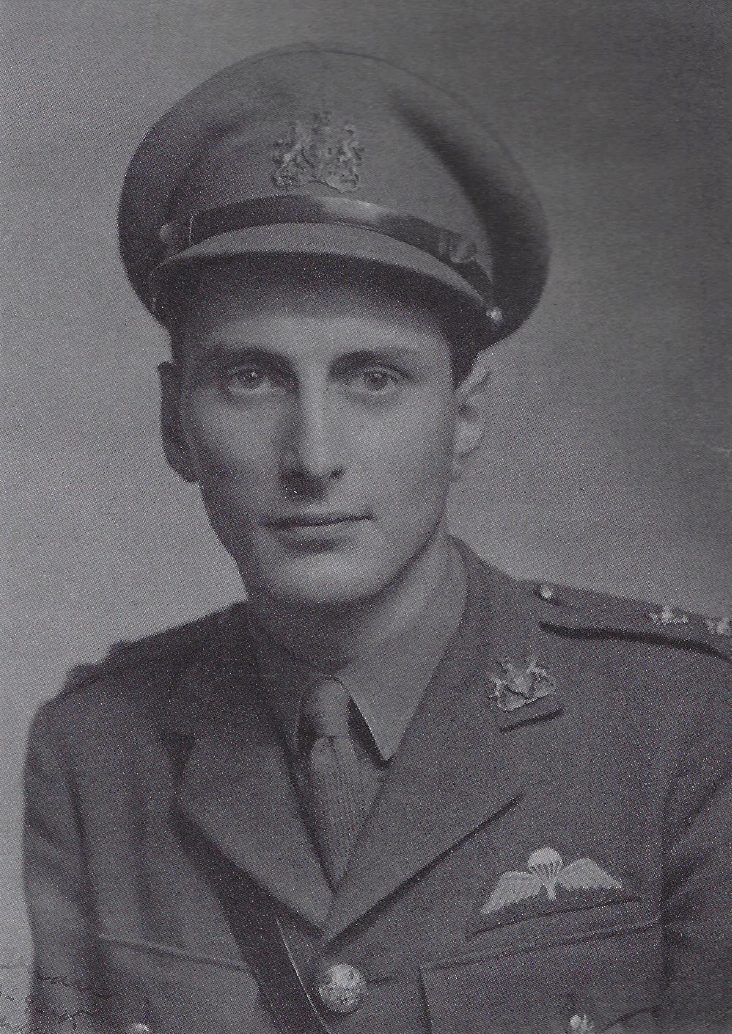
BRIAN STONEHOUSE MBE (1918-1998)
The Dachau Drawings
April 30th, 1945
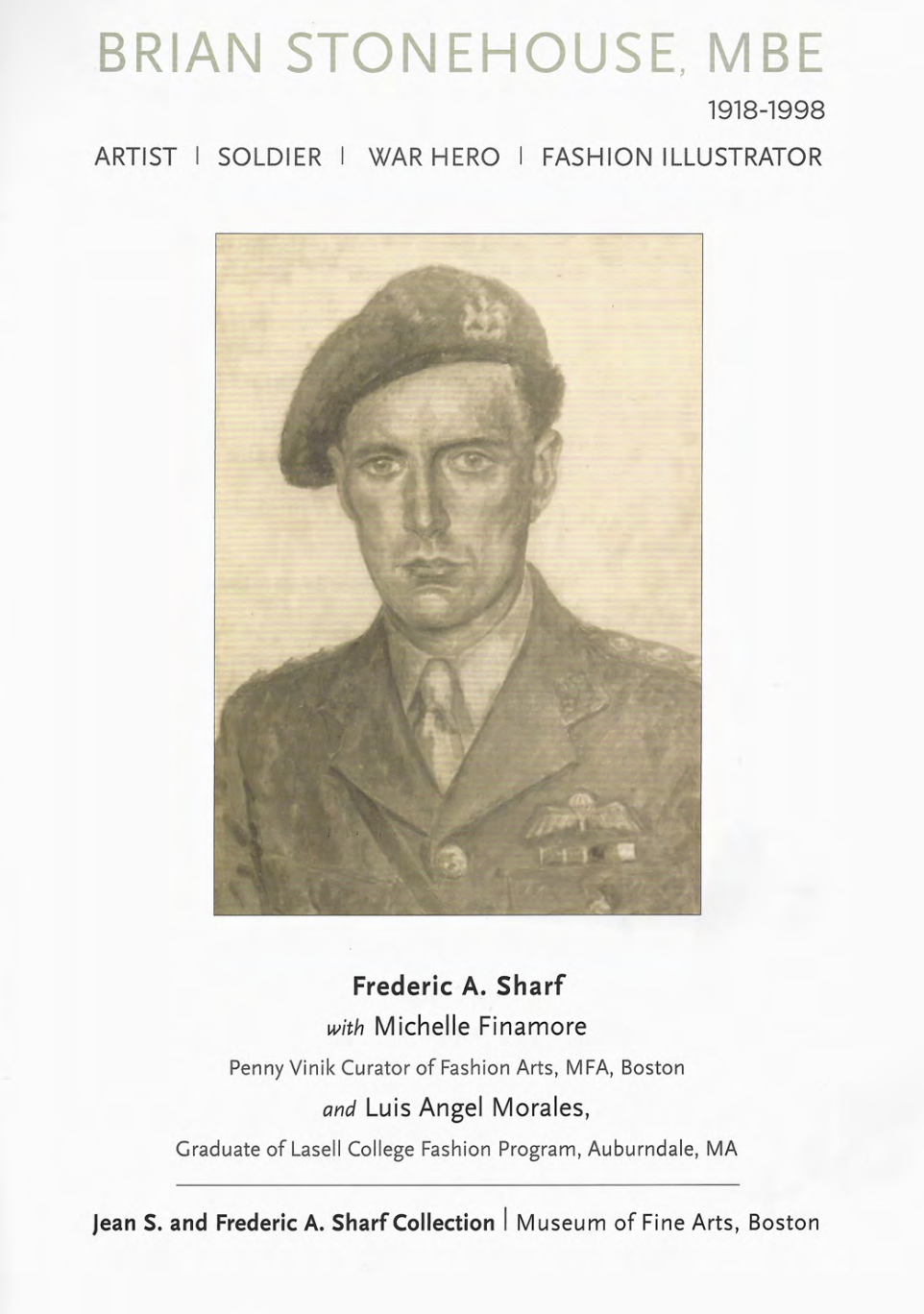
Brian Stonehouse MBE (1918-1998) was recommended for the Special Operations Executive in early 1942 and parachuted into occupied France later that year. Disguised as an art student (code name, Celestin), a radio concealed within his artist’s box, he was tasked with aiding the resistance movement and supplying information to the Allies from behind enemy lines.
His mission lasted only a few months. Having spent too long transmitting on his radio he was located and arrested by the Vichy French and the Gestapo. Stonehouse was sent to the notorious Fresne prison, near Paris, where he suffered prolonged periods of interrogation and solitary confinement. Labelled Nacht und Nebel (Night and Fog) – Hitler’s directive designed to make resistance collaborators disappear – he was moved to four Concentration Camps; first Saarbrüchen (Neue Bremm), then Mauthausen (Wiener Neudorf), then Struthof-Natzweiler, and finally, in September 1944, to Dachau.
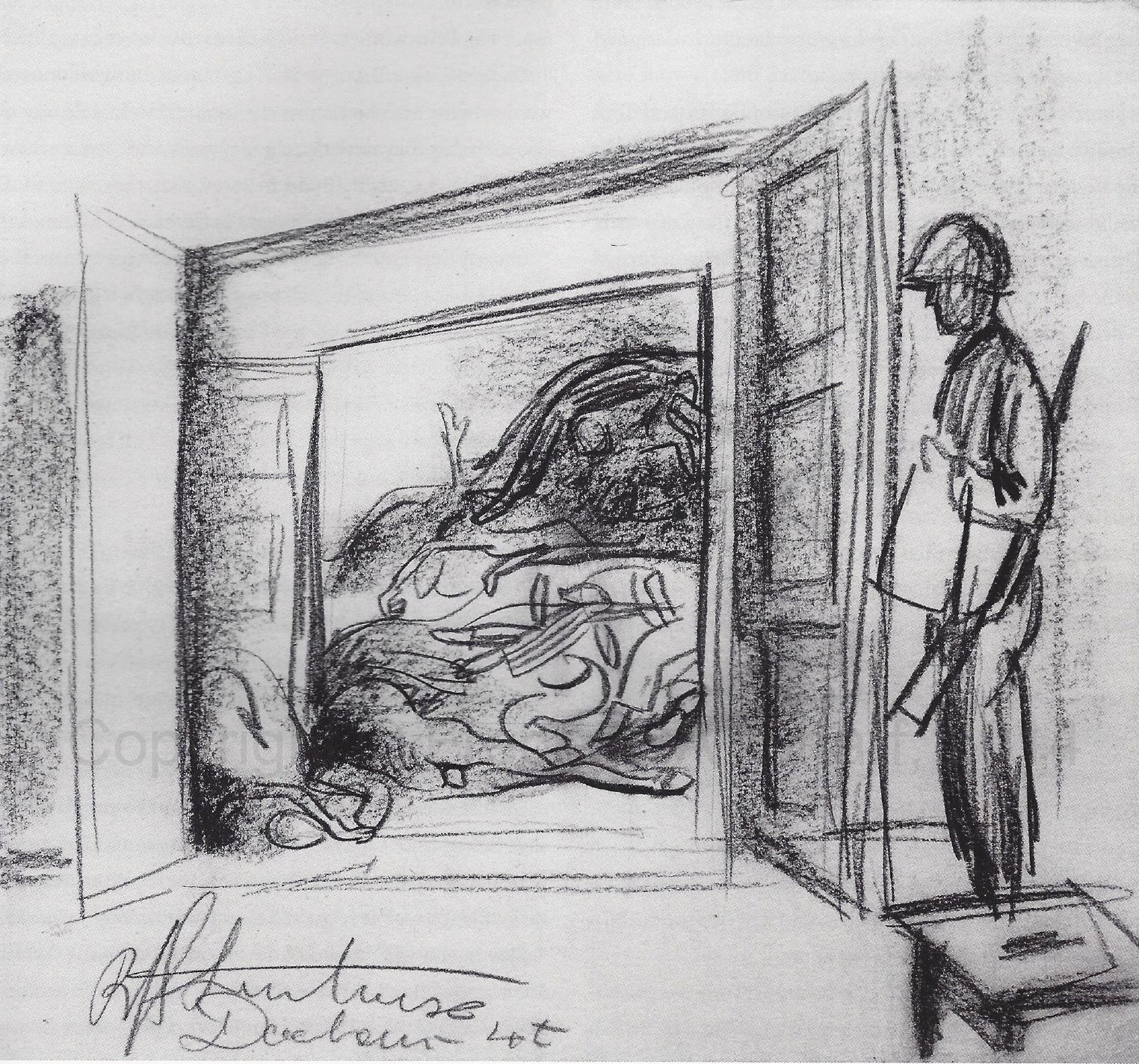
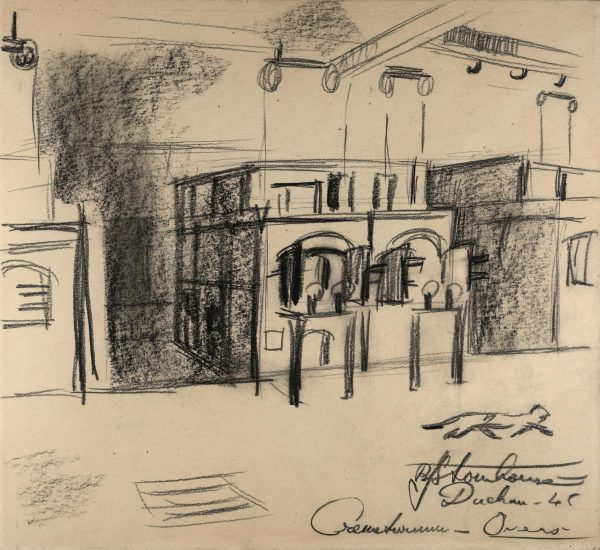
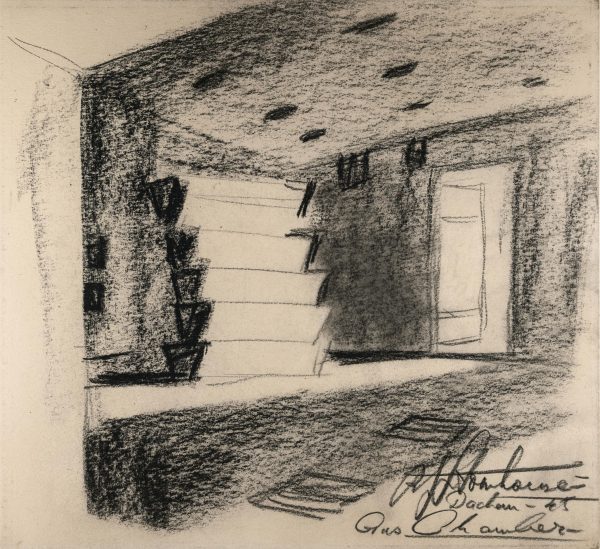
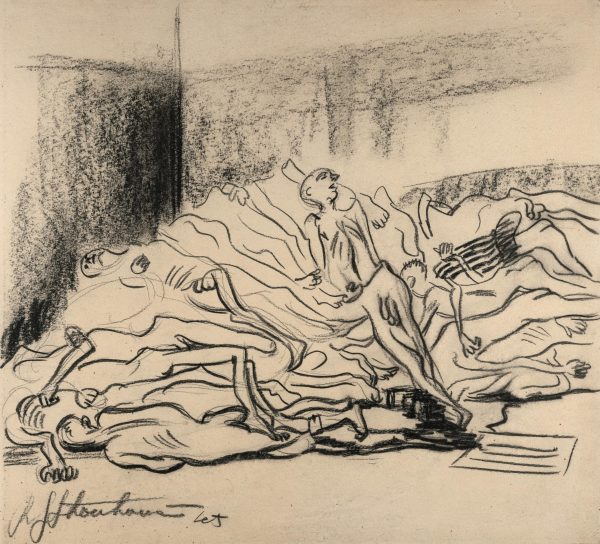
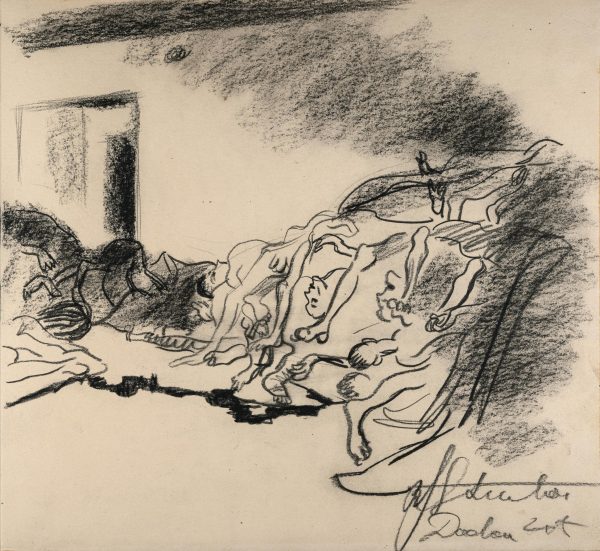
Dachau was liberated by the Americans on 29th April 1945. The following day, having witnessed and withstood the extreme brutality of the Nazi death camp system, Stonehouse bravely visited the Crematorium, Mortuary and Gas Chamber to record the atrocious scenes his captors had left behind. He made five drawings. [1]
DACHAU, Monday Evening, April 30, 1945 – I visited and made sketches of piles of corpses at the Krematorium. Not much time to sketch, as the place had been mined by the SS before they left, and the building was expected to blow up at any minute. The stench was almost unbearable, and a high percentage of the Americans who looked round the Krematorium had to vomit. I took round Lt. W.J.F of the Rainbow Unit. He was very much affected by the sight. [2]
(Extract from a diary started by Stonehouse on liberation day).
Stonehouse’s powerful drawings show the Dachau mortuary, crematorium and gas chamber.
The crematorium drawing shows the oven doors open and the menacing systems of hooks and pulleys used to operate them. A typhus epidemic had been raging in the camp for months, claiming thousands of lives. A train with many more dead had also recently arrived from Buchenwald Concentration Camp, which the Germans had evacuated. This and a shortage of coal used for operating the cremtorium ovens had resulted in the pile-up of corpses seen in the two expressive drawings Stonehouse made in the mortuary. These works, on first impression an illegible mass, are on closer inspection fluid delineations of bodies, twisted in various states of rigor mortis. Stonehouse’s drawing of the Gas Chamber shows that it was being used for storage by the time of liberation. In the centre of the composition is a stack of simple wooden coffins. There was a plot of land used for executions a short distance from the main buildings of the camp. The coffins were used to carry bodies back to the busy mortuary.[3]
There are only a small number of known drawings made by Dachau survivors in the immediate aftermarth of liberation. Retrospective, post-war works by holocaust survivors are more common, as are drawings made by artists attached to liberating forces, most notably at Bergen-Belsen. These drawings by Brian Stonehouse then, are extraordinarily rare survival; a moving example of the compulsion of a survivor to record and convey the terrible crimes committed at a concentration camp in the moments immediately after liberation, and despite the experiences they had just endured.
Drawing had been integral to Stonehouse’s very survival throughout the War. He drew while in solitary confinement at Fresne prison, helping him retain his sanity. He made portraits of camp officers, providing momentary respite from slave labour and he made drawings of fellow captives that earned him cigarettes he could exchange for bread. A number of the portraits Stonehouse made at Dachau are in the Imperial War Museums, London.
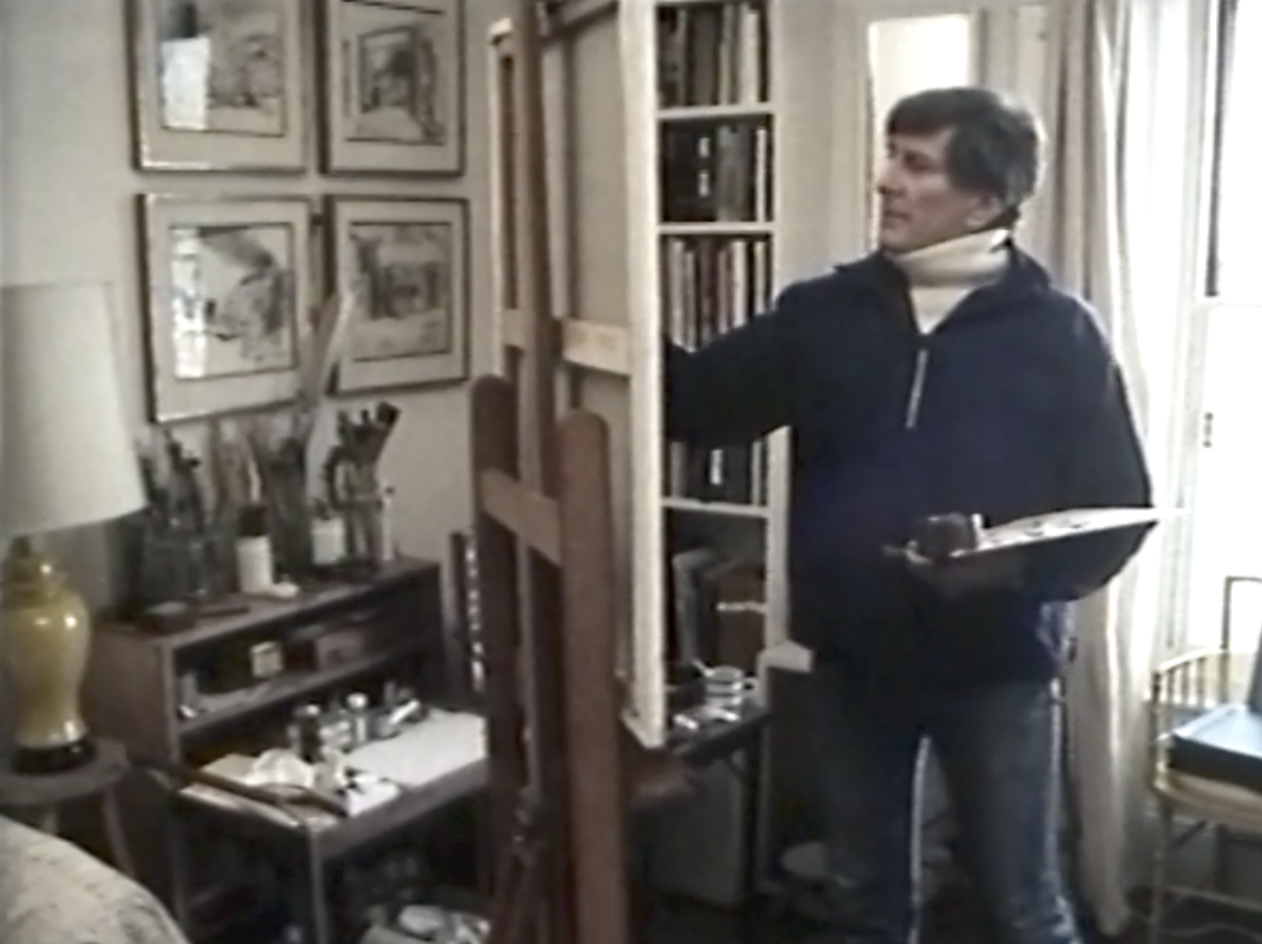
After the War, Stonehouse was drafted in as an interrogator at the War Tribunals. There he met Major Harry Haller, an American socialite who supported his move the USA in 1946. In New York, he embarked on a new career as a portrait painter and successful fashion illustrator, in 1952 becoming the first new artist to be taken on at Vogue since 1939. He stayed with the magazine until 1962 and continued to work for brands such as Elizabeth Arden and Saks Fifth Avenue until his return to the UK in 1979.
Stonehouse took The Dachau Drawings with him to the USA. They are still in the frames he had made for them there, and in which he would have exhibited them at The Playhouse Gallery, Washington D.C, in 1948. When he returned to London in 1979 the drawings returned too and were hung in the studio in his flat in Queen’s Gardens (see illustration).[4] In c.1986/87 Stonehouse had a selling exhibition at Queen’s Gardens from which a friend and neighbour bought these four drawings. They remained in that private collection until we acquired them in 2025. They are now offered for sale as a set.
The fifth drawing Stonehouse made on 30th April 1945 remained in his possession until his death. It was acquired by us, along with a large collection of his fashion illustrations, in 2014 and sold that year to a private collector who donated it to the Museum of Fine Arts, Boston.
General Eisenhower thought Stonehouse had ‘one of the most amazing experiences of the war’. Like Stonehouse himself, The Dachau Drawings are remarkable survivors that bore witness to the greatest horror of the Twentieth Century.
CLICK HERE for NEW YORK TIMES article covering these extraordinary works!
[1] Brian Stonehouse (Oral History) IWM9852. (Click to listen)
[2] Extract from a diary started by Stonehouse on liberation day and transcribed in his manuscript memoir War Script.
[3] We are grateful to Dr Christoph Thonfeld, Head of Research Department at the Dachau Concentration Camp Memorial Site, and his colleagues for sharing their knowledge of the camp at the time of libertion.
[4] Four of the drawings can be seen hanging on the wall of his studio in an ITV documentary made about his war experiences. The works also feature elsewhere in the film.
The following drawings were made at Dachau Concentration Camp on 30th April 1945, the day after the camp had been liberated by the Americans.
We will be exhibiting the drawings at 31 East 72nd Street, New York as part of Master Drawings New York
Friday 30th January to Saturday 7th February
They will return to London and be exhibited at 30 Museum Street
19th February – 7th March
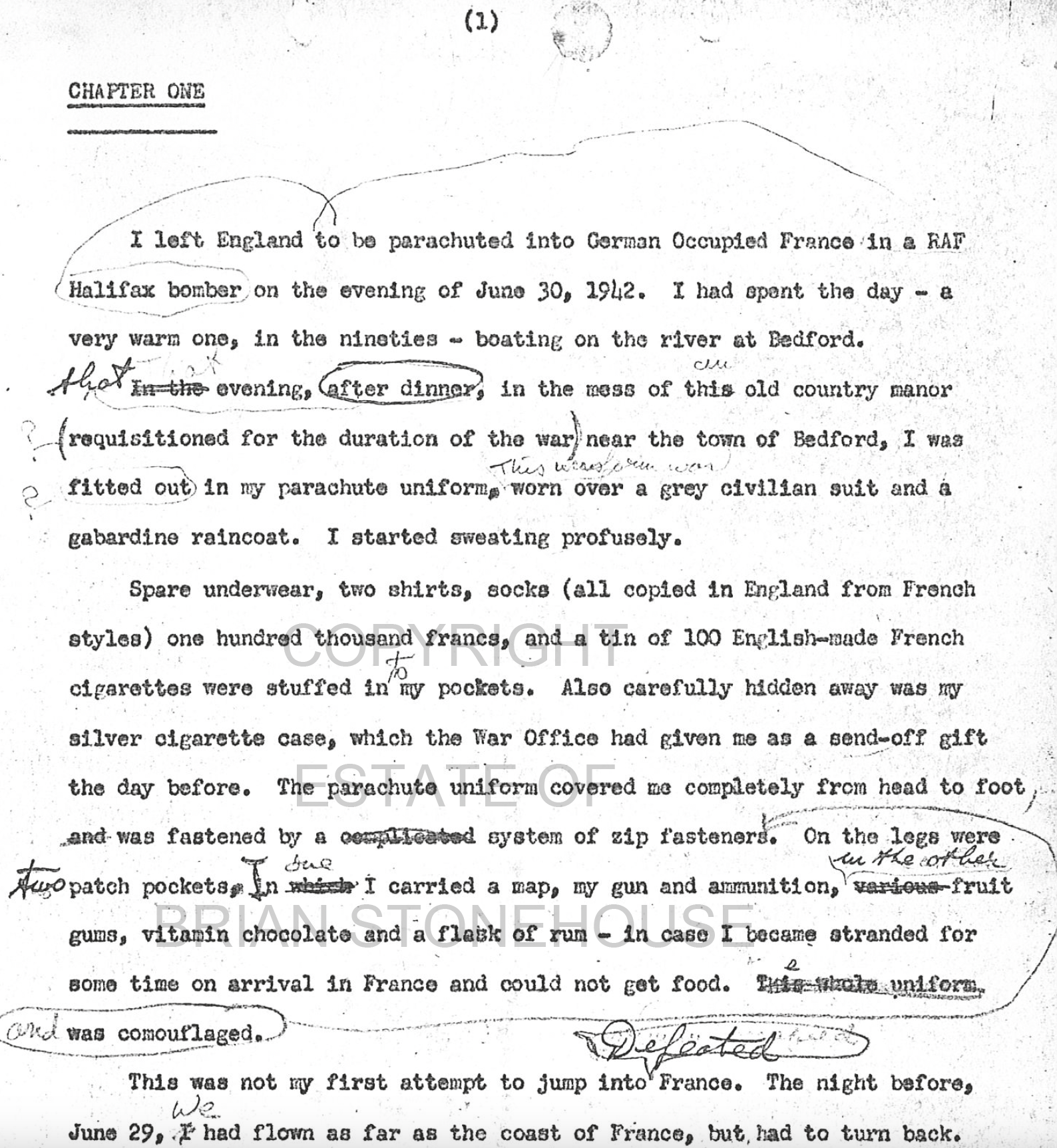
WAR SCRIPT
One of the most amazing experiences of the War
General Eisenhower thought Stonehouse had ‘one of the most amazing experiences of the war’. Alongside the TV documentary mentioned above and the audio files with IWM, we are lucky to have Stonehouse’s own written account of his War. We currently working on an essay that will draw on these resources, and many more, to be published soon …
BRIAN STONEHOUSE
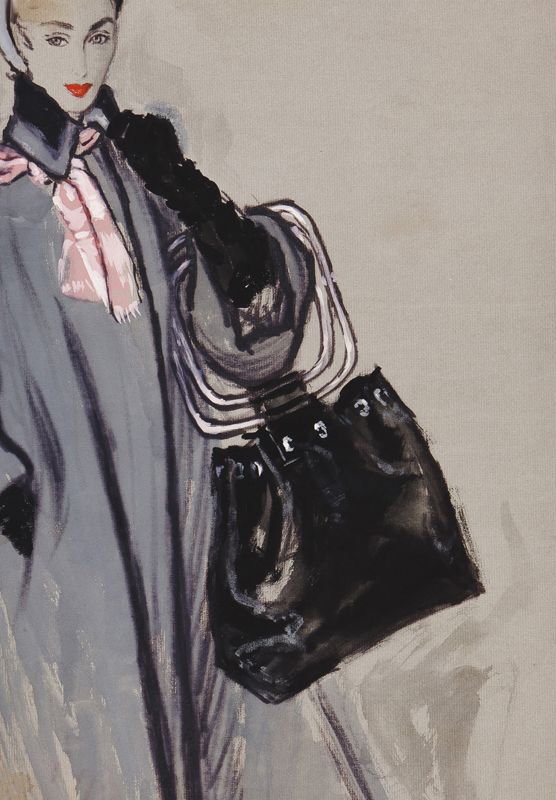
New York Fashion Illustrations
In 1952, Stonehouse became the first new fashion illustrator to be employed by American Vogue since 1939. Interest in fashion was strong after the drab War Years and Stonehouse found himself in the thick of fashion illustration’s golden decade.

BRIAN STONEHOUSE
Artist, Soldier, War Hero, Fashion Illustrator
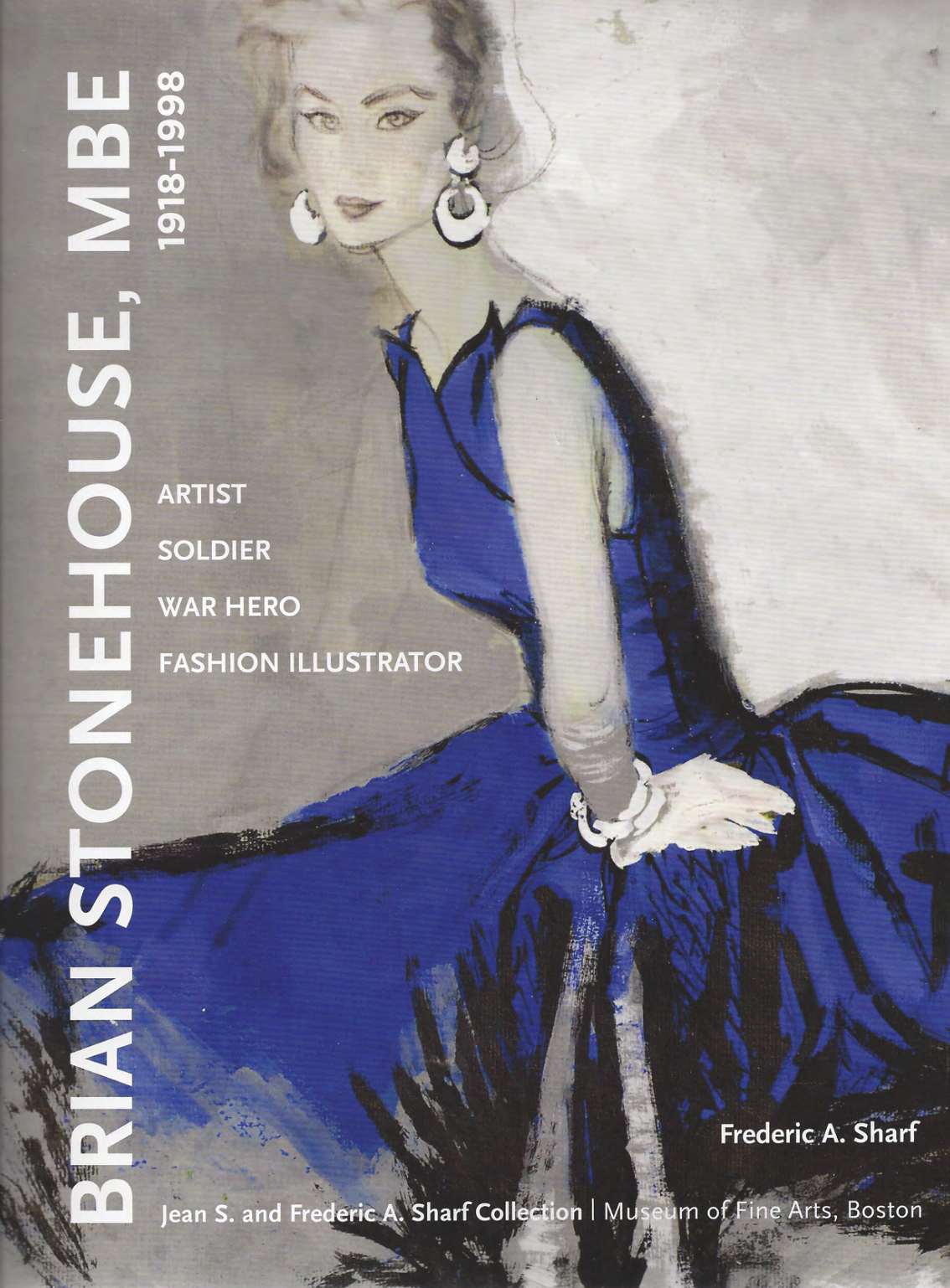
This book, written in 2014, is a good general introduction to Stonehouse’s life. It illustrates a number of the fashion illustrations sold by us to the collector and philanthropist Fred Sharf, who in turn donated them to the MFA Boston.
Read Here