
EDNA CLARKE HALL
The Poem Paintings
12th March – 11th April 2026
PRIVATE VIEW
6-8pm Thursday 12th March
RSVP
IN CONVERSATION
Alison Thomas, author of Portraits of Women, Gwen John and Her Contemporaries (Blackwells, 1994/6)
and the introduction to Edna Clarke Hall’s Poem Paintings at the bottom of this page, will be
‘In Conversation’ with Tom Edwards 6.30pm-7pm on Thursday 12th March.
THE ‘IN CONVERSATION’ IS NOW FULL!
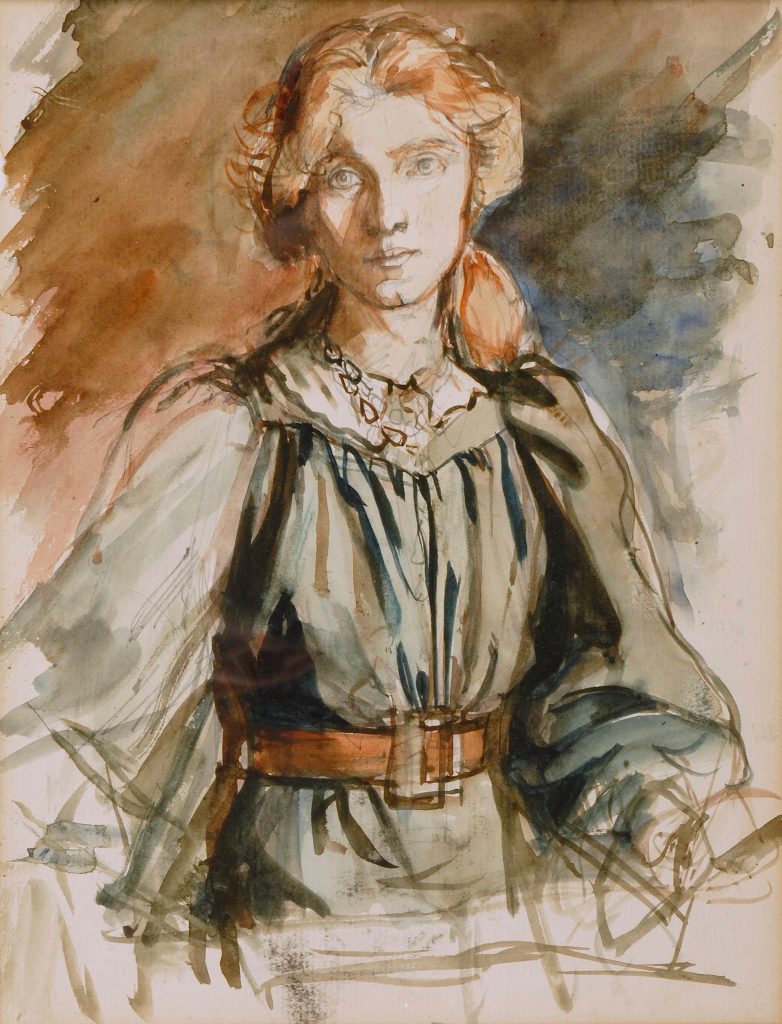
2026 is shaping up to be something of an annus mirabilis for Edna Clarke Hall (1879-1979). Aside from this exhibition, timed to coincide with the one hundred year anniversary of Edna’s Poem Paintings being exhibited at the Redfern Gallery, Eiderdown Books are publishing a new edition of Wuthering Heights illustrated with Edna’s work and with an introduction by Eliza Goodpasture. Max Browne, who has himself previously written on Edna’s Wuthering Heights works, will also be publishing a large and well-illustrated overview of her life and work, and Alison Thomas, custodian of Edna’s residual artistic estate, has made a generous gift of sketchbooks and drawings to the V&A, thereby further boosting her already considerable standing in public collections. The combined effect will, we all hope, bring a greater awareness and appreciation of Edna’s work.*
Edna Clarke Hall was one of the fabled generation of students that entered the Slade in the mid-1890s and had a seismic influence on British Art in the early years of the Twentieth Century. It is startling to think that there was a time when William Orpen, Augustus and Gwen John, Ambrose McEvoy, Edna Clarke Hall and many more now revered names sat alongside one another in the life-room at the Slade, all under the influential (if sometimes difficult!) tutelage of Henry Tonks.
In 1959 Augustus John wrote that, of their generation at the Slade, ‘ … the girls were supreme’. None more so than Edna. She was, before Augustus’s own coming to artistic-fruition in 1897, the unchallenged star of the Slade and Tonk’s great hope. However, it is the women who have until recently felt the greatest neglect. This is due both to contemporary and historical receptions of their work, which has not treated it on equal terms with that made by men, and the deeply patriarchal society in which they lived. Many of the most talented female student artists of the 1890s were expected, once married, to prioritise home life over their work or to completely set it aside.
As the reader will learn on reading Alison Thomas’s introduction below, Edna was just such an artist whose work was entirely shaped by her domestic life and relationships. Alison has been the foremost champion of Edna’s work since the 1990s and her book Portraits of Women, Gwen John and Her Contemporaries (Blackwells, 1994/6) still stands as the cornerstone study of her life. For those of you who would like to learn more about Edna’s work, and her Poem Paintings in particular, are encouraged to come and listen to Alison in conversation with myself on the evening of the Private View of this exhibition on Thursday 12th March.
Tom Edwards, February 2026
*Wuthering Heights by Emily Brontë with illustrations by Edna Clarke Hall and introduced by Eliza Goodpasture will be published by Eiderdown Press on 20th March.
The book can be pre-ordered (and after the 20th, bought!) from their website (CLICK HERE).
It will also be available in many good, independent book shops. We are proud to have financially supported this publication.
The Art of Edna Clarke Hall by Max Browne can be bought online (CLICK HERE).
In addition to the peice at the bottom of this page, Alison Thomas has written on the Poem Paintings for ArtUK (CLICK HERE)
This is our third exhibition of the work of Edna Clarke Hall. Previous exhibitions were …
Cornish Summers at Gillan Creek 1915-1925, November 2006
and
Wuthering Heights and Upminster Common, March 2008
NOTES TO THE EXIBITION
All works are from Edna Clarke Hall’s artistic estate via Alison Thomas, who is its custodian.
The Poem Paintings are all roughly the same size. For ease we can given 16×11.5 inches (unframed) for each, despite some slight variation between sheets.
All works are sold in same-sized frames and mounts.
An introduction to Edna Clarke Hall’s Poem Paintings by Alison Thomas can be read at the bottom of this page.
-
 £2,000Sold
 -
 £875Sold
 -
 £1,500Sold
 -
 £2,000Sold
 -
 £1,250Sold
 -
 £1,250Sold
 -
 £2,000Sold
 -
 £1,750Sold
 -
 £1,500Sold
 -
 £2,000Sold
 -
 £1,500Sold
 -
 £1,100Sold
 -
 £2,250Sold
 -
 £2,000Sold
 -
 £2,000Sold
 -
 £875Sold
 -
 £1,100Sold
 -
 £1,750Sold
 -
 £1,750Sold
 -
 £875Sold
 -
 £1,750Sold
 -
 £1,750Sold
 -
 £1,250Sold
 -
 £875Sold
 -
 £1,100Sold
 -
 £1,500Sold
 -
 £1,250Sold
 -
 £975Sold
 -
 £1,500Sold
 -
 £2,250Sold
 -
 £975Sold
 -
 £675Sold
 -
 £675Sold
 -
 £750Sold
 -
 £750Sold
EDNA CLARKE HALL’S POEM PAINTINGS
By Alison Thomas
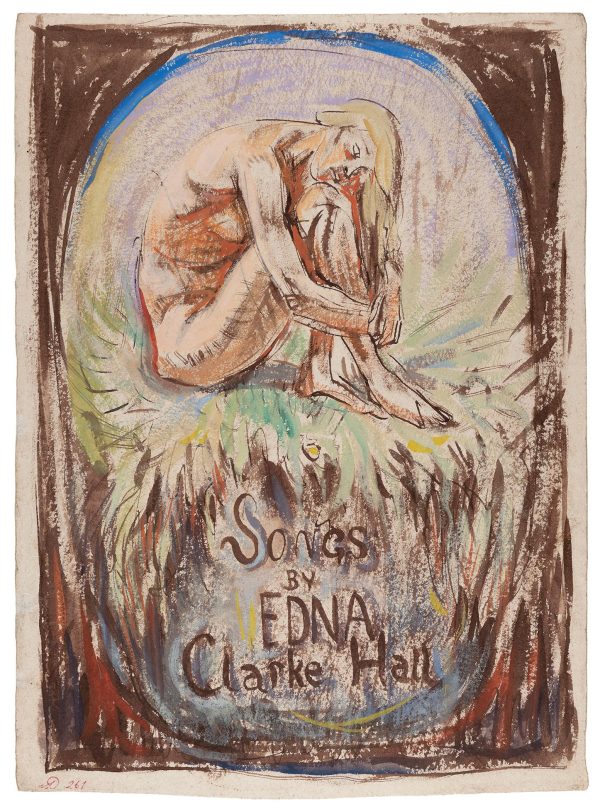
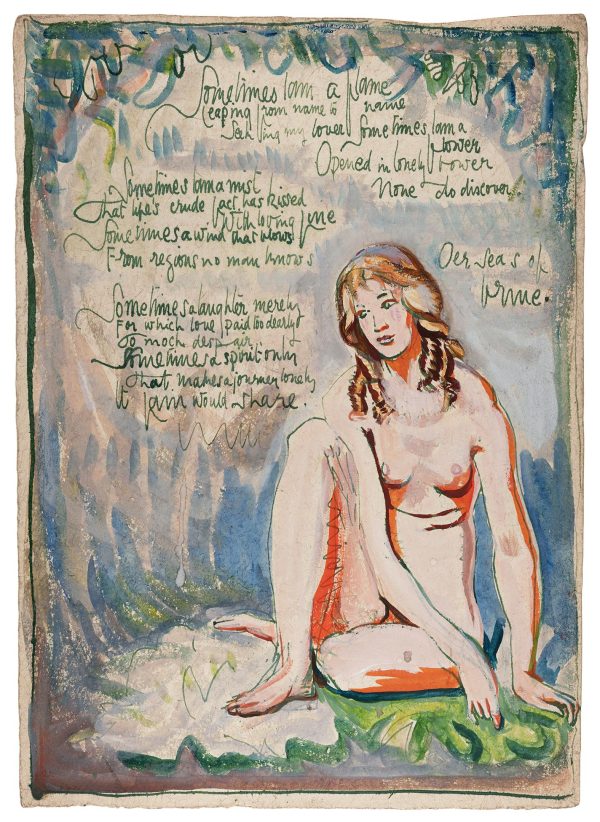
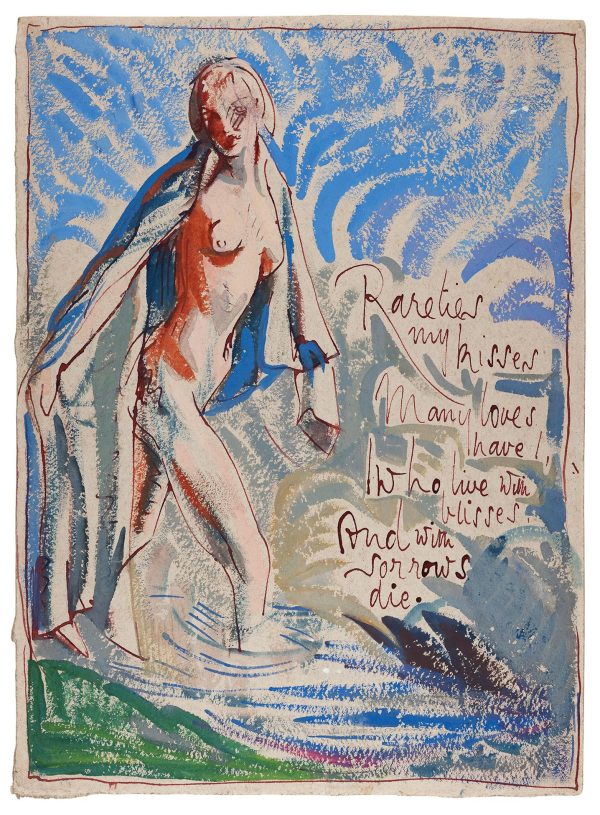
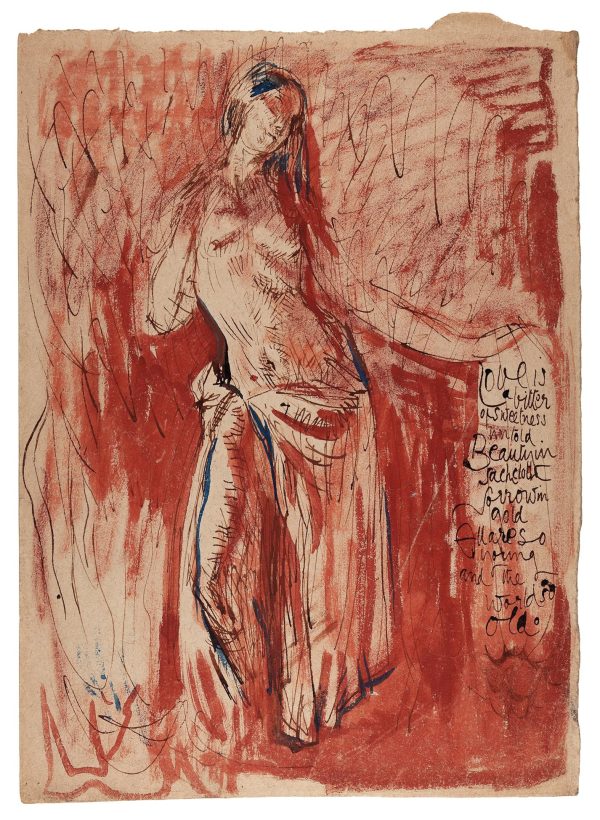
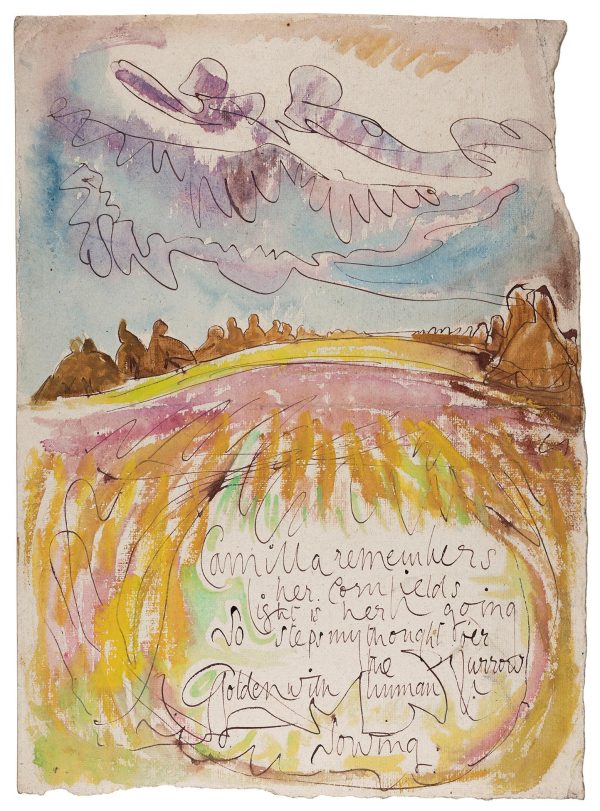
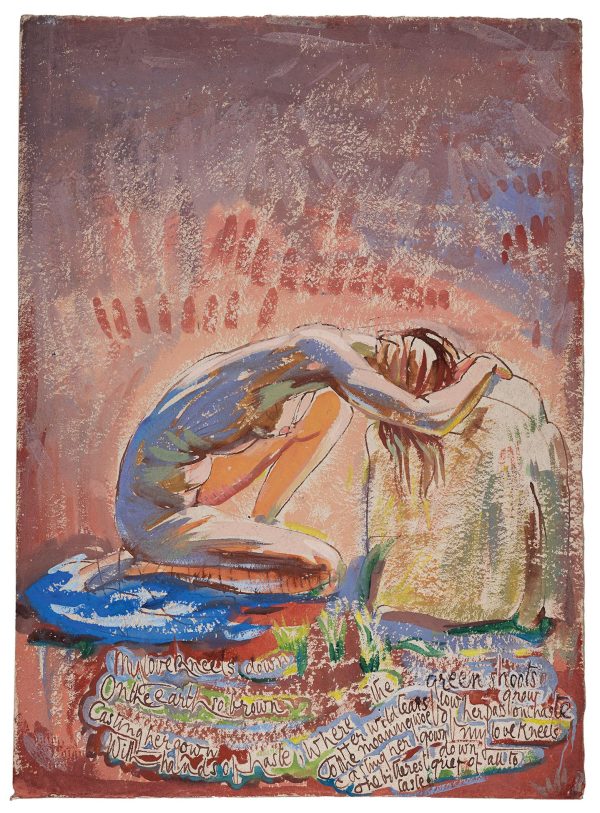
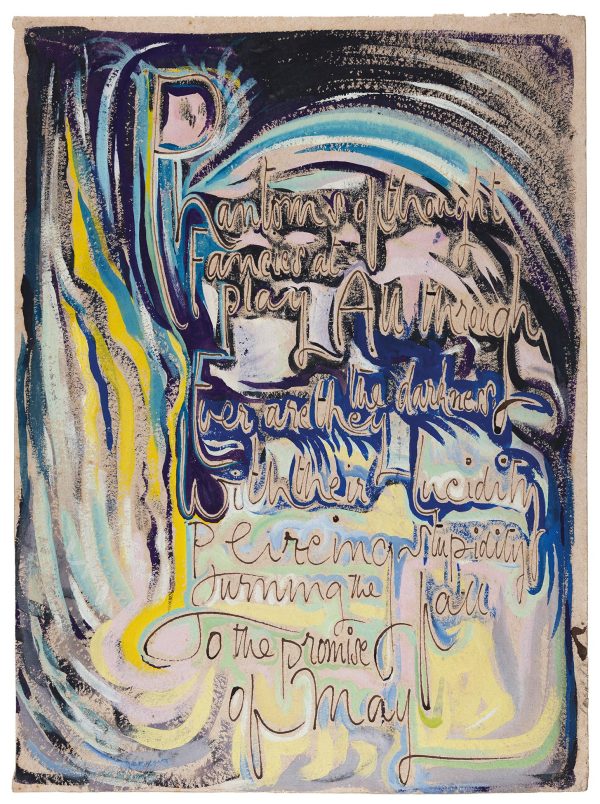
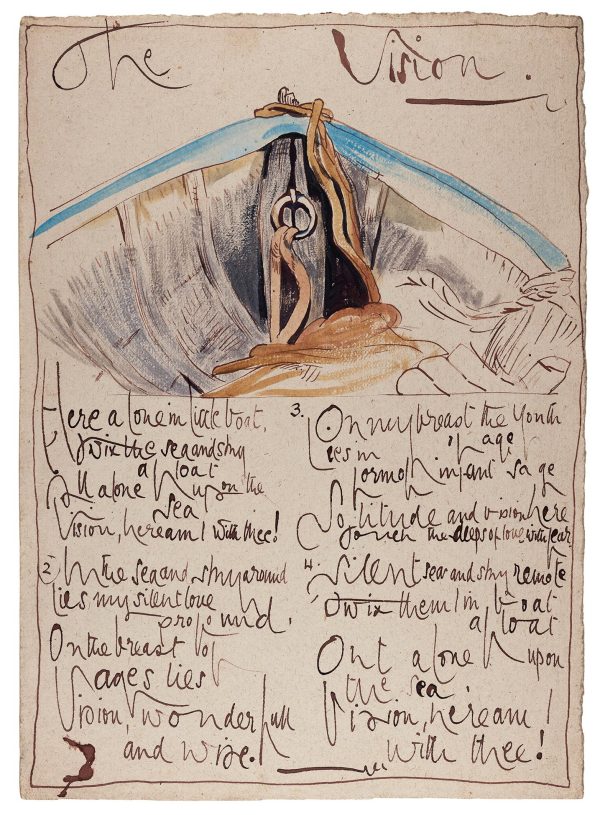
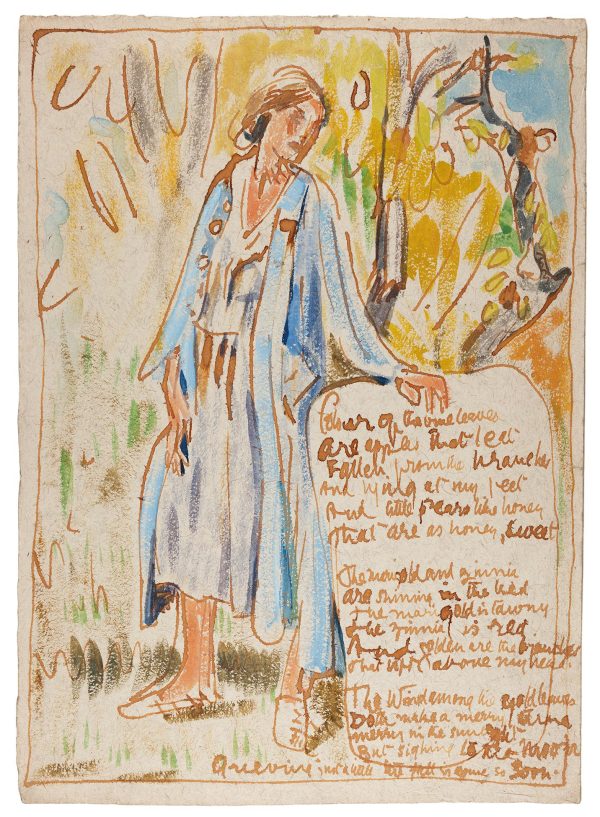
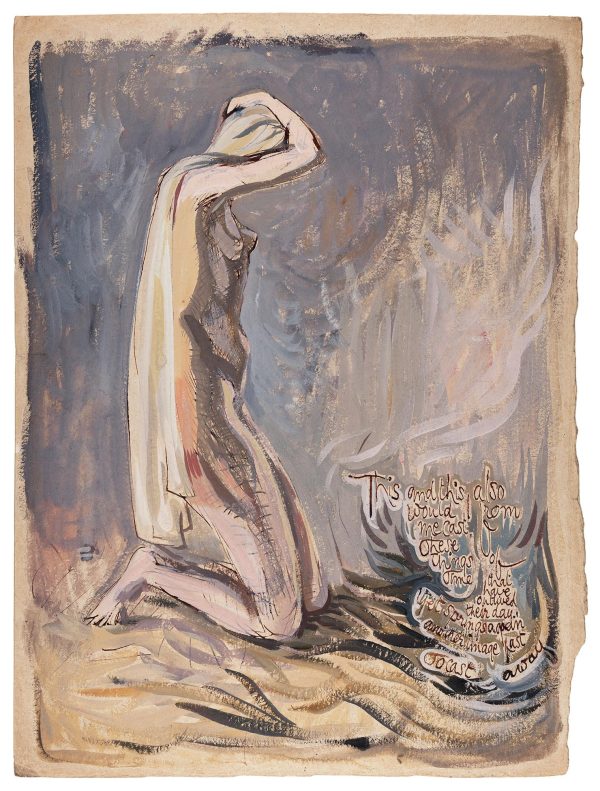
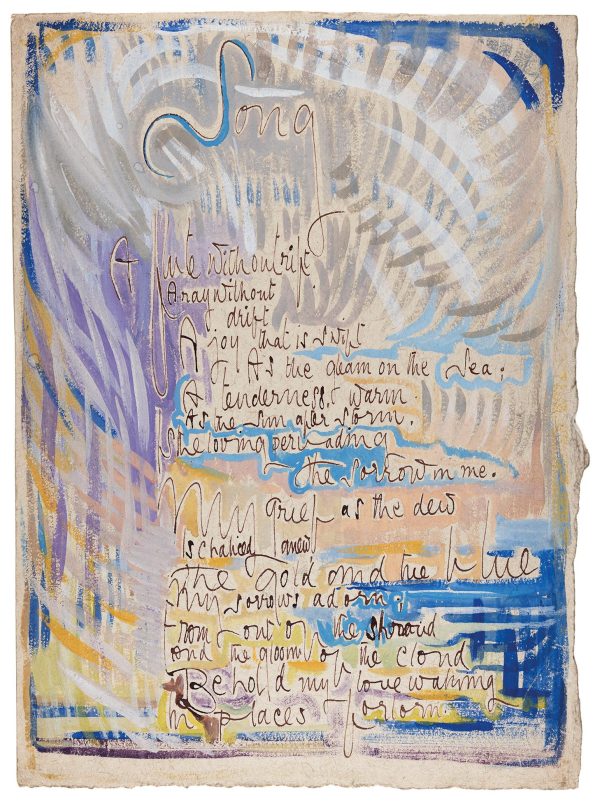
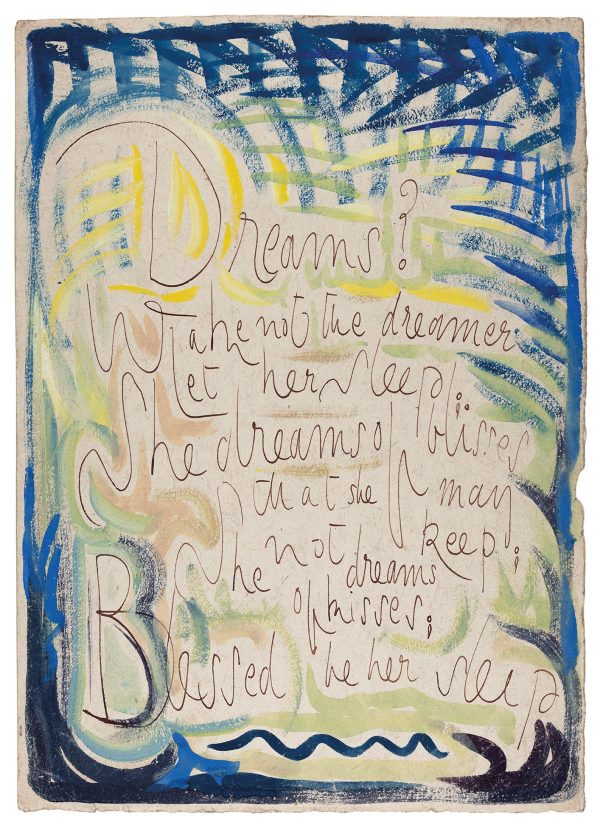
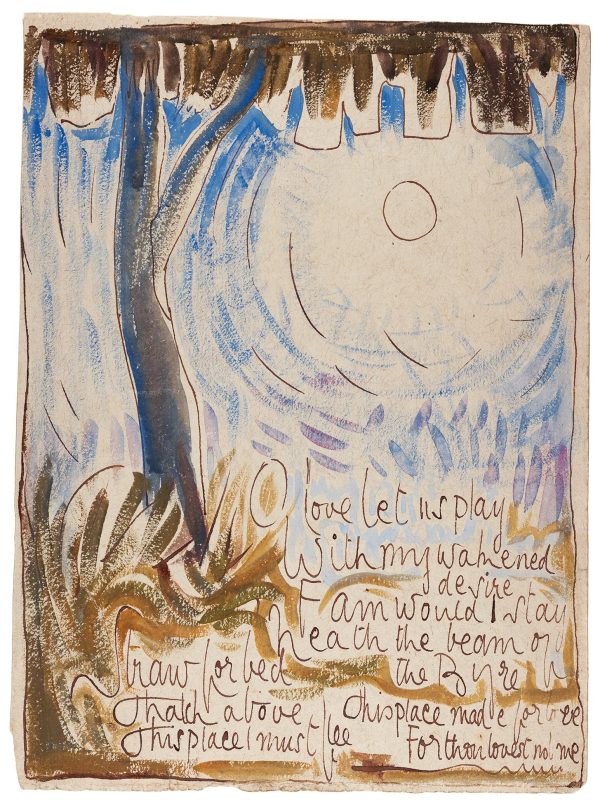
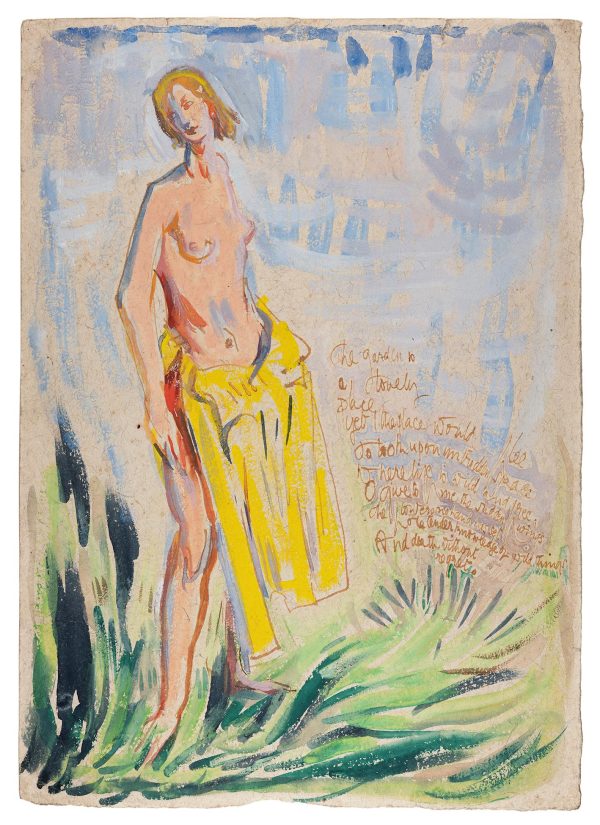
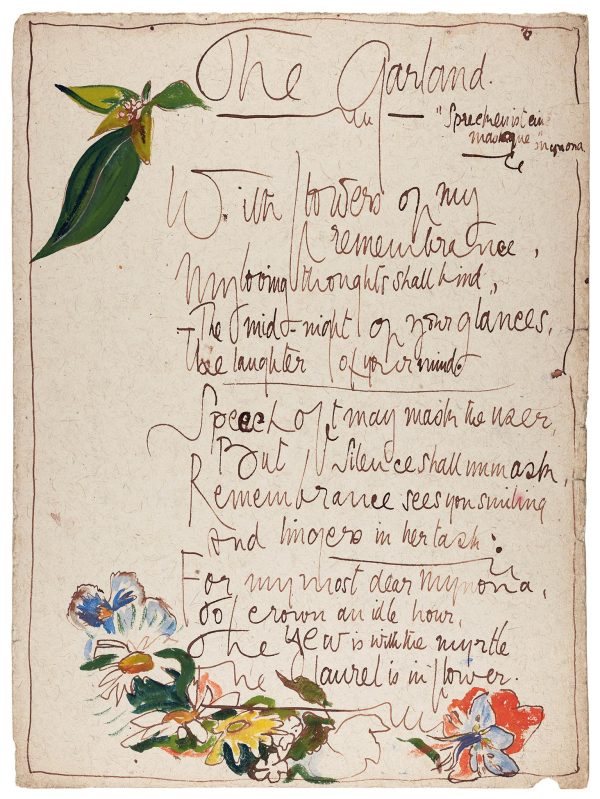
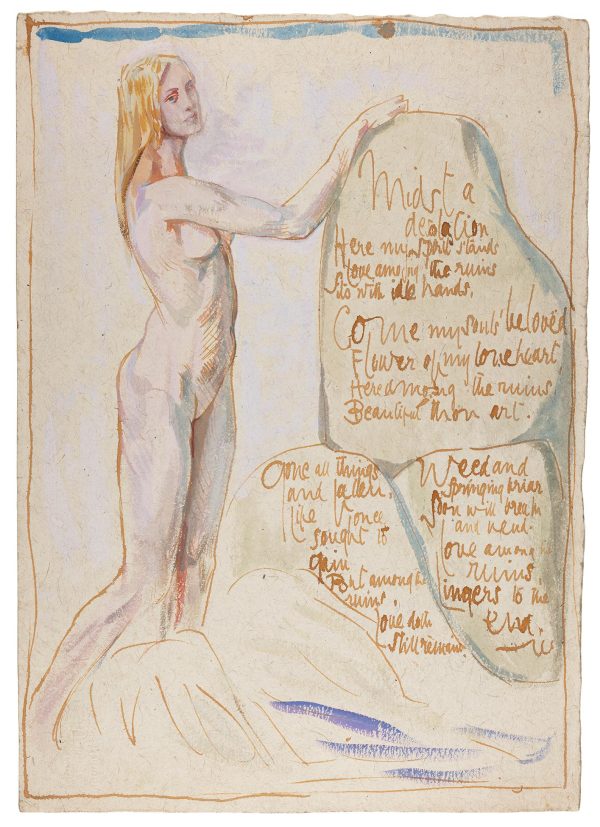
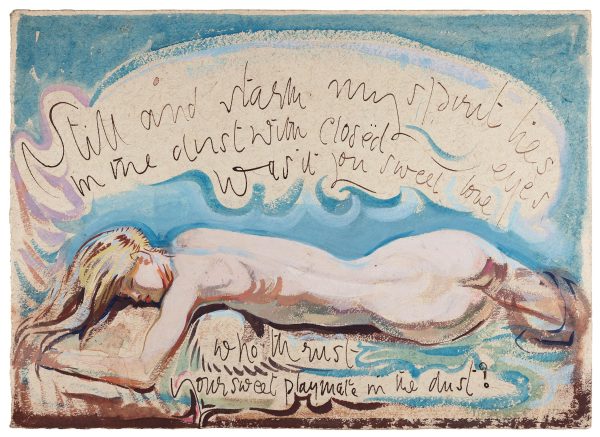
One hundred years ago, in February 1926, British artist and poet Edna ClarkeHall (1879-1979) held an exhibition at London’s Redfern Gallery in whichthe focus was twenty-one of her recently completed Poem Paintings. These works were an innovative aspect of Clarke Hall’s oeuvre produced during that decade. In these predominantly ink and gouache works and occasional lithographs, Clarke Hall combined text with visual image in an attempt to evoke mood and feeling. Lines of her own poetry, in flowing calligraphy, intertwine with vibrant strokes of primary colour usually accompanied by female nudes. These works clearly indicate that Clarke Hall knew of and was influenced by the work of William Blake. While Blake’s compositions result from an idiosyncratic semi-religious vision, Clarke Halls’ are more intimate; exploring themes of solitude, personal loss, and the pleasures and pains of love. Unfortunately there exists no documentary evidence as to what prompted such a combination of word and image though insight can be gained into the Poem Paintings’ genesis through a consideration of the artist’s biography.
Clarke Hall’s Poem Paintings were produced during the early 1920s as she recovered from a mental breakdown. The artist was then in her early forties and had suppressed for two decades bitter disappointment at an emotionally barren marriage. No longer able to contain her despair she experienced…..
…..a state of mind akin to
Those who plunge, after shocking life
Razors and carving knives into their gizzards.1
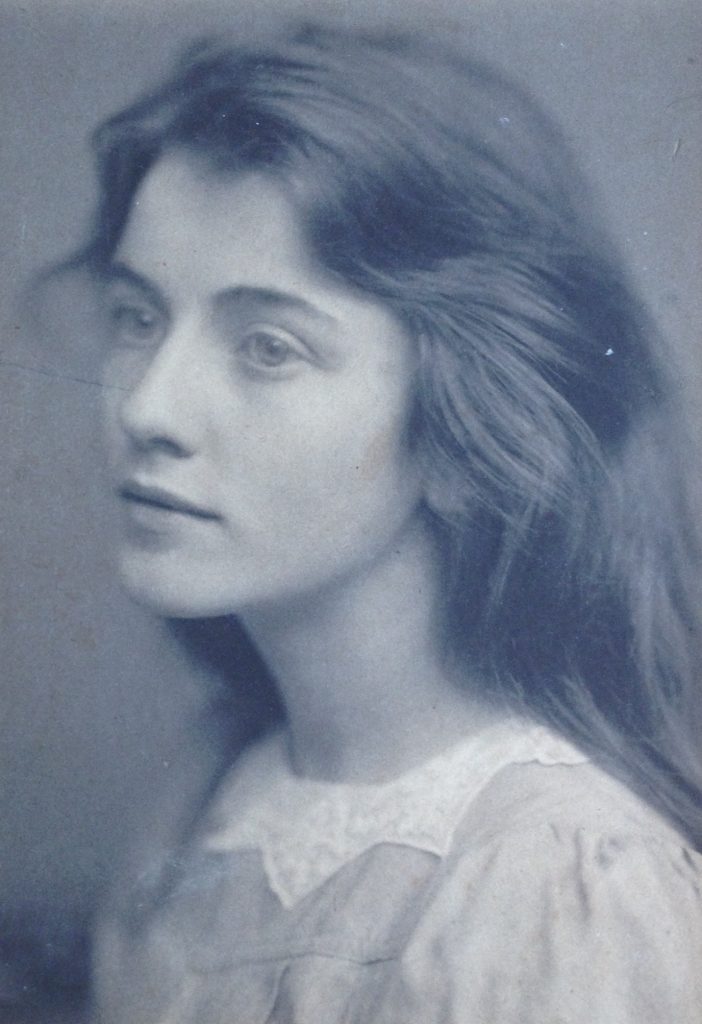
In 1898 at the age of nineteen, Edna Clarke Hall (née Waugh) married the barrister William Clarke Hall.2 She soon found herself bound to a man whose feelings towards her were very different from the adoration that she had experienced during the six years of their courtship; years that coincided with her art education. Significantly, it was her future husband who had first recognised Clarke Hall’s talent and recommended that she would benefit from a formal art training. In the early 1890s William Clarke Hall had been a regular visitor to the Waugh family home in St Albans as a colleague of Edna’s father. Although Edna had elder sisters closer in age to Clarke Hall (in 1892 he was twenty six to Edna’s thirteen years), it was Edna’s particular beauty and vivacity that attracted him. Convinced of his protégée’s artistic potential from the sketchbooks she showed him filled with pre-Raphaelite inspired images of children, angels and flower filled meadows, he persuaded Edna’s parents to send her to the Slade School of Fine Art in central London where Edna enrolled in the autumn of 1893 aged just fourteen; one of the School’s youngest ever students.
Edna thrived in the disciplined atmosphere of the Slade with its emphasis on traditional figure drawing. The many awards she gained for her fine draughtsmanship culminated in a special prize in the 1897 annual Summer Composition Competition for her magnificent watercolour of The Rape of the Sabine Women and in the following year she was awarded a Slade scholarship. Edna was part of one of the most talented generations of Slade students: her student contemporaries included Augustus and Gwen John (both close friends), Ambrose McEvoy and William Orpen.
Throughout her student years Edna’s barrister admirer encouraged and supported her, writing upon their engagement that:
If you do me the great honour of marrying me, you must have no trouble about domestic affairs at all. I want you to consider Art your profession and I will not have you hampered in any way by stupid household details.3
Yet, after their marriage three days before Christmas in 1898, and even before she had completed her art training, Edna discovered in her husband a man who was unable to respond to the devoted love she offered him, or to the work that she now produced. Edna’s inspiration increasingly became the immediate world of her experience: the couple’s new home and its rural surroundings, a personal response to the domestic environment and the natural world with which she was intimately involved. By contrast, for her husband, serious Art was exemplified by the allegorical and historical works produced by Victorian academicians such as Watts, Leighton and others. He seems to have had the expectation that his wife would wish to produces similar grand compositions. Clarke Hall further confounded her husband’s expectations of her by adopting watercolour rather than oil as her principal painting medium. As she herself subsequently explained:
Oil was not the right medium for me. It was too slow. I wanted to draw a subject quickly, seize it, convey my impression.4
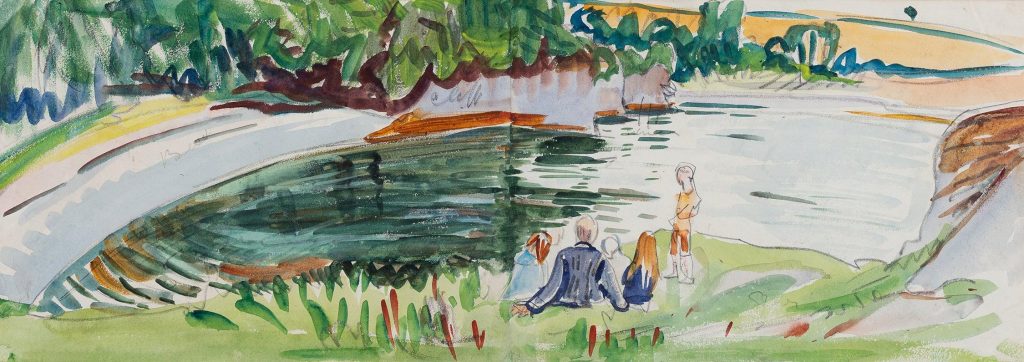
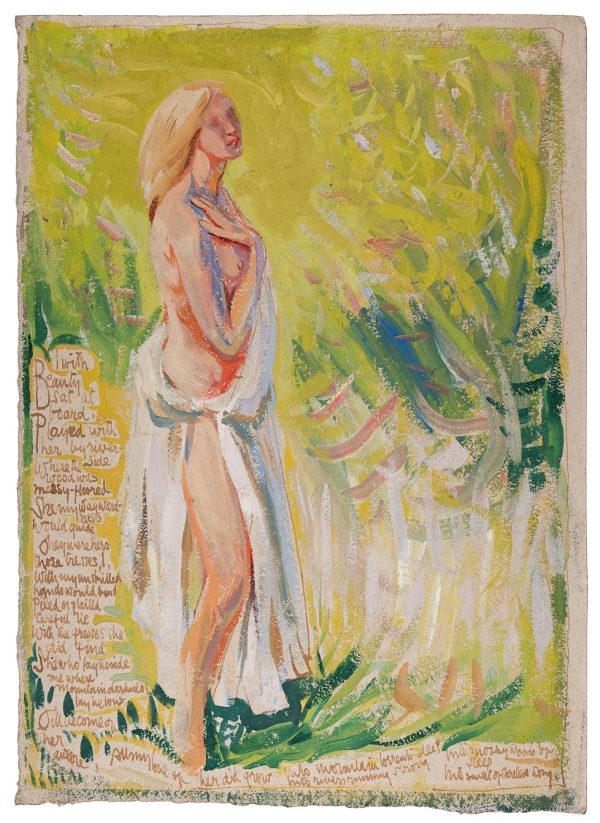
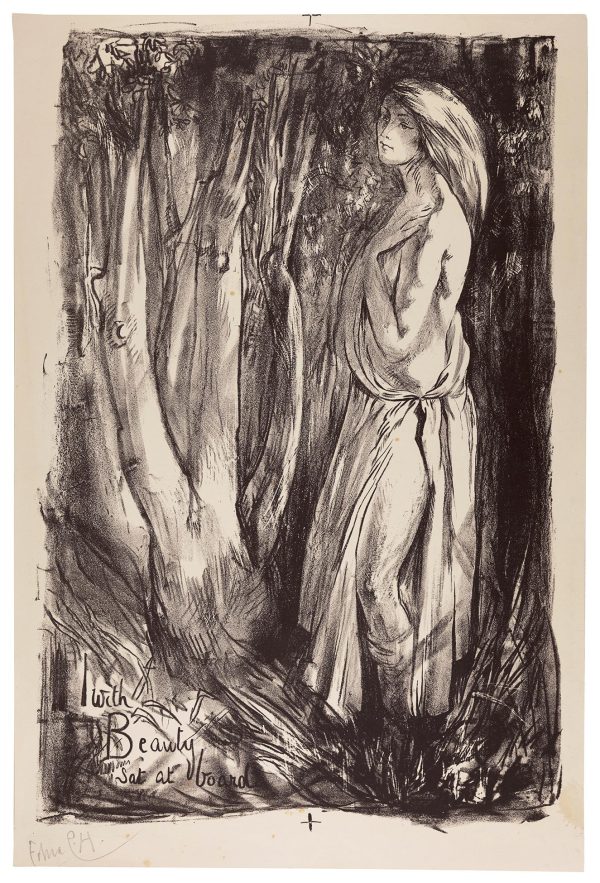
Soon after their marriage the Clarke Halls rented and subsequently bought a Georgian farmhouse, Great House, on the edge of the then rural Upminster Common, Essex where Edna lived for the rest of her long life. In the peace of the countryside Edna found solace for her conjugal problems and inspiration for her work (described years later in the Poem Painting I with Beauty sat at board, No 11). Away from her husband’s criticism of her person and work, Clark Hall set up a studio at the top of one of the farm’s barns. In this private space she produced vivid impressions of her Essex life: of, for example, an open sided barn, filled with newly cut hay from surrounding fields; on one occasion imaginatively transformed into the contemporary setting for a nativity scene. Clarke-Hall’s cook, housemaid or visiting friends would often be persuaded to sit for a portrait. After the birth of Clarke Hall’s two sons (Justin born in 1905 and Denis in 1910) she would depict them absorbed in their childish pursuits at home or on their annual Cornish holidays. In the late 1900s Clarke Hall started exhibiting these works with the New English Art Club, the Allied Arts Association, the Bloomsbury group’s Friday Club and in 1914 in her first solo show at the Chenil Gallery in Chelsea.
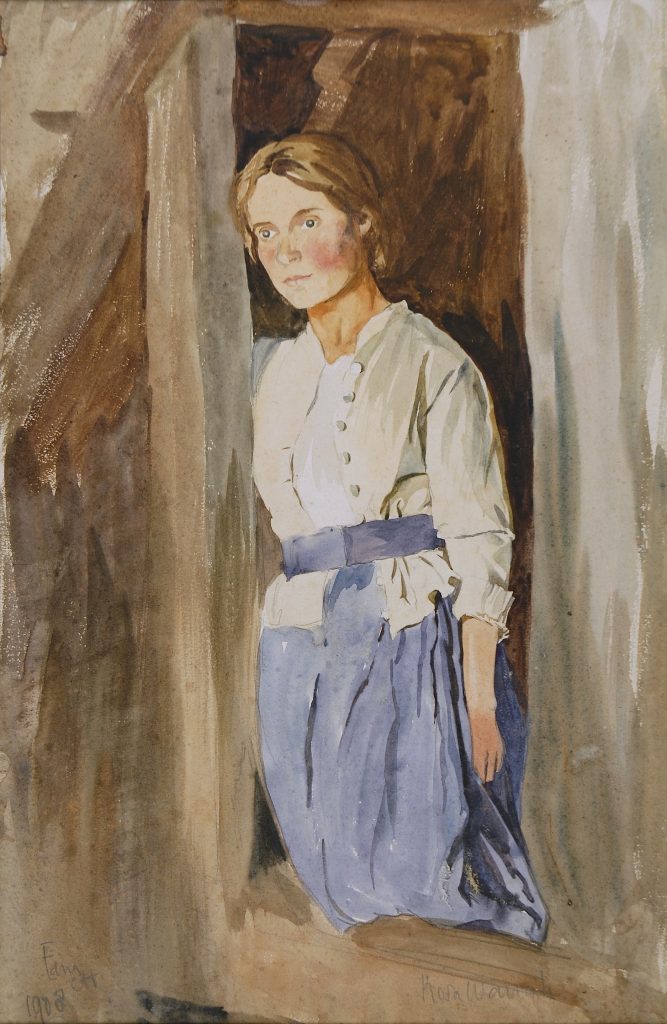
The outbreak of the First World War began a destabilising period for Clarke Hall. In the spring of 1915 Carola Schmidt, her sons’ German governess and her frequent model, and with whom Clarke Hall formed a close and supportive friendship, returned to Germany. In September 1916, after a German airship dropped bombs on Upminster Common before crashing in flames close to Great House, Clarke-Hall’s husband decided that his wife and sons must move to the greater safety of a cottage in the Buckinghamshire countryside. Many of her closest friends were serving on the Western Front including the poet Edward Thomas, killed in 1917 and whose death affected her badly. By the time she returned to Great House in October 1918 Clarke Hall was in a deep melancholy and was on the brink of a nervous breakdown:
I try my very best to master it but there it is, sometimes for weeks with hardly a break, sometimes in concentrated terrible moments that leave me tired for a long time afterwards.5
Clarke Hall experienced uncharacteristic depressive moods, exhaustion, headaches and severe apathy towards painting, which by 1919 she had abandoned.
Relief from this precarious mental state came in an unexpected intervention from Clarke Hall’s former drawing master (and now Slade Professor) Henry Tonks. Tonks had long been aware of the limitations that Clarke Hall’s married life imposed upon her painting and had offered her valuable support at critical times. Returning to London after the war, he was deeply concerned to discover Clarke Hall’s depressive condition. In early 1921 therefore he introduced Clarke Hall to the neuroscientist and psychologist Sir Henry Head (1861-1940). Both an eminent physician and published poet, Head understood the nature of Clarke Hall’s illness and was sympathetic to its cause. He believed that certain innovative psychological treatments developed by his colleagues William Rivers (1864-1922) and Arthur Brock (1879-1947) to help shell shocked serviceman at the Craiglockhart Hospital near Edinburgh might help Clarke Hall. The basis of Rivers and Brock’s treatments was ‘autognosis’ and ‘ergotherapy’ based on the principle of re-establishing mental stability through self understanding, attained by means of repeated interactional analytical examination of a patient’s, hopes, fears, and emotional memories: what might now be regarded as a ‘talking cure’. To further help patients emotionally free themselves from the residue of past traumatic events Rivers and Brock believed it was essential for patients to engage in practical productive activities. Creativity was therefore an important aspect of ergotherapeutic treatment, Brock believing that such cognitive activities aided a patient’s psychological re-ordering. These ideas formed the basis of Head’s successful restoration of Clarke Hall’s mental stability. He encouraged her to discuss her troubled marriage and associated feelings in all their minutiae. He further realised that it was important for Clarke Hall to re-engage with her art. Through Head’s mediation Clarke Hall acquired a London studio; at 2 South Square, Gray’s Inn. In this tranquil environment her Poem Paintings were conceived.
From early childhood Clarke Hall had written poetry. Verse flowed as easily from her as did drawings. She was a lyric poet. The cackle of a distant woodpecker or the glint of the autumn sun on vine leaves would prompt verse to come lilting in my mind6 and cause her to rush for pen and paper. However in poems composed during the period of her mental collapse, Clarke Hall gave frank expression of her longing for reciprocal love: ‘for its light and darkness, its elation and bitterness, its aspiration and defeat’.7 The Poem Pictures explicitly express her most intimate personal feelings in a way that her drawing and painting had hitherto never done.
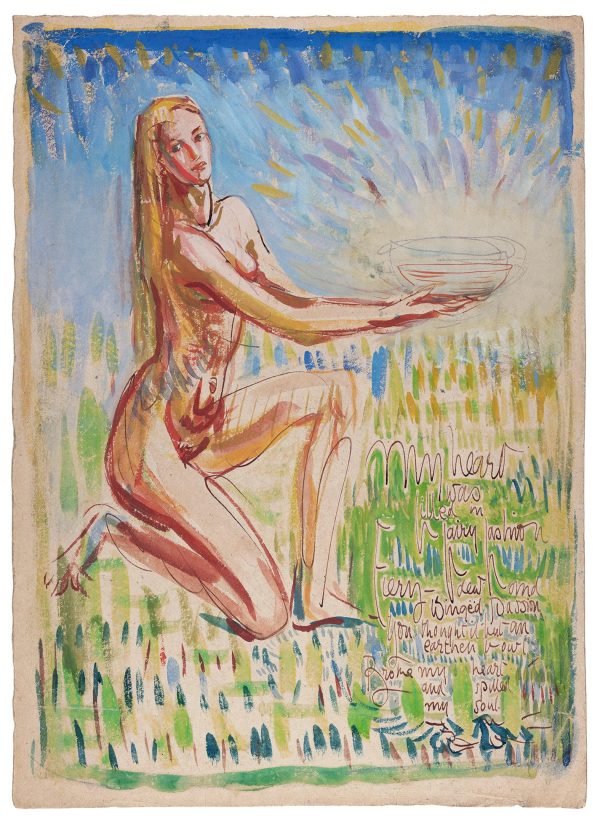
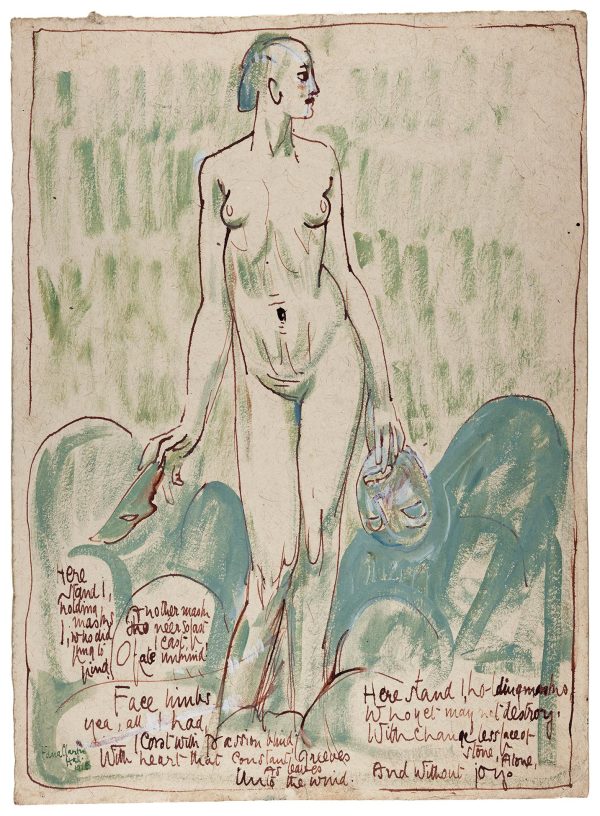
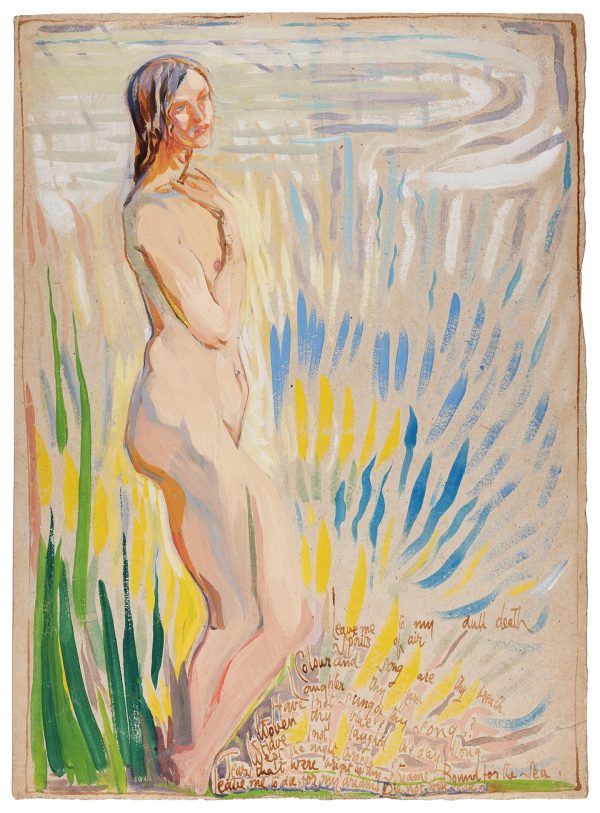
In most of Clarke Hall’s Poem Paintings the imagery consists of a single nude female figure, often adolescent in form with exaggeratedly elongated limbs: eg No 27. Such anatomically incorrect figures are, at first encounter, surprising given Clarke Halls’ fine draughtsmanship skills; but they were not drawn from live models, but rather from an inner ‘visionary eye’, and serve to heighten the emotional impact of the painting. Each was produced under the impulse of a moment’s intense emotion, as she related in a revealing letter to a close friend in which she describes the making of My heart was filled in fairy fashion (No 5). Clarke Hall here describes lying in a hammock in the garden of Great House on a summer’s afternoon next to her husband while altering a pair of his flannel
trousers, a brief and rare instance of congenial companionship. She had gone indoors to fetch a pair of scissors, but passing through her workroom:
As I went through it, I forgot everything and about half an hour afterwards I found I had been painting a page with a brand new poem on it………. My heart was filled in fairy fashion…… there it was in radiation of colours.8
This description of Clarke-Hall’s creative process in My heart was filled accords with that of another extraordinary series of drawings; those that Clarke Hall made in response to Emily Bronte’s novel Wuthering Heights. In these drawings made more than two decades earlier, Clarke Hall reacts to the emotional turmoil of her early married life. Years later Clarke-Hall describes how she seemed to work:
as under a spell……these drawings used to slide out of my mind with complete ease…… Apparently they came from a deep unconscious start which was not eally under my command.9
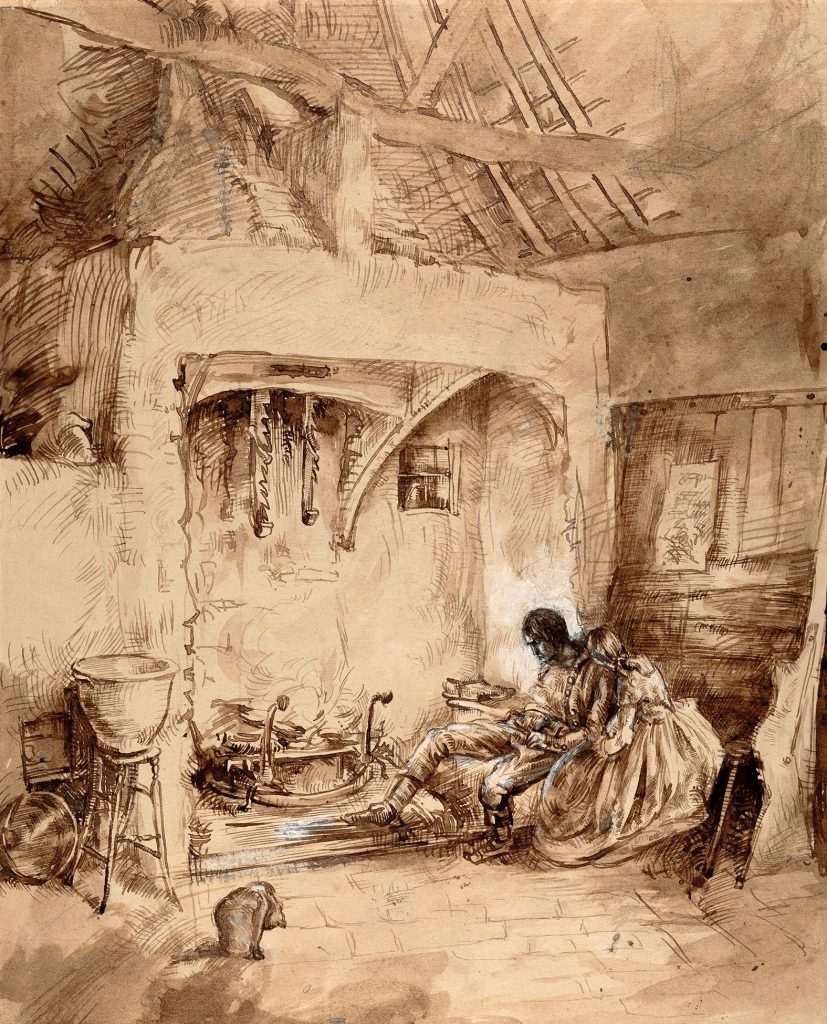
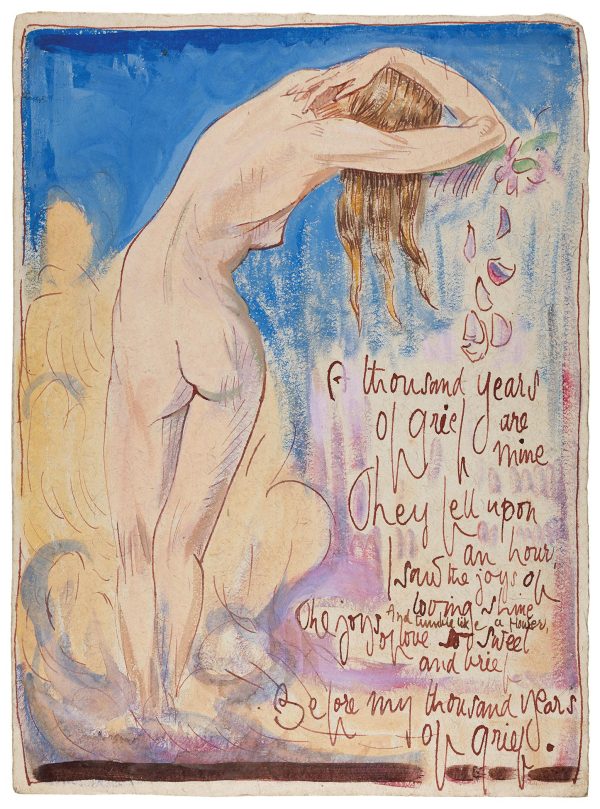
It is likely that the Poem Paintings were produced similarly and indeed are contemporary with a final group of Wuthering Heights inspired drawings where she repeatedly depicted some of the events in the novel that she regarded as being most significant. In the same way there are many variants of the same subject of some of the Poem Paintings. For example, there exist nine known versions of A thousand years of grief are mine (No 15), and six of This and this also would I from me cast (No 19): each only subtly different in composition. One explanation for these repetitions might simply be the artist working out a satisfactory composition, but given the circumstances of their creation, it is more likely that these multiple versions represent a creative enactment of the ‘autognosis’ aspect of Head’s treatment whereby the repeated rendering of The thousand years of grief or of These things that have outlived their day (from No 19), were part of the therapeutic ‘conversation’; expunging years of hurt, longing and despair.
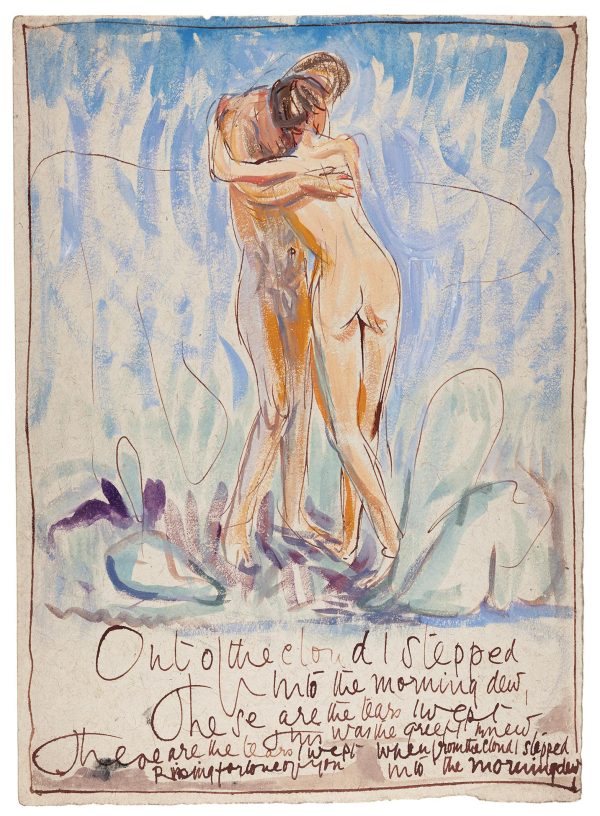
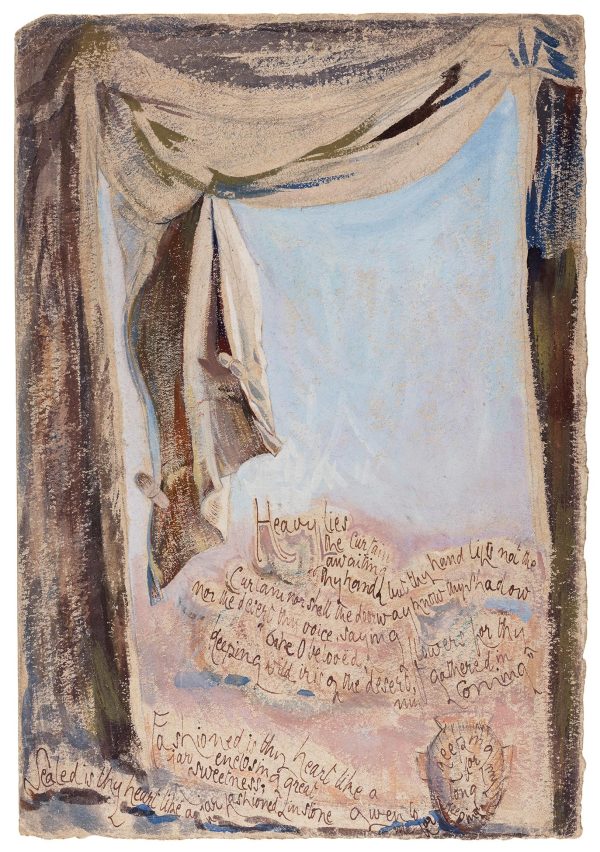
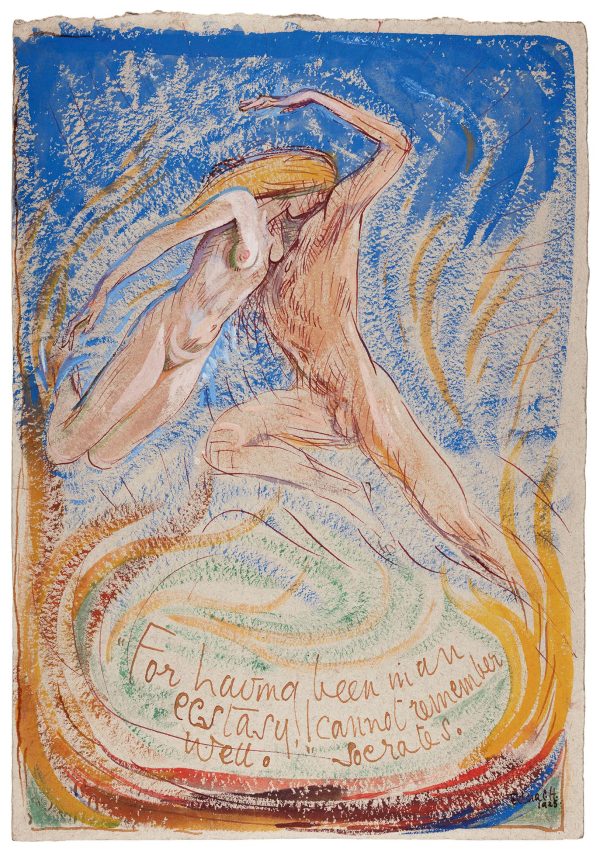
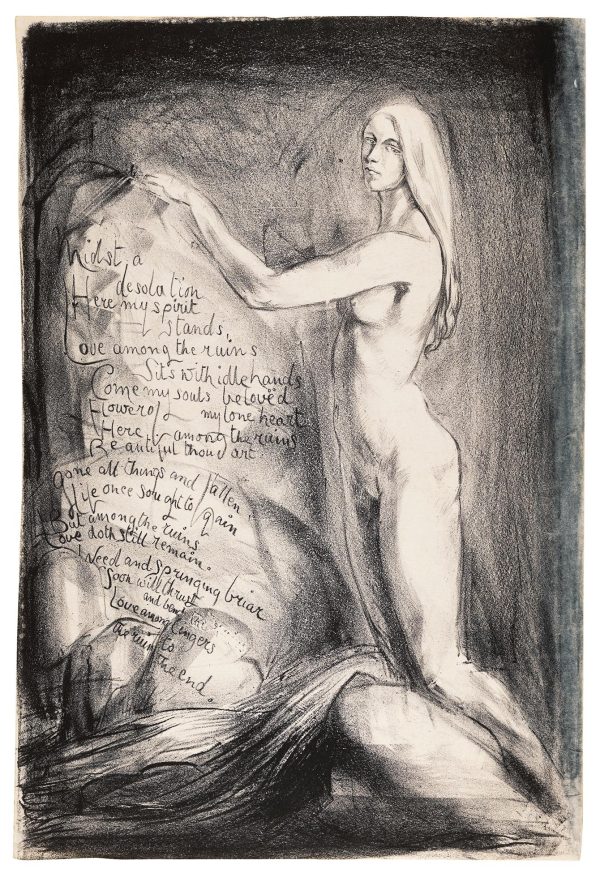
It is probable that the autognosis encouragement to repeatedly describe past traumatising personal experiences is apparent in Clarke Hall’s consistent use of the first person pronoun in her poems’ narratives. Likewise, the adolescent nature of the paintings’ figures suggest, perhaps unconsciously so, that Clarke Hall was depicting her youthful self. In fact the autobiographical nature of the Poem Paintings is reinforced by the occasional inclusion of imagery from Clarke Hall’s everyday life. The setting for O love let us play (No 25) is the farmyard Byre. In Heavy lies the curtain (No 6) Clarke Hall depicts her curtained bed; a refuge for her at times of emotional crisis. Here Clarke Hall lies waiting or her lover whose ‘hand lifts not the curtain’. Her yearning for the physicality of love is poignantly expressed in the few Poem Paintings which depict couples in mildly sensual poses: as in Out of the cloud I stepped (No 3) and her often repeated image in For having been in an ecstasy (No 14).10
There is one Poem Painting which contains a contemporary self portrait. The figure in Colour of the vine leaves (No 18) is Clarke Hall as she was in the early 1920s, clad in a favourite long blue dress-coat. The paintings mood is more optimistic; speaking of ‘beauty (that) cannot die’. It is tempting to suggest a later date for this painting.
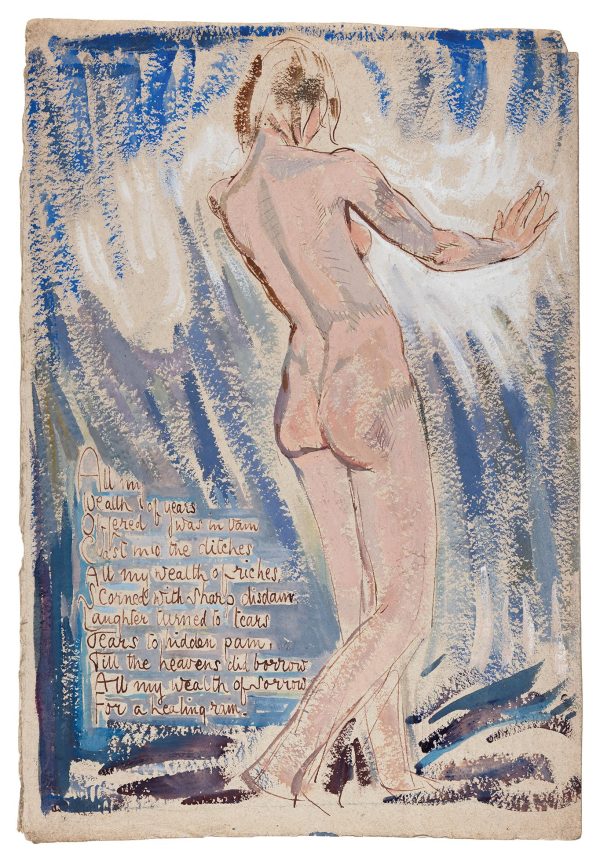
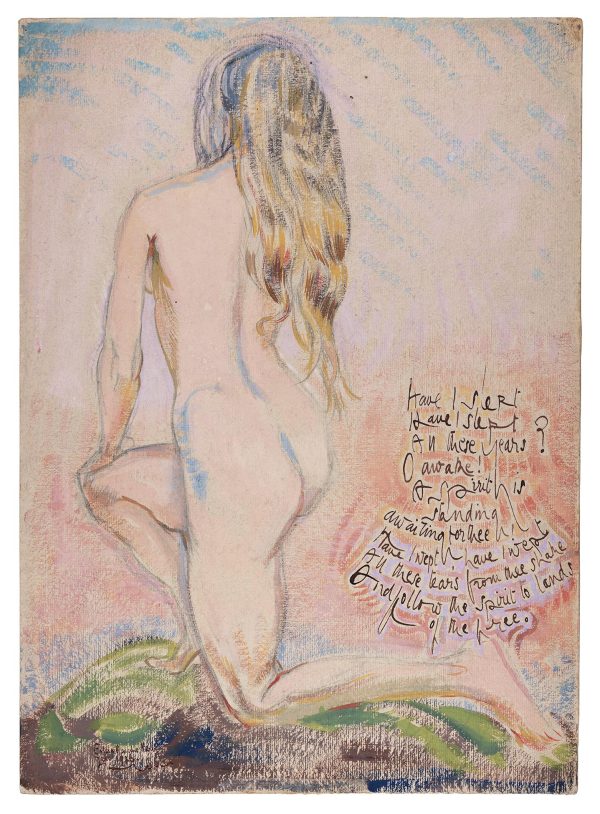
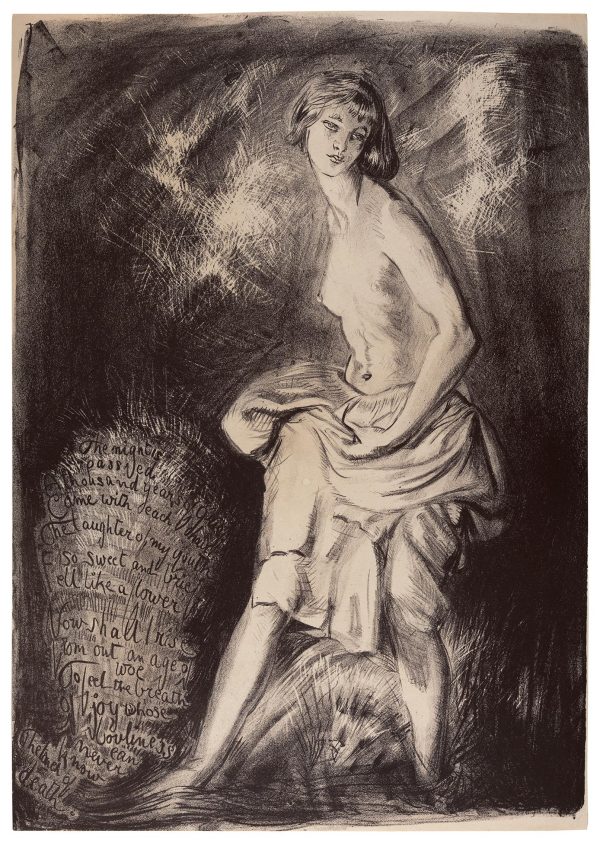
Although few of the Poem Paintings are dated, Kathryn Murray, in her seminal study of the paintings,11 suggested that it is possible, as Head’s treatment began its process of healing, to identify a transition in the work towards the expression of more positive sentiments. There are some Poem Paintings, perhaps the earlier ones, which are replete with a sentiment of despair and hopelessness, even recrimination, as in Still and Stark (No 30), for he ‘Who thrust your sweet playmate/In the dust’; while in All my wealth of years (No 7), Clarke Hall laments her ‘wealth of riches/scorned with sharp disdain’. In Here stand I holding masks (No 24), she writes of a ‘heart that constant grieves……Alone/And without joy’. Nevertheless, in The night is passed (No 32) Clarke Hall hints at a dissociation from past misery; that she can ‘rise from out an age of woe’ into a more positive future with the strength of what little love she has known. Other poems speak of freedom and rebirth. Have I slept (No 8) ends with Clark Hall resolving to end her weeping and ‘follow the spirit/To the lands of the free’ .
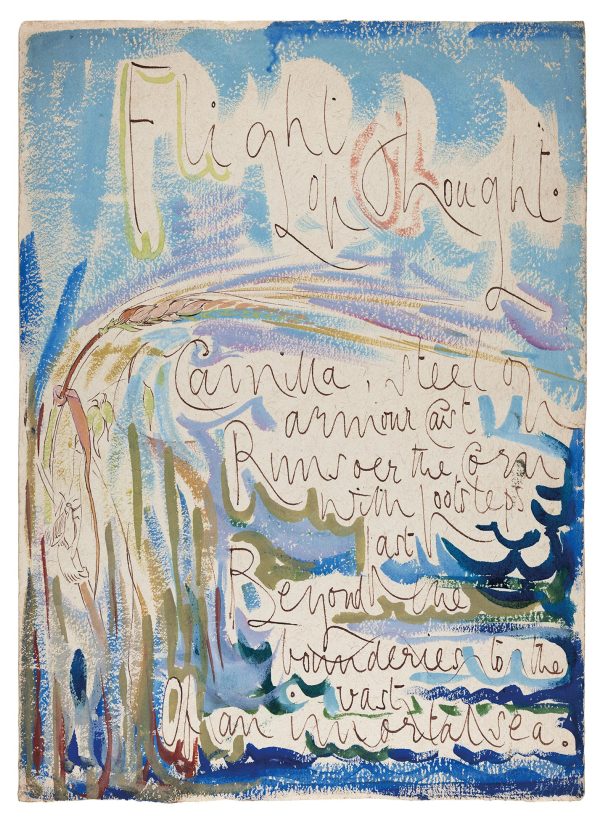
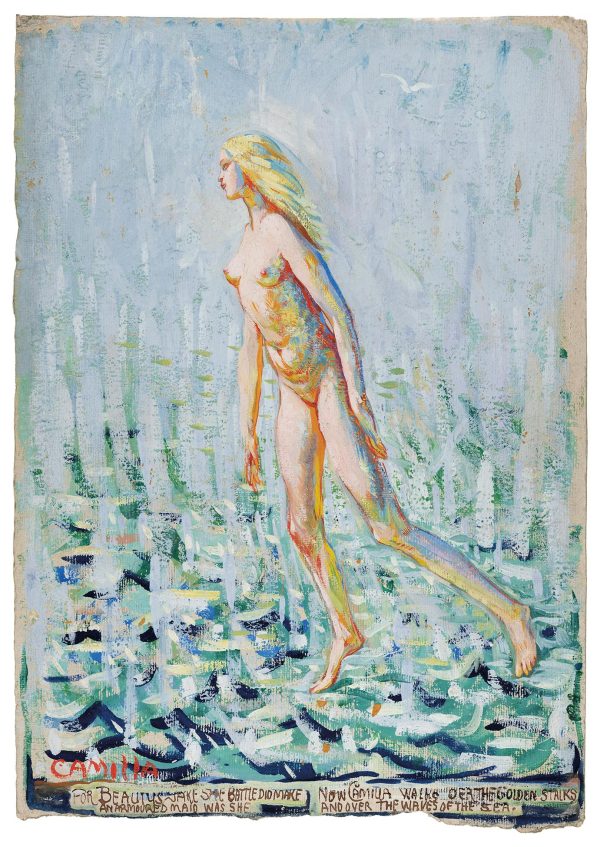
Explicitly a sense of freedom and renewal emanate from a group of works inspired by the myths of Camilla, Prosperina and Venus. The story of the virgin warrior chieftain Camilla, culminating in her death in a battle against the Trojans, is related in Virgil’s Aeneid.12 Virgil recounts how Camilla was so fast on her feet that she could run over a field of wheat without breaking its stalks, and over the ocean without wetting her feet. As Clarke Hall began to recover from her breakdown and to begin a new life of spatial and emotional liberation, she was particularly impressed by Camilla’s free roaming weightless spirit with its imperviousness to physical constraint. She penned at least five different Camilla poems which complement numerous paintings of Camilla running ‘O’er the corn with footsteps fast’ (No 2) and ‘O’er the waves’ (No 22). Other paintings of Camilla simply depict her titled image.
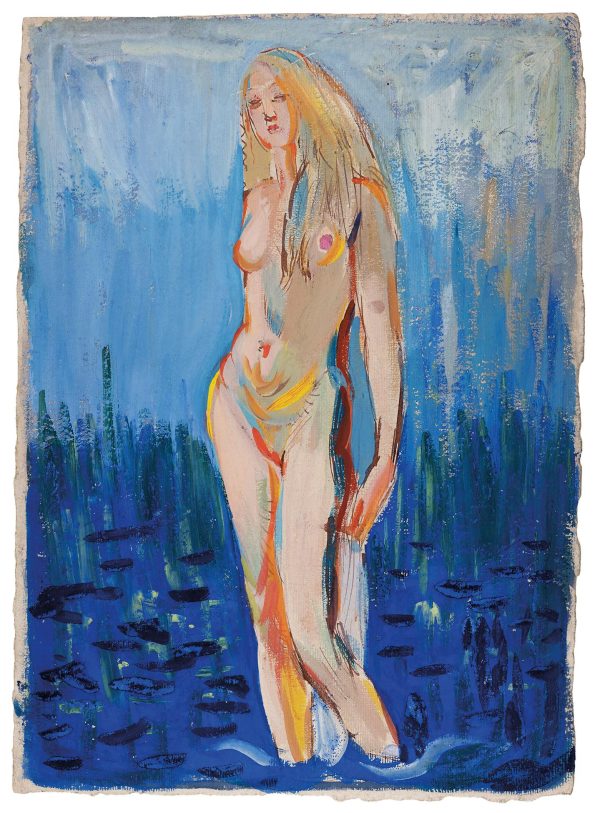
A similar absence of verse is also to be seen in a series of paintings of Prosperina joyfully emerging with up-stretched arms from her winter’s imprisonment in the Underworld, signalling the beginning of spring, and also in Clarke Hall’s paintings of Venus. In Venus (No 26), with its tilted blonde head and the contraposto pose of a figure emerging from a deep azure sea, there is clearly a debt to Botticelli’s Birth of Venus, first encountered by her thirty years previously on a student trip to Florence. Clarke Hall’s multiple depictions of Venus during the time of her recovery was surely the result of a sensation of creative renewal, symbolised by the notion of rebirth. Significantly, one version of Clarke Hall’s Venus, now in the Victoria & Albert Museum,13 has written alongside the painting’s rising figure, the single Latin word – Redintegratio (I restore).
It is in the work of William Blake that we can find a precedent for the body of work that are Clarke-Hall’s Poem Paintings. She is known to have owned books of Blake’s poetry, lines from which she would often quote by heart. In a letter to a close friend,14 written whilst in the midst of her mental collapse, Clarke-Hall wrote of reading Alexander Gilchrist’s 1863 biography of the poet-artist, a seminal work that brought knowledge of the then largely neglected visionary to a wider public. The Poem Paintings’ medium, appearance and themes directly recall Blake’s illuminated books. Echoing his Songs of Innocence and Experience, Clarke Hall even entitled her poems ‘Songs’ (Nos 1, 20 & 33) and composed her own Songs of Farewell and of Forgetting. Yet, Blake’s poems are but the seed from which Clarke-Hall’s deeply personal and original body of work grew: the product of a ‘vivid and striking imagination’ as the art critic of the Times of India15 commented when a selection were shown at her 1926 exhibition at the Redfern Gallery, London.
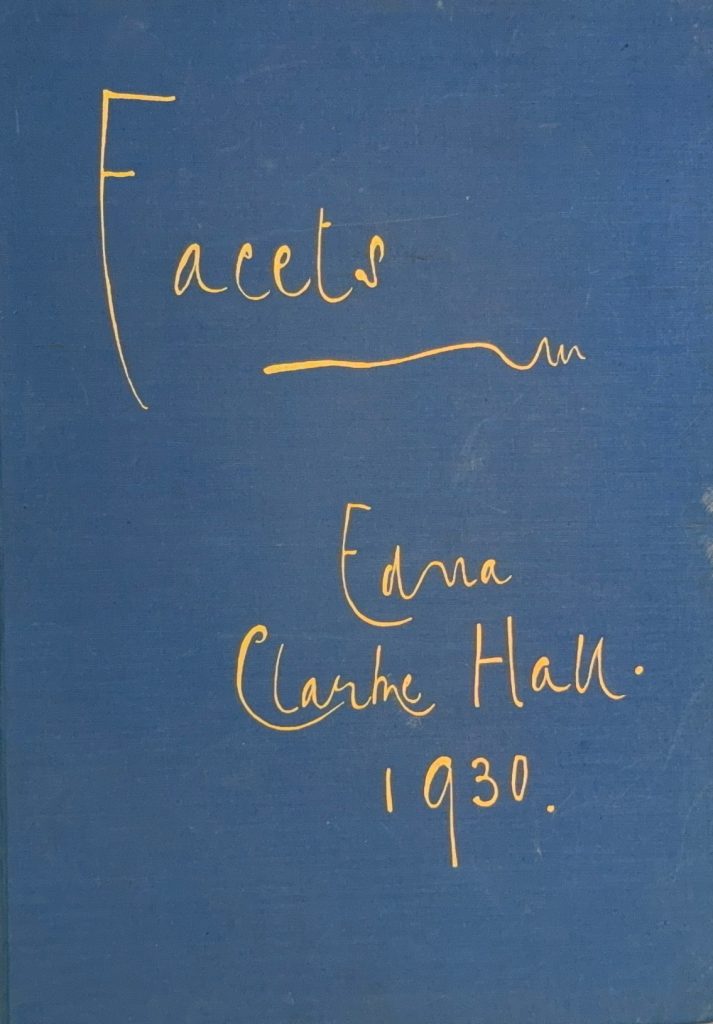
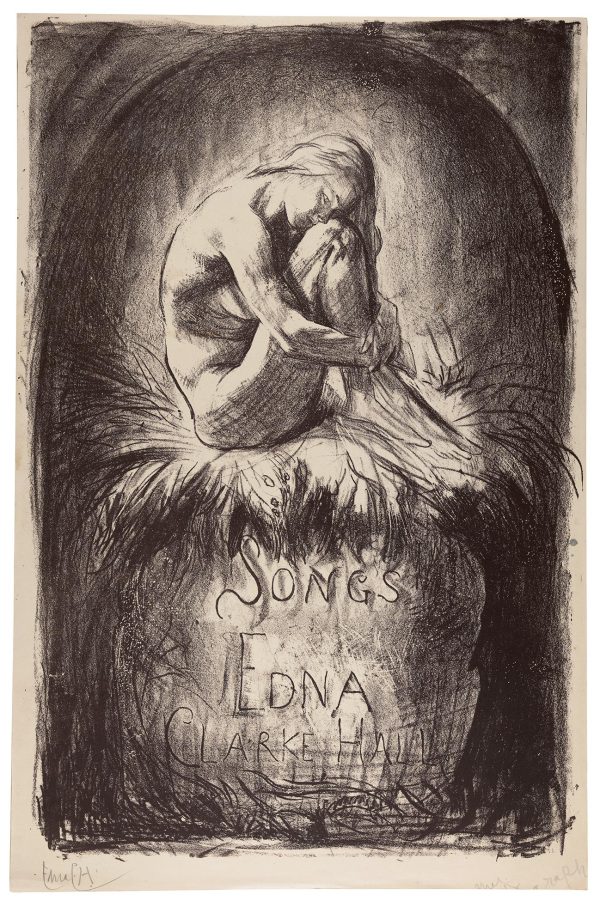
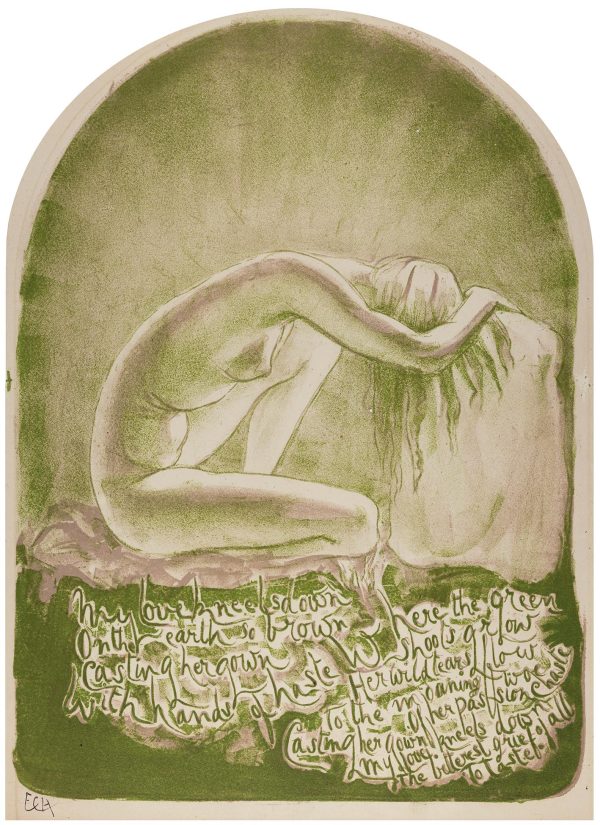
Initially, Clarke Hall was reluctant to exhibit her Poem Paintings, recognising their highly personal nature. However urged by friends, and also by Head himself, that they should be more widely known, she relented. In the spring of 1926 Ernest Benn published a book of her poetry16 and the Redfern Gallery showed twenty one of her Poem Paintings as part of a major solo exhibition of her work. Six Poem Paintings sold alongside multiple copies of lithographic printed versions. Shortly before acquiring her Gray’s Inn studio, Clarke Hall had enrolled in printmaking classes at London’s Central School of Art and Crafts. Initially she produced etchings but from the mid 1920s her interest shifted to lithography into which medium her Poem Paintings’ designs transferred well (Nos 31-35). The four examples illustrated, together with two others, were incorporated in Facets, a second book of Clarke Hall’s poetry, published in 1930.17
Never again did Clarke Hall produce such deeply personal work. From the mid 1920s onwards Clarke Hall became absorbed by other themes, particularly still life and flower painting. These watercolours of overflowing bowls of flowers or baskets of mushrooms and grapes scattered on her kitchen table were realised in a bolder and more painterly manner than in any previous work. Not only had obtaining a London studio been essential in enabling Clarke Hall’s emotional recovery, it had supplied the necessary environment to realise a previously unachieved professionalism in her work. Clarke Hall exhibited widely during the 1920s and 1930s including mounting four more solo exhibitions. Many of the UK’s major museums and galleries purchased her work which was profiled in numerous art publications. Following the end of the Second World War, with her studio having been destroyed in the Blitz, Clarke Hall’s artistic output declined. Her last dated work is from 1954. Clarke Hall continued living at Great House until four months before her death on the 16th November 1979 at the age of one hundred years.
Alison Thomas, January 2026
Footnotes
- Edna Clarke Hall, in unpublished writings. Tate Archives
- William Clarke Hall (1866-1932) became one of the UK’s leading children’s
magistrates and was knighted for his work on child penal reform. Clarke Hall and
Morrison on Children, now in its 32nd edition, continues to be the leading
authority on children’s law. - Undated letter from William Clarke Hall to Edna Waugh; Tate Archives.
- Edna Clarke Hall: The Heritage of Ages p40 (unpublished MS, Tate Archives)
- Edna Clarke Hall, in private journal, Tate Archives
- Undated letter from Edna Clarke Hall to Michel Salaman; Tate Archives
- Ibid
- Undated letter from Edna Clarke Hall to Ruth Head; Tate Archives
- The Heritage of Ages, p50
- Words spoken by Socrates in Plato’s Phaedrus.
- Murray, Kathryn (2012). Self-ordering creativity and an independent work space: Edna
Clarke Hall’s Poem Pictures: https://etheses.bham.ac.uk/id/eprint/3755/ - Virgil, Aeneid, Books 7 & 11
- Edna Clarke Hall: Standing Female Nude, Victoria & Albert Museum E.2939 – 1948
- Undated letter from Edna Clarke Hall to Michel Salaman; Tate Archives
- Times of India 2nd March 1926
- Clarke Hall, E (1926). Poems; Ernest Benn, London.
- Clarke Hall, E (1930). Facets; Elkin, Matthews and Marrot, London.