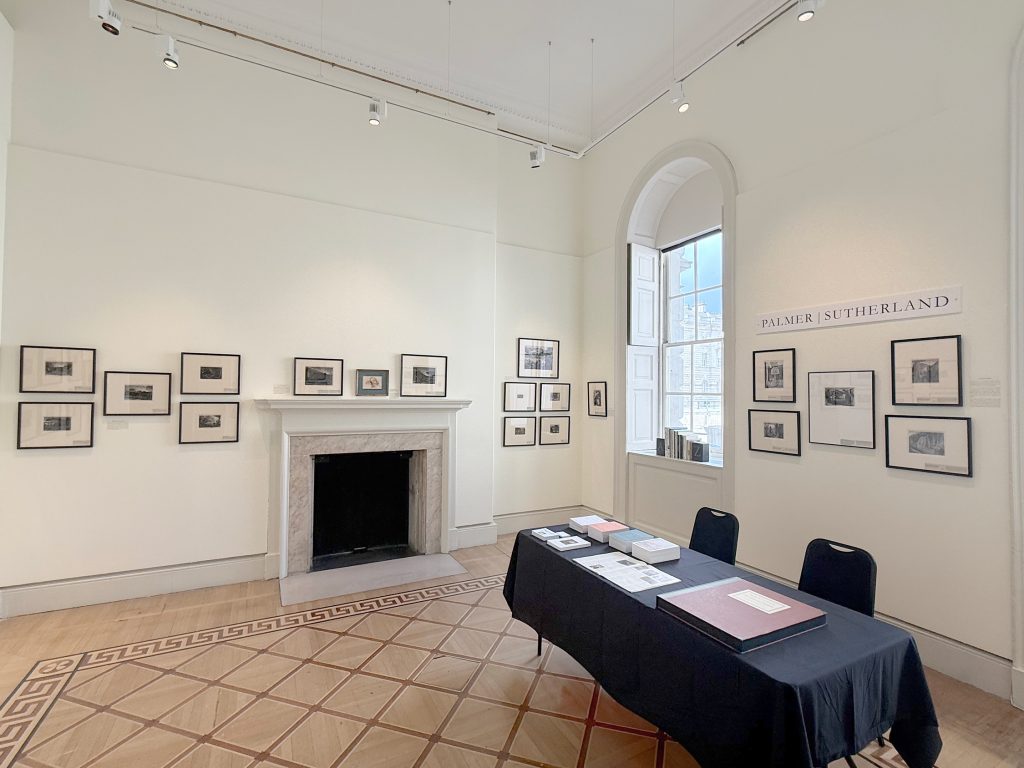
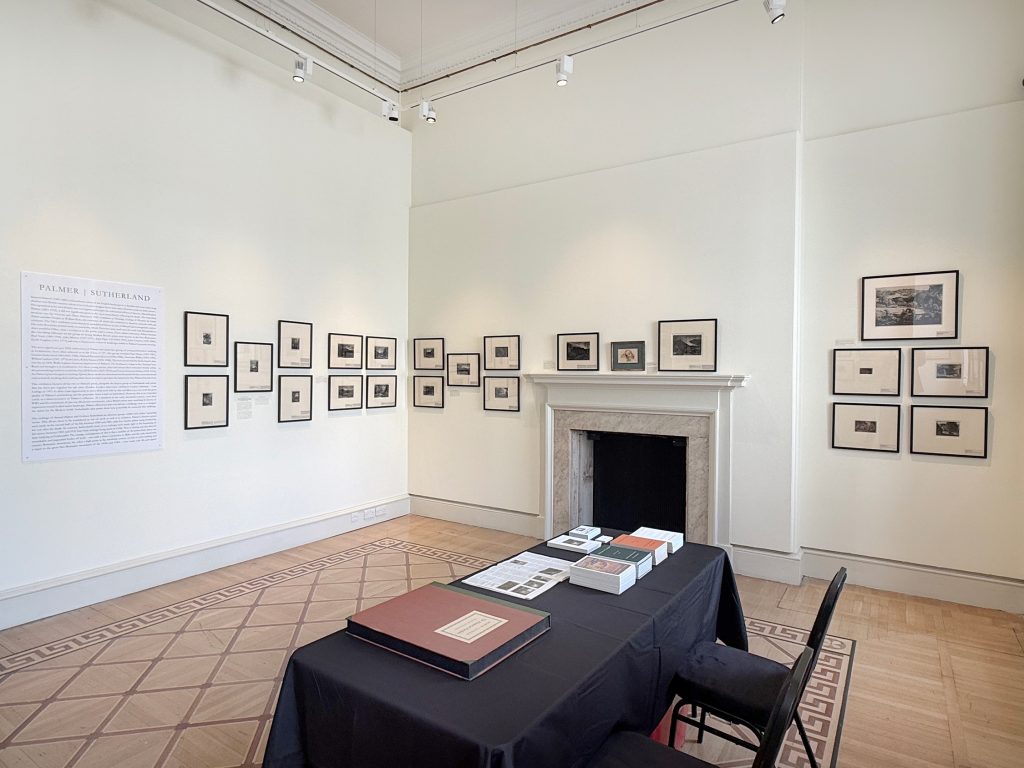
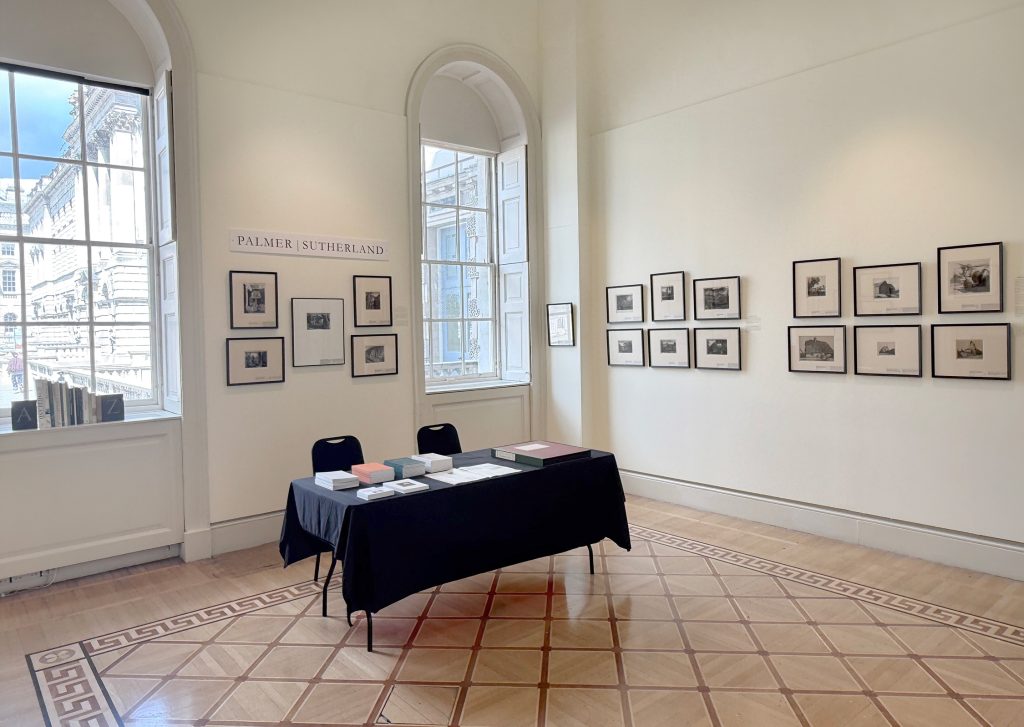
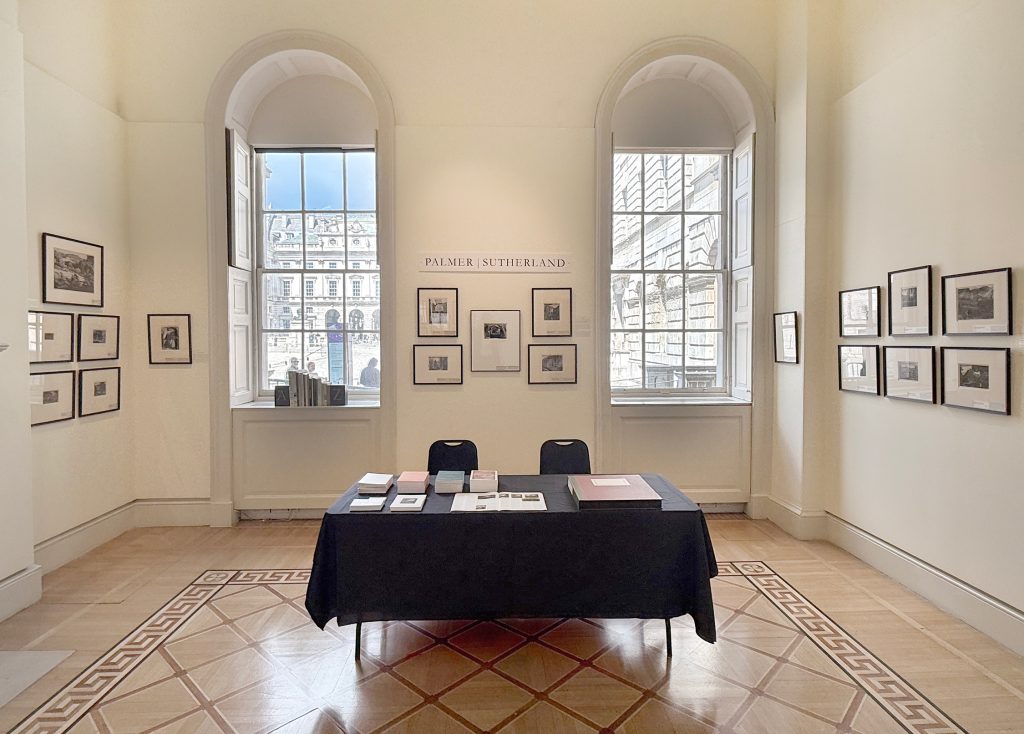
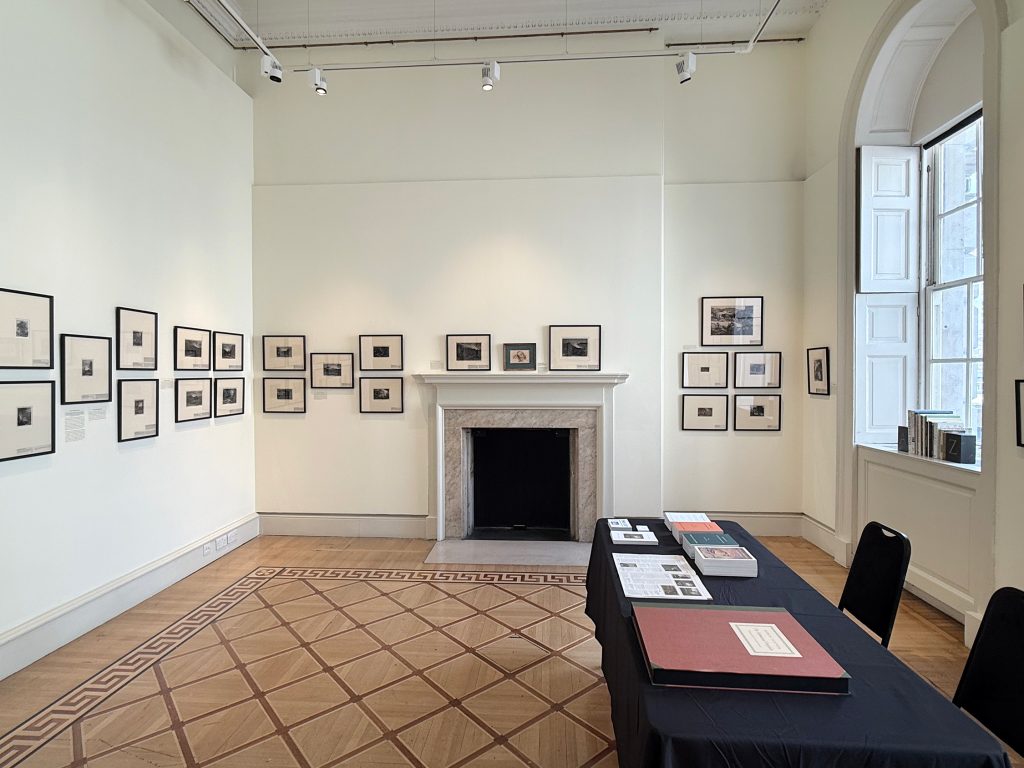
Thursday 14th – Sunday 17th May at the London Original Print Fair Contact the gallery for complimentary tickets.
THE EXHIBITION WILL CONTINUE
at 30 Museum Street, London WC1A 1LH Tuesday 19th May – Tuesday 2nd June
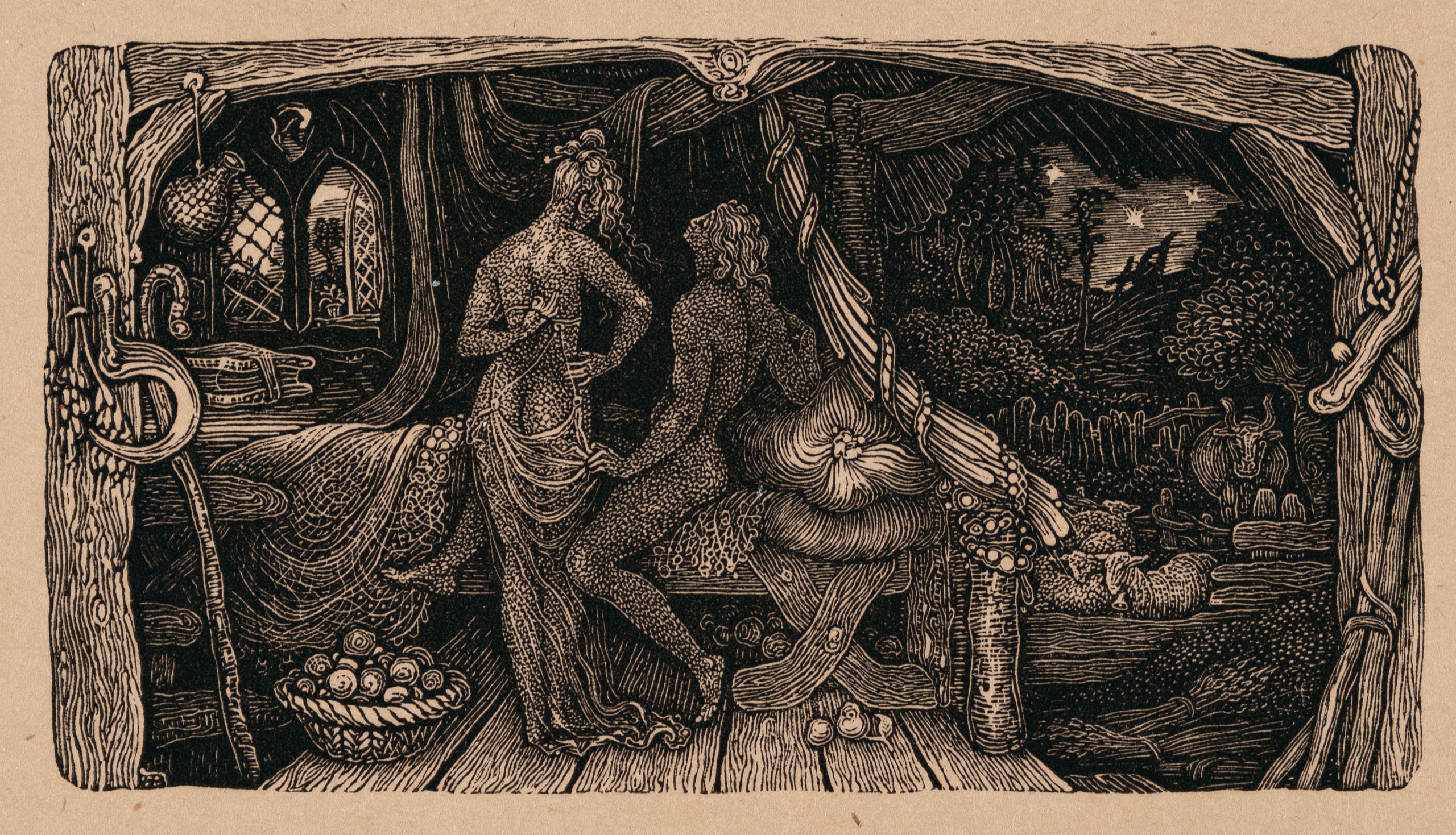
Samuel Palmer’s (1805-1881) extraordinary vision of the English landscape is so familiar and casts such a long shadow over British creative culture that it is hard to imagine there was a time when his work was little-known. His reputation in his own lifetime was never great and despite the substantial efforts of his son, Alfred Herbert Palmer (1853-1932), it did not significantly grow in the years immediately following his death. The watershed moment was the Victoria and Albert Museum’s 1926 Exhibition of Drawings, Etchings & Woodcuts by Samuel Palmer and other Disciples of William Blake, the centenary of which our exhibition is timed to coincide with and celebrate. The V&A exhibition immediately re-established Palmer as one of Britain’s great imaginative artists. His early Shoreham period works in particular, which Victorian taste (and even his son!) had disregarded as mere youthful follies, were a revelation to the public and to artists. From relative obscurity, Palmer became the overriding influence on the group of young Modern British artists now known as the Neo-Romantics. Paul Nash (1889-1946), John Minton (1917-1957), John Piper CH (1903-1993), John Craxton (1922-2009), Keith Vaughan (1912-1977) and others all pursued a vision of landscape similar to Palmer’s in poetic intensity.
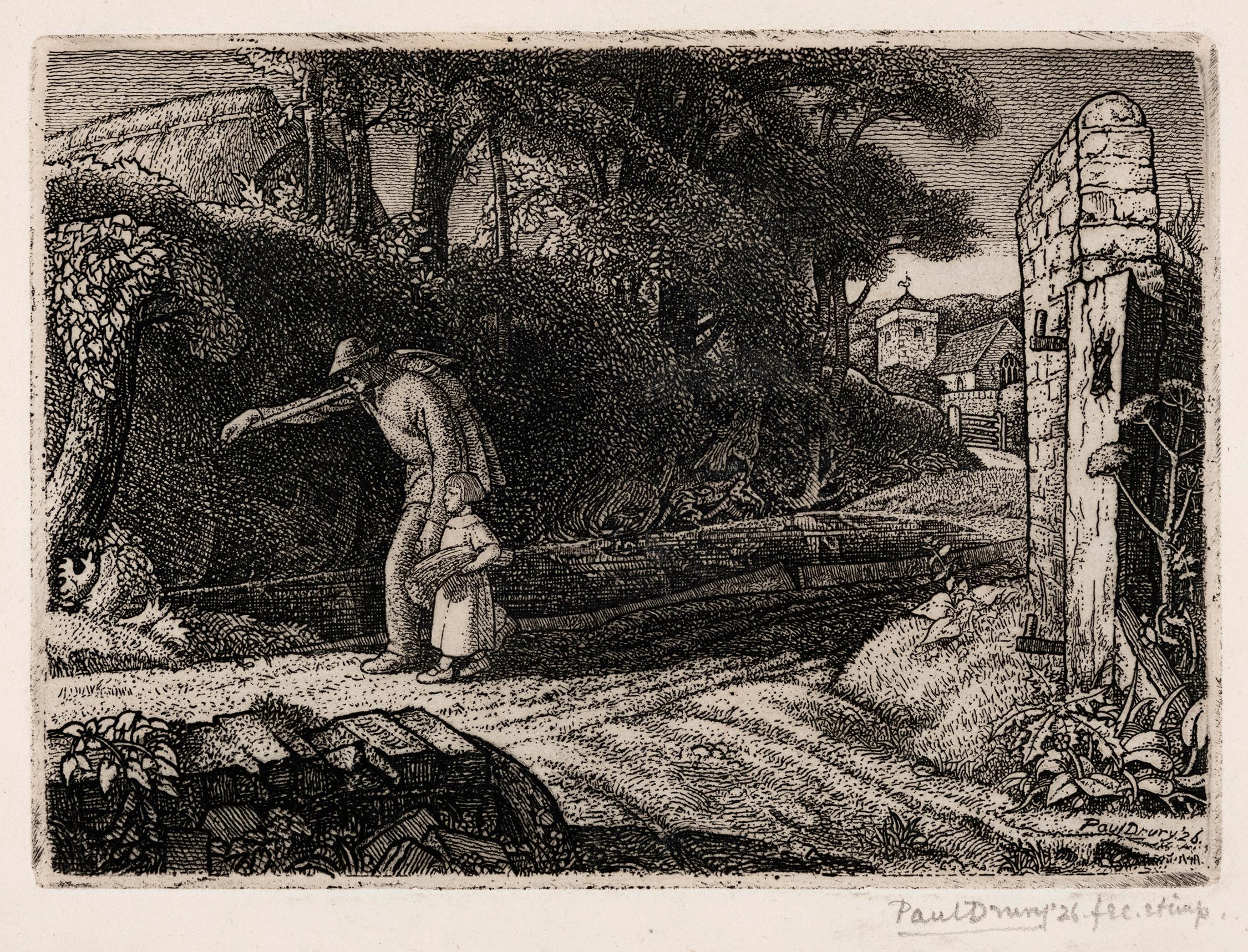
While the 1926 V&A exhibition was responsible for Palmer’s wider fame, there were a small number of people championing his work in the preceeding years. Martin Hardie (1875-1952) and Laurence Binyon (1869-1943), of the V&A and British Museum respectively, were academic enthusiasts who were instrumental in enabling the 1926 exhibition. Artists who appreciated Palmer’s work included Hardie, himself a printmaker as well as curator, Sir Frank Short R.A. P.R.E. (1857-1945) and F L Griggs R.A. R.E. (1876-1938). However, the most significant pre-1926 rediscovery of Palmer was made by a group of young printmakers studying at Goldsmiths. Now often referred to as the ‘Class of ’21’, this group included Paul Drury (1903-1987), Graham Sutherland OM (1903-1980), Edward Bouverie Hoyton (1900-1988), Alexander Walker (1895-1984), William Larkins (1901-1974) and, later, Robin Tanner (1904-1988). The story as recorded by Sutherland is that, one day in 1924, Willie Larkins found an impression of Palmer’s The Herdsman’s Cottage in the Charing Cross Road and brought it to Goldsmiths. For these young artists, who had started their education firmly within the printmaking tradition established by J M Whistler (1834-1903) and Francis Seymour Haden (1818-1910), the Palmer print changed everything. Sparse, linear work was abandoned and henceforth they were interested only in heavily working their etching plates in an attempt to produce the luminosity that Palmer had achieved.
No claim can be made that Graham Sutherland has been forgotten or neglected like Palmer was. However, his early prints are certainly under-appreciated. In the middle part of the twentieth century Sutherland was considered Britain’s greatest living painter – more so than Francis Bacon (1909-1992), with whom he worked closely in the ’40s, or Freud (1922-2011), who he mentored. Sutherland’s reputation was almost entirely based on his paintings of the late 1930s to 1960s, but, as we hope this exhibition shows, taken together the early prints should be considered one of his crowning achievements.
This exhibition features all bar one of Palmer’s prints, alongside the largest group of Sutherland’s early prints that has been put together for sale since Gordon Cooke’s important exhibition Graham Sutherland – Early Etchings of 1993. It offers a rare opportunity to assess their work side by side and allows us to see, with unusual fullness, both the great quality of Palmer’s printmaking and the generative force it had on Sutherland. However, this is not intended solely as a demonstration of Palmer’s influence. At a moment in the early twentieth century, soon after WWI and the excitement of pre-war Modernist movements, when British artists were searching for forms of expression rooted in their native landscape, Palmer offered not just a model but a challenge: how to re-imagine his vision for the Modern world. Sutherland’s early prints show how powerfully he answered that challenge. Much like when Palmer’s work was rediscovered in 1926, we hope Sutherland’s early prints will be a revelation to those who did not see the last significant gathering of them, more than thirty years ago.
THE EXHIBITION
The etchings of Samuel Palmer and Graham Sutherland are discrete groups within each artists’ sprawling ouvre. This allows them to be considered as sets of work as well as in isolation. Palmer’s thirteen prints were made in the second half of his life, between 1850 and 1881, with four further plates being finished by his son after his death. In contrast, Sutherland’s forty or so etchings were made right at the beginning of his career, between 1922 and 1932 (two final etchings being made in 1938). That is, during and just after his time studying at Goldsmith’s. The strange consequence of this is that a number of the prints from these two remarkable and important bodies of work – one with a direct connection to Blake and the early nineteenth century Romantic movement, the other a high-point in the twentieth century revival of print-making and a segue to the great Neo-Romantic movement of the 1930s and 1940s – were made only 40 years apart!
SAMUEL PALMER (1805-1881)
‘Oh the joy! Colours and brushes pitched out of the window […] great needles sharpened three-corner-wise like bayonets […] and a Great Gorge of old poetry to get up the dreaming‘. (Samuel Palmer, Letter of 1872).
Unlike some of his fellow ‘Ancients’ such as George Richmond R.A. (1809-1896) and Edward Calvert (1799-1883), Palmer did not make many prints during the famous Shoreham years. However, William Blake (1757-1827), a God to those young artists who gathered at Shoreham in the 1820s, was still the major influence on Palmer’s etchings when he began making them in the 1850s. A clear line can be drawn between Palmer’s prints and Blake’s small, intense illustrations made for Dr Thornton’s The Pastorals of Virgil in 1821. At their heart Palmer’s print are, like Blake’s – romantic, pastoral and literary.
Palmer revelled in the exacting and arduous technique of etching. The slow pace suited his way of working and his reflective mind. He wrote … ‘its difficulties […] are an elegant mixture of the manual, chemical and calculative, so that its very mishaps and blunders (usually remediable) are a constant amusement. The tickling sometimes amounts to torture, but on the whole, it raises and keeps alive a speculative curiosity – it has something of the excitement of gambling, without its guilt and its ruin’ (Samuel Palmer, Letter of 1872).
The Small Plates (1850-1857)
Palmer’s first five etchings are all small works. They are often grouped together for this reason as much as their similar date. Four were made in 1850, during the first rush of excitement of taking up etching. The fifth ‘The Sleeping Shepherd’ (L.6) was made after a hiatus, in 1857. With the exception of ‘The Willow’ (L.1), which is based on a drawing made from life (Manchester Art Gallery, 1936-196), they are works of the imagination, inspired by literary sources.
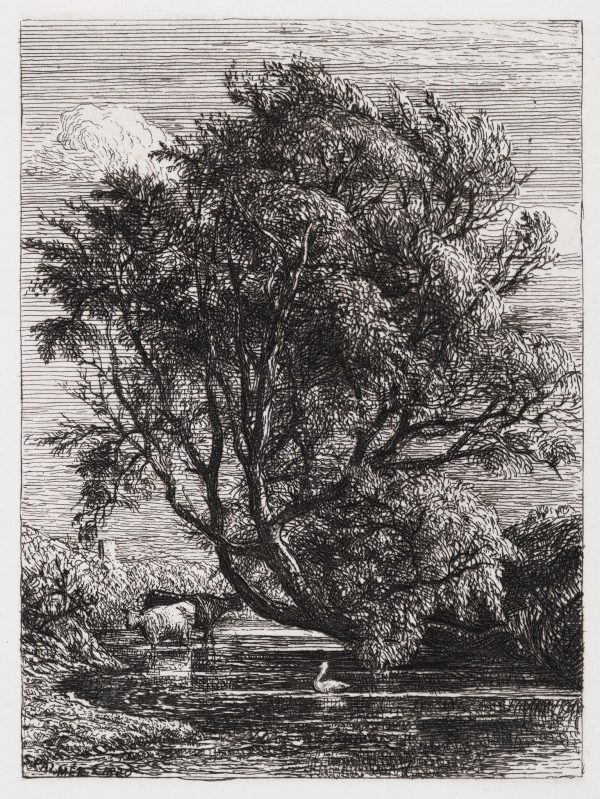
Palmer, Samuel (1805 – 1881)‘The Willow’ (L.1).Etching. 1850. State I of III. This is the etching Palmer submitted for membership to the Etching Club, and for which he was unanimously elected.3.5×3 inches.
£1,250
Sold
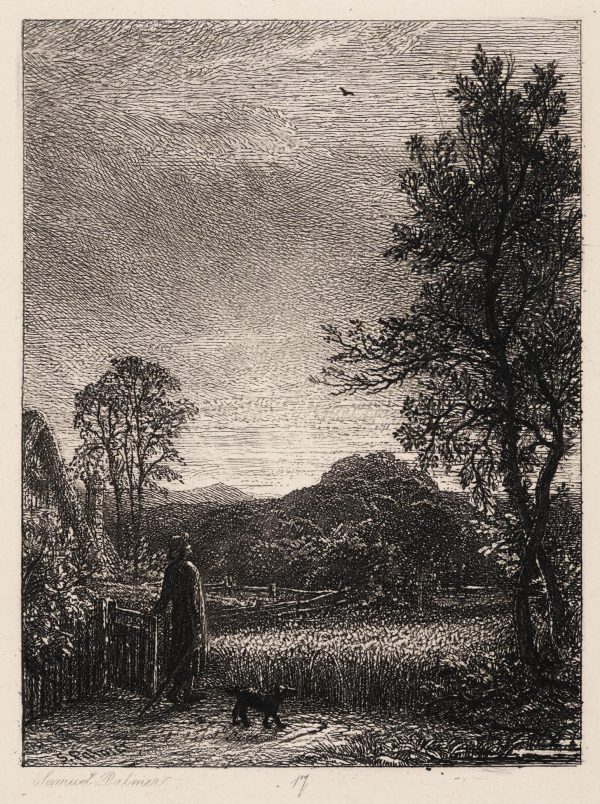
Palmer, Samuel (1805 – 1881)‘The Skylark’ (L.2).Etching. 1850. State VIII of VIII. As published in ‘Etchings of the Art Union of London by the Etching Club’, 1857, pl.17. The genesis of this composition can be traced back to a drawing of c.1831/32. Palmer also completed a painting of the subject in c.1839 (National Museum of Wales A361). The work is inspired by the lines from Milton’s ‘L’Allegro’ … ‘To hear the Lark begin his flight / And singing startle the dull night / From his watch-tower in the skies, / Till the dappled dawn doth rise …’.3.75×3 inches.
£3,000
Sold
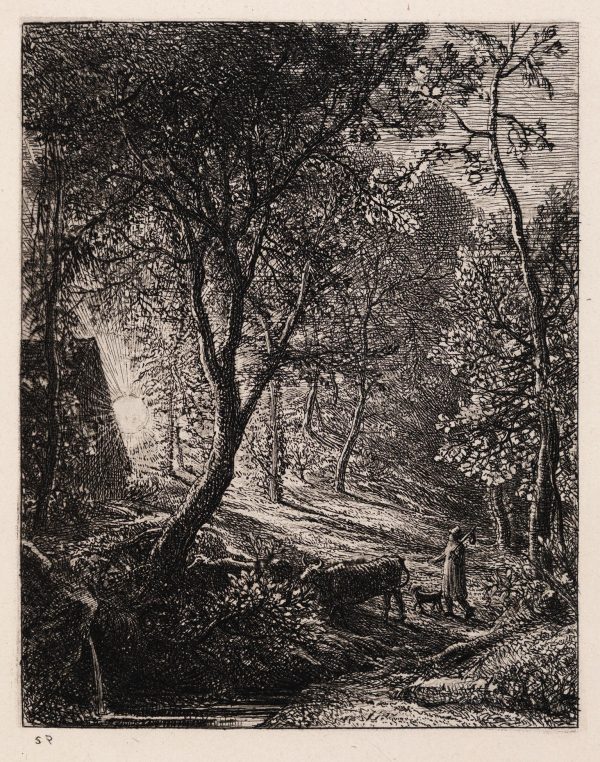
Palmer, Samuel (1805 – 1881)‘Herdsman’s Cottage’ (L.3).Etching. 1850. State II of II. Published by P G Hamerton in ‘Portfolio’ (1872, where erroneously titled ‘Sunrise’), ‘Examples of Modern Etching’ (1875) and ‘Etching and Etchers’ (1880). This image of a Herdsman retiring home at sunset can be seen as a counterpoint to the image of sunrise in ‘The Skylark’ (L.2.).4×3 inches.
£1,250
Sold
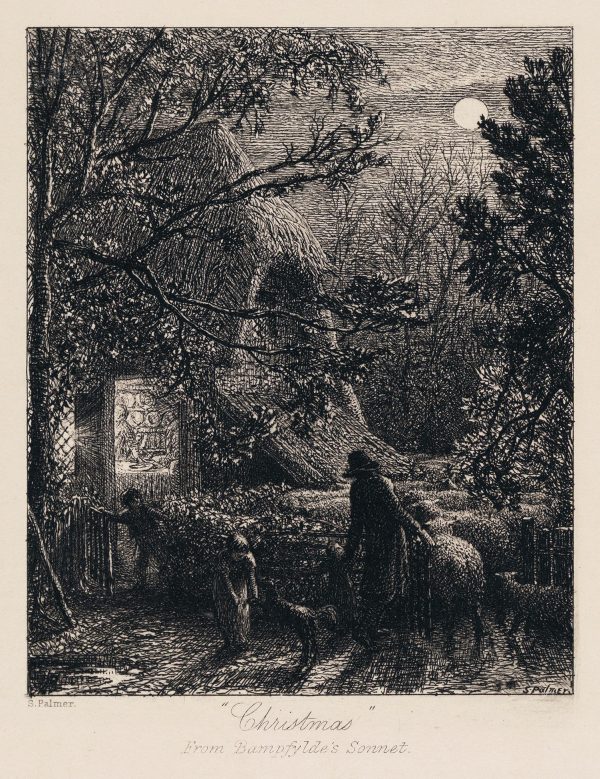
Palmer, Samuel (1805 – 1881)‘Christmas’ or ‘Folding the Last Sheep’ (L.4).Etching. 1850. State IV of V. As published in A. H. Palmer, ‘Samuel Palmer: A Memoir’ (1882). Provenance: gift from A. H. Palmer, the artist’s son, to Joseph Palmer (1853-1931). This print illustrates John Codrington Bampfylde’s sonnet ‘Christmas’…. ‘With footstep slow, in furry pall clad / His brows enwreath’d with holly never-sear, / Old Christmas comes, to close the waned year; / And ay the Shepherd’s heart to make right glad; / Who, when his teeming flocks are homeward had, / To blazing hearth repairs, and nut-brown beer, / And views, well-pleas’d, the ruddy prattlers dear / Hug the grey mongrel; meanwhile maid and lad / Squabble for roasted crabs. – Thee, Sire, we hail, / Whether thine aged limbs thou dost enshroud, / In vest of snowy white, and hoary veil, / Or wrap’st thy visage in a sable cloud; Thee we proclaim with mirth and cheer, nor fail / To greet thee well with many a carol loud’.4×3 inches.
£3,750
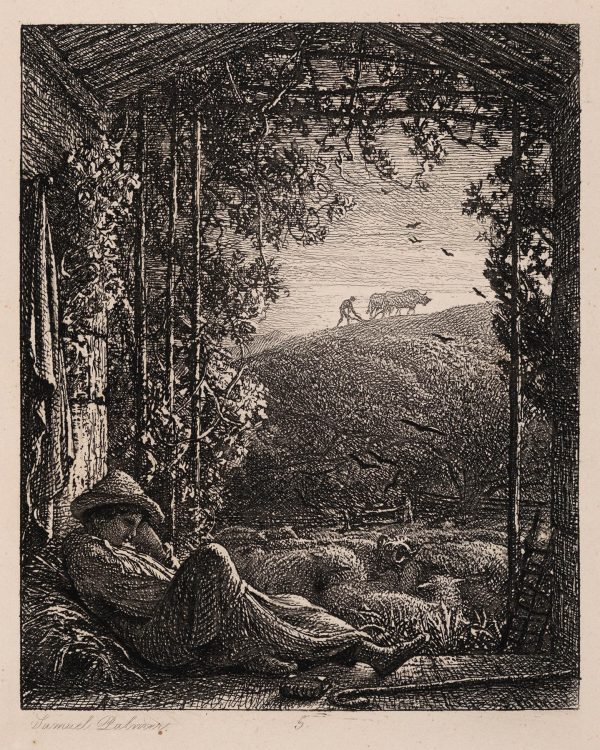
Palmer, Samuel (1805 – 1881)‘The Sleeping Shepherd’ (L.6).Etching. 1857. State IV of IV. Published in ‘Etchings of the Art Union of London by the Etching Club’, 1857, Pl.5. Palmer also made related paintings of this subject, the earliest dating to the 1830s. Although possibly inspired by some lines from Milton’s ‘L’Allegro’ … ‘While the ploughman near at hand / Whistles o’er the furrow’d land, / And the milkmaid singeth blithe, / And the mower whets his scythe, / And every shepherd tells his tale / Under the hawthorn in the dale’ … the figure was loosely based on the 2nd century Roman sculpture of Endymion in the British Museum (1805,0703.23). Of the sculpture, Palmer wrote ‘More than two thousand years ago the sculptor bade that marble live. It lived, but slept, and it is living still. Bend over it. Look at those delicate eyelids; that mouth a little open. He is dreaming. Dream on, marble shepherd; few will disturb your slumber’.3.75×3 inches.
£3,750
Sold
The Large Plates (1857-61)
The first of Palmer’s larger plates contrast with his earlier etchings not just in size but also in format. A shift from vertical to horizontal compositions allowed Palmer to make a series of landscapes that are literally and metaphorically broader in scope. These are brave and complex works that pool all of his previous experience in landscape painting. Technically, they are his most experimental prints and went through many states.
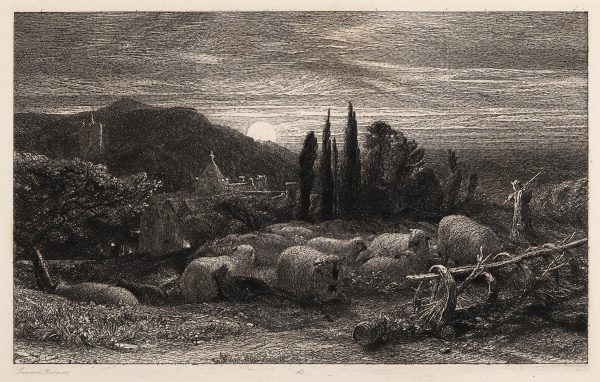
Palmer, Samuel (1805 – 1881)‘The Rising Moon’ or ‘An English Pastoral’ (L.7).Etching. 1857. State VII of IX. Published in ‘Etchings of the Art Union of London by the Etching Club’, 1857, Pl.10. Raymond Lister observed that the village in this work recalls Shoreham nestled in its valley, while the distant hills resemble Devon and the aerial perspective and light demonstrate his experience of Italy. In this respect the print is something of an essay in Palmer’s accumulated abilities as a landscape artist.4.5×7.5 inches.
£2,500
Sold
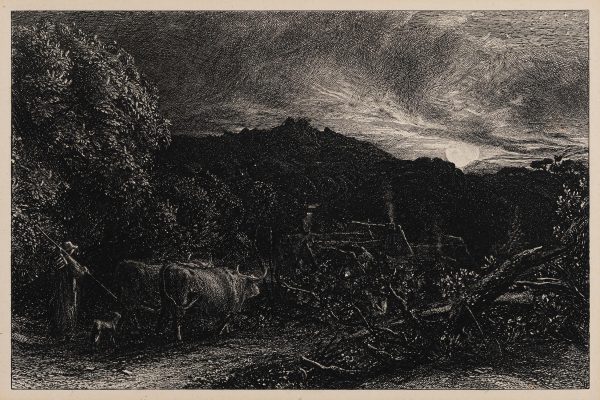
Palmer, Samuel (1805 – 1881)‘The Weary Ploughman’ or ‘The Herdsman’ (L.8).Etching. 1858. State VIII of VIII. As published in ‘A Selection of Etchings by the Etching Club’, 1865. The literary inspiration for this print are the lines from Thomas Gray’s ‘Elegy Written in a Country Churchyard’ … ‘The curfew tolls the knell of parting day / The lowing herd wind slowly o’er the lea, / The plowman homeward plods his weary way, / And leaves the world to darkness and to me’.5×7.75 inches.
£2,000
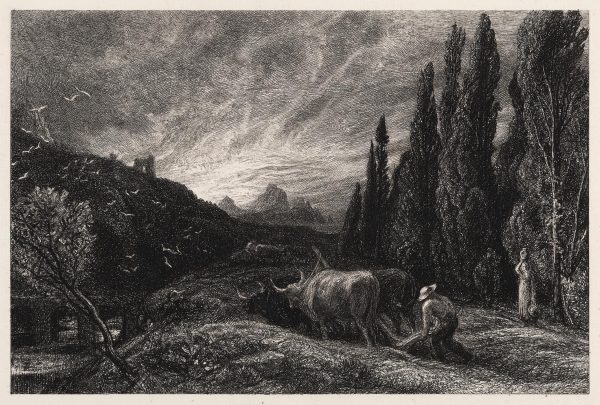
Palmer, Samuel (1805 – 1881)‘The Early Ploughman’ or ‘The Morning Spread upon the Mountains’ (L9).Etching. 1860/1861. State V of IX. This plate was re-bitten in 1880, it’s sixth state, when Palmer decided to return to it. The composition relates closely to a few of Palmer’s watercolours, including some of his illustrations to Milton. However, this particular work doesn’t seem to have a direct literary source. Rather, it is a continuation of Palmer’s exploration of pastoral compositions set at particular times of day.5×7.75 inches.
£1,750
Sold
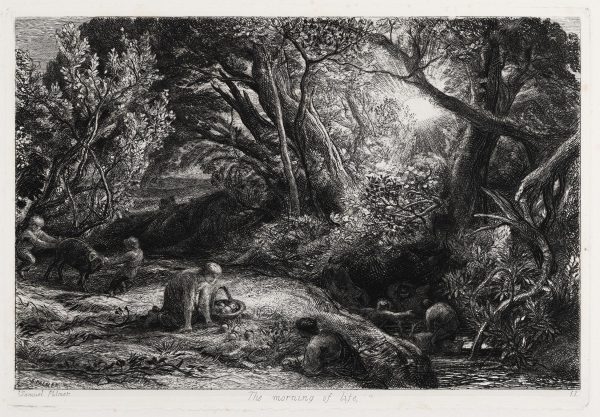
Palmer, Samuel (1805 – 1881)‘The Morning of Life’ (L.10).Etching. 1860/61. State VII of VII. Published in ‘Etchings of the Art Union of London by the Etching Club’, 1872, Pl.13. This work is a virtuoso, technical display of using paper to achieve effects of light. The composition began as ‘Hercules and Cacus’, but Palmer’s constant working of the plate resulted in a work of pure and independent poetry.5.25×8 inches.
£1,750
Sold
Milton / Il Penseroso (1879)
Palmer’s two late etchings inspired by Milton’s Il Penseroso are considered his masterpieces in the medium. They derive from his project to make a series of watercolours based on Il Penseroso for Leonard Row Valpy, a collector (and Ruskin’s solicitor) who had commissioned Palmer to make a body of work on a subject of his choosing. Palmer obsessed over his Milton works for the last fifteen years of his life with the result that they became deeply personal, melancholic works as well as illustrations.
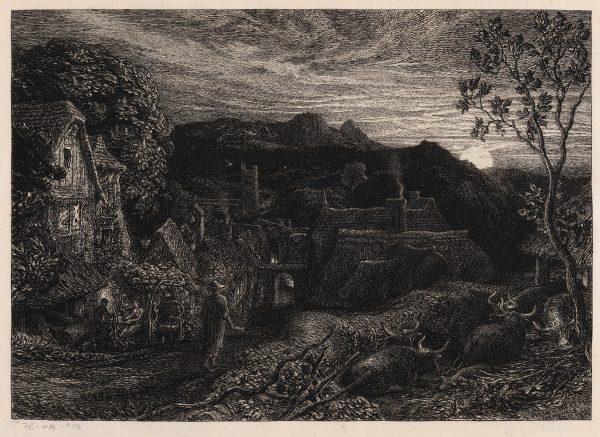
Palmer, Samuel (1805 – 1881)‘The Bellman’ (L.11); an illustration to Milton’s ‘Il Penseroso’.Etching. 1879. State VII of VII. Printed from the original plate by Sir Frank Short, Martin Hardie and F. L. Griggs in 1926. Edition of 60. This print illustrates the lines ‘Or the Bellman’s drousie charm / To bless the dores from nightly harm’. The main inspiration for the village here is Shoreham. In a letter to P. G. Hamerton, Palmer made clear just how much it is a work of nostalgia … ‘… It is a breaking out of village-fever long after contact – a dream of that genuine village where I mused away some of my best years, designing what nobody would care for’. This is one of the five prints by Palmer that Short, Hardie and Griggs pulled impressions of in 1926, the year of the famous V&A Palmer exhibition. The original, uncancelled, plates had been sent to Griggs by A. H. Palmer. The impressions are particularly fine and widely admired.6.5×9 inches.
£5,000
Sold
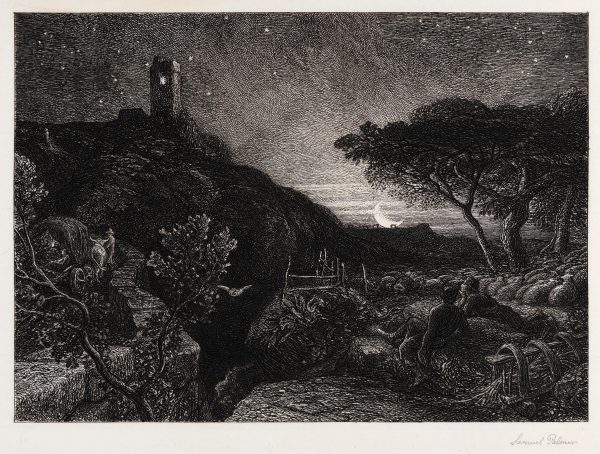
Palmer, Samuel (1805 – 1881)‘The Lonely Tower’ (L.12); an illustration to Milton’s ‘Il Penseroso’.Etching. 1879. Signed. State VI of VII. As published by R Ansdell for The Etching Club in ‘Il Penseroso’, 1880. This print illustrates the lines directly following on from those in ‘The Bellman’ (L.11) … ‘Or let my lamp at midnight hour, / Be seen in some high lonely tow’r, / Where I may oft out-watch the Bear, / With thrice great Hermes’. ‘The Lonely Tower’ is an even more personal work than ‘The Bellman’, the tower being closely related to the tower on Leith Hill near the spot Palmer’s first son had died in 1862 and which stands above the village of Abinger where he was buried. Palmer could see the tower from the window of his studio at Furze Hill House, Redhill, his last home.6.5×9 inches.
£10,000
The Eclogues of Virgil (1880-81)
Palmer’s other great project towards the end of his life was an illustrated translation of Virgil’s Eclogues. Only one of his prints, ‘Opening the Fold’ (L.13), was finished in his lifetime. Four further plates which had been left in a well-developed state on his death in 1881 were finished by his son, A. H. Palmer. The prints were eventually published alongside Palmer’s translation as An English Version of the Eclogues of Virgil in 1883.
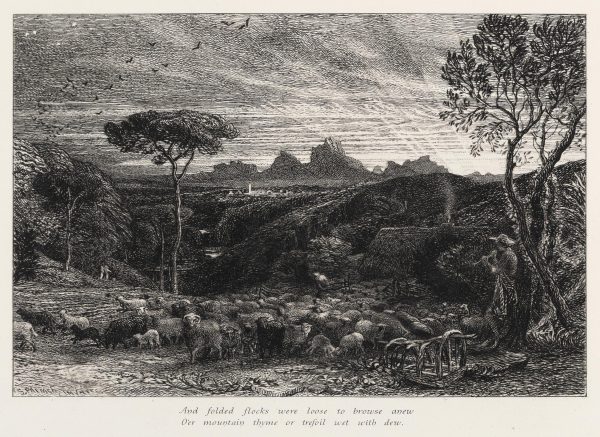
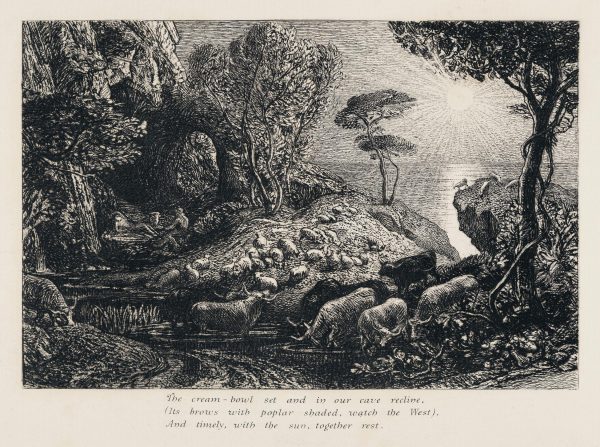
Palmer, Samuel (1805 – 1881)‘Opening the Fold’ or ‘Early Morning’ (L.13); an illustration to Virgil’s Eclogue VIII.Etching. 1880. State VII of X. As published in the small paper edition of ‘An English version of the Eclogues of Virgil’ (1883).4.5×7 inches.
£1,000
Sold
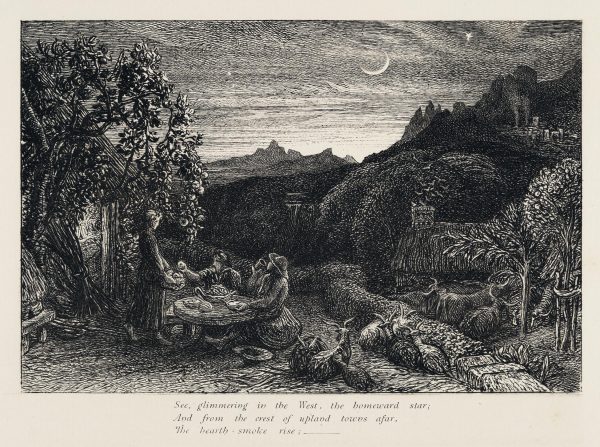
Palmer, Samuel (1805 – 1881)‘The Homeward Star’ (L.14); an illustration to Virgil’s Eclogue I.Etching. c.1880. Completed by A. H. Palmer before 1883. State II of IV. As published in the small paper edition of ‘An English version of the Eclogues of Virgil’ (1883).4×6 inches.
£875
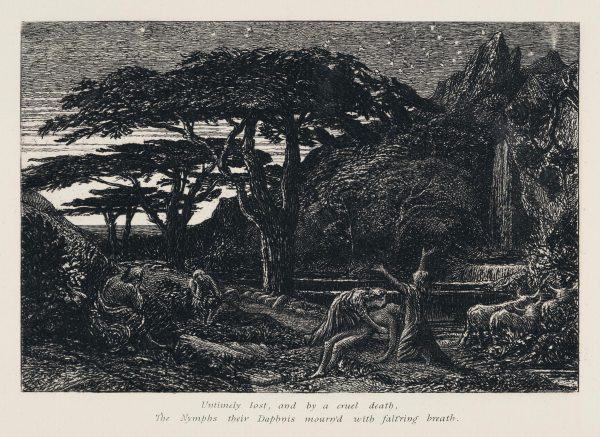
Palmer, Samuel (1805 – 1881)‘The Cypress Grove’ (L.15); an illustration to Virgil’s Eclogue V.Etching. c.1880. Completed by A. H. Palmer before 1883. State II of IV. As published in the small paper edition of ‘An English version of the Eclogues of Virgil’ (1883).4×6 inches.
£475
Sold
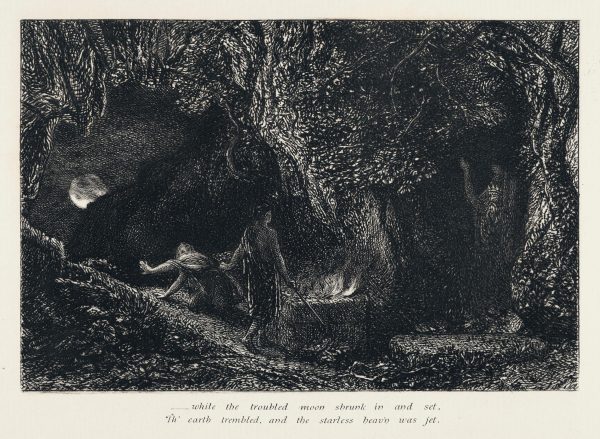
Palmer, Samuel (1805 – 1881)‘The Sepulchre’ (L.16); an illustration to Virgil’s Eclogue VIII.Etching. c.1880. Completed by A. H. Palmer before 1883. State II of IV. As published in the small paper edition of ‘An English version of the Eclogues of Virgil’ (1883).4×6 inches.
£375
Sold
Palmer, Samuel (1805 – 1881)‘Moeris and Galatea’ (L.17); an illustration to Virgil’s Eclogue IX.Etching. c.1880. Completed by A. H. Palmer before 1883. State II of IV. As published in the small paper edition of ‘An English version of the Eclogues of Virgil’ (1883).4×6 inches.
£575
Sold
GRAHAM SUTHERLAND OM (1903-1980)
Sutherland made almost all his etchings between the ages of 19 and 28. However, he had a natural talent for print making and even his earliest attempts are startlingly mature works. Such was the rapid progress he made that by 1924, before turning 21, he had his first solo exhibition of prints at the Twenty One Gallery. He was elected an associate of the R.E. the following year and had his second exhibition at the Twenty One Gallery in 1928.
While the ‘Class of ’21’ (see the introduction at the top of this page) rebelled against the sort of printmaking being taught at Goldsmith’s, they in fact benefitted from the experience of a succession of influential masters at the college. Alfred Bentley R.E. (1878-1923), Frederick Marriott R.E. (1860-1941), Malcolm Osborne R.E. (1880-1963) and Stanley Anderson R.E. (1884-1966) each, to a greater or lesser extent, gave Sutherland and his peers a sound technical basis from which to work.
Early Works (1922-24)
Sutherland’s early prints are varied, exploratory works which show the influence of Rembrandt, Dürer and Whistler. They are essentially linear, although he manages to achieve an impressive variety of textures and plays of light. All demonstrate his technical prowess and sensitivity to rural English subjects. It was these prints, shown at the Twenty One Gallery in 1924, that first established his reputation.
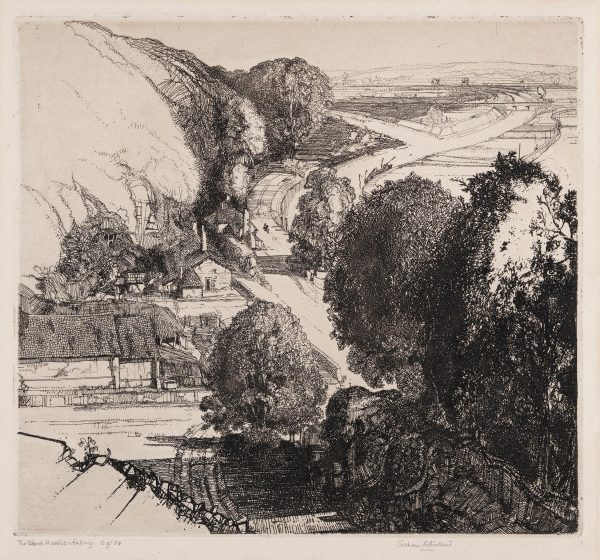
Sutherland O.M., Graham (1903 – 1980)‘The Black Rabbit’ (T.8 / C.12).Etching. 1923. Probably state I of III. Signed and titled ‘The Black Rabbit Stabling’ and editioned 6/50. The subject is The Black Rabbit pub on the road in the centre of the image, set back from the River Arun near Arundel. Both Tassi and Cooke list two known states. However, an impression inscribed ‘3rd State’ was recently sold and the present print would seem to predate that reproduced by Tassi as State I. Despite Sutherland’s intention that this state should run to an edition of 50, there can only have been a small number printed.7.5×8.25 inches.
£3,750
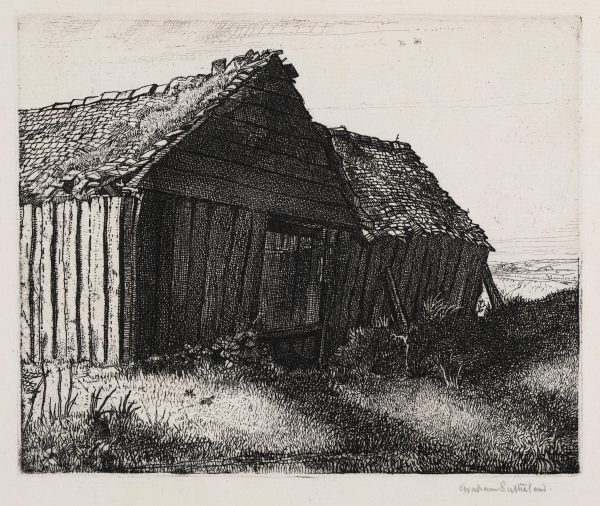
Sutherland O.M., Graham (1903 – 1980)‘Warning Camp’ (T.9 / C.15).Etching. 1924. Signed. State II of II. The subject is a barn at the village of Warningcamp near Arundel which reappears in the centre of ‘The Village’ (C.25). The print fits in with a number of works depicting romantic dilapidated country buildings made by Sutherland and his Goldsmith’s contemporaries. See, for example, his ‘Number Forty-Nine’ (C.24) and Paul Drury’s ‘Hayling Island’ (RG.7) of the same year.5×6 inches.
£2,750
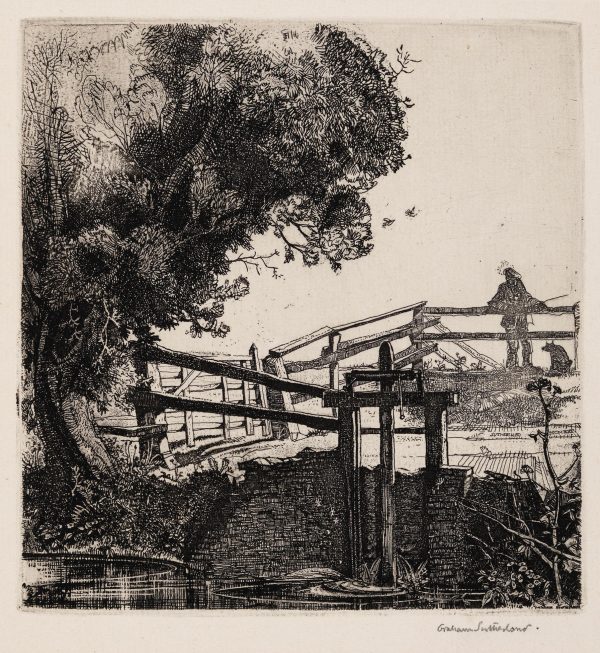
Sutherland O.M., Graham (1903 – 1980)‘The Sluice Gate’ (T.10 / C.16).Etching. 1924. State IV of IV. Signed. This is a beautiful impression of Sutherland’s most Rembrandt inspired print. Like ‘The Black Rabbit’ (C.12) and ‘Warning Camp’ (C.15) it is a virtuoso piece of print making for a student of twenty years old.5.5×5 inches.
£2,750
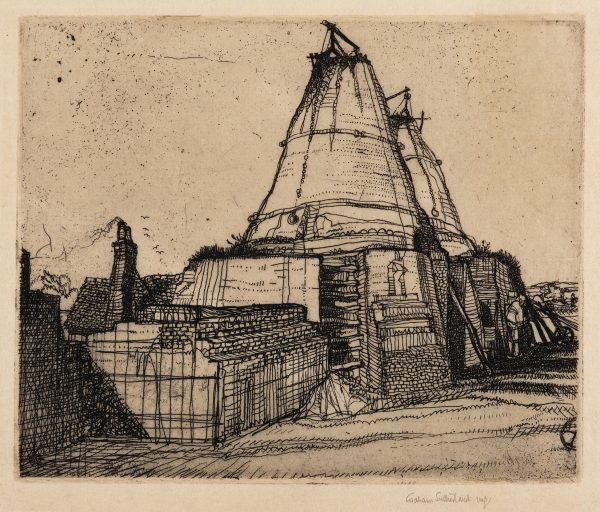
Sutherland O.M., Graham (1903 – 1980)‘Poling Potteries’ (T.13 / C.22).Etching. 1924. State I of I. Signed. The village of Poling, near Arundel, had a well established pottery until the 1950s. Like ‘Warning Camp’ (C.24) and ‘Number Forty-Nine’ (C.15), Sutherland is concerned with the rustic fabric of the buildings.4.5×5.25 inches.
£1,750
Sold
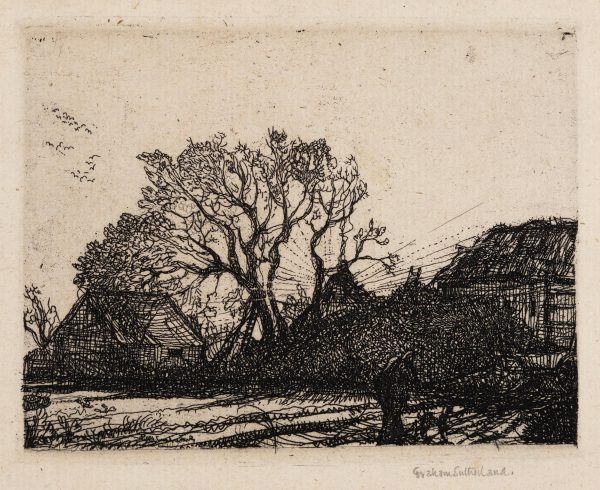
Sutherland O.M., Graham (1903 – 1980)‘Cudham, Kent’ (T.16 / C.20).Etching. 1924. Signed. Printed on antique laid paper, inscribed ‘Amhurst 1805’. Sutherland made this and another Kentish landscape (‘Barrow Hedges Farm’, C.23) directly onto the copper plate. They both show the first seeds of Palmer’s influence, not least in the light emanating from behind the roof in the background.3×4 inches.
£2,500
Sold
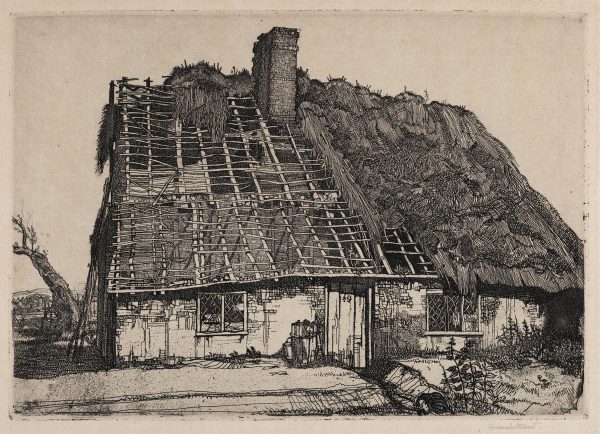
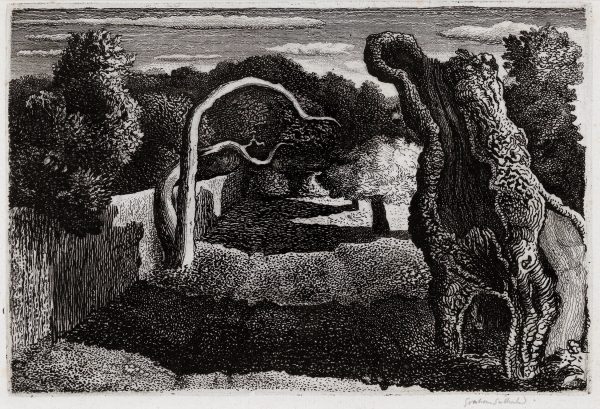
Sutherland O.M., Graham (1903 – 1980)‘Number Forty-Nine’ (T.14 / C.24).Etching. 1924. State III of III. Signed. This dilapidated cottage was at Clapham near Arundel. The influence of Rembrandt and Whistler are still present, but there is a strong and growing sense of romance in Sutherland’s depiction of the decaying building, the contorted old tree, and their contrast with the inviting looking village – a symbol of life – in the distance.7×9.75 inches.
£3,250
The Pastoral Plates (1925-28)
The discovery of Palmer in 1924 (see the introduction at the top of this page) caused the first seismic shift in Sutherland’s art. His linear work was abandoned in favour of rich, tonal prints with intense sources of light and luminescence. This technical approach was bolstered in 1926 after he and Paul Drury visited and took instruction from F L Griggs R.E. (1876-1938). Under Palmer’s influence, Sutherland’s rural subjects became romantic, pastoral compositions of the imagination rather than based on observational drawing. Rather than following Palmer’s literary bent, he had been ‘amazed at the completeness, both emotional and technical’ of Palmer’s prints and found it ‘wonderful that a strong emotion, such as was Palmer’s, could change and transform the appearance of things’.
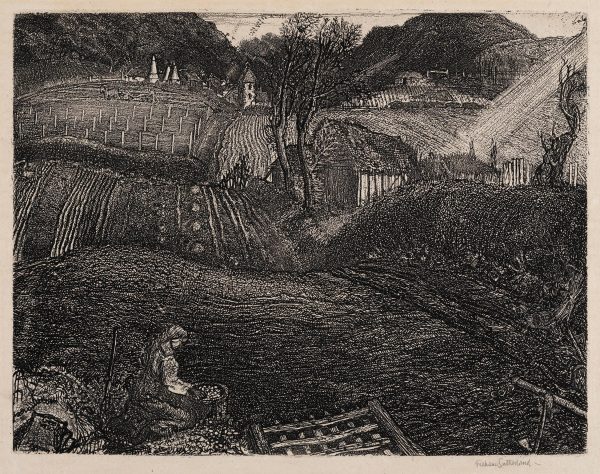
Sutherland O.M., Graham (1903 – 1980)‘The Village’ (T.20 / C.25).Etching. 1925. State III of III. Signed. This is the first of Sutherland’s six Pastoral works. The high horizon, extensive working of the plate, beautiful play of light and the subject of the woman gathering potatoes is in stark contrast to his previous work. It demonstrates the extraordinary effect that Palmer’s work had on him, and just how completely he understood it, despite his young age.6.75×8.75 inches.
£4,500
◐
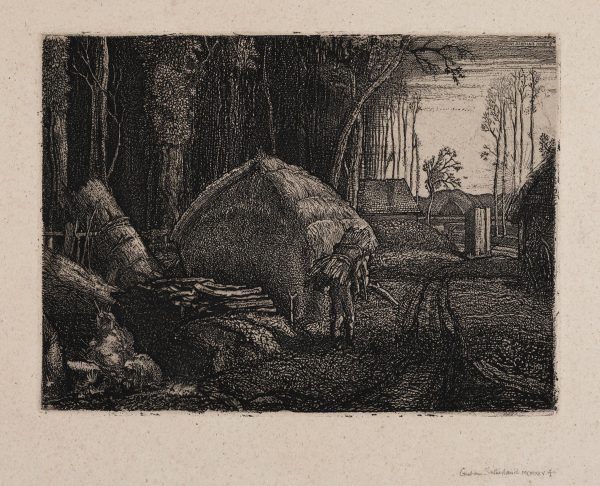
Sutherland O.M., Graham (1903 – 1980)‘Pecken Wood’ (T.21 / C.26).Etching. 1925. State III of IV. Signed and dated, ‘MCMXXV’. Inscribed ‘Pecken W. G.S. imp’ and ‘8 Sheets for Pecken Wood’. In this composition the foreground is enclosed by an dark, ancient wood. From there the labourer follows a track towards a village in the distance where the composition opens up and a Winter sun sets. Sutherland creates a sensitive, pastoral narrative which conveys man’s long history with our environment, its continuation to the present day and a sense of it reaching out into the future.5.5×7.25 inches.
£3,500
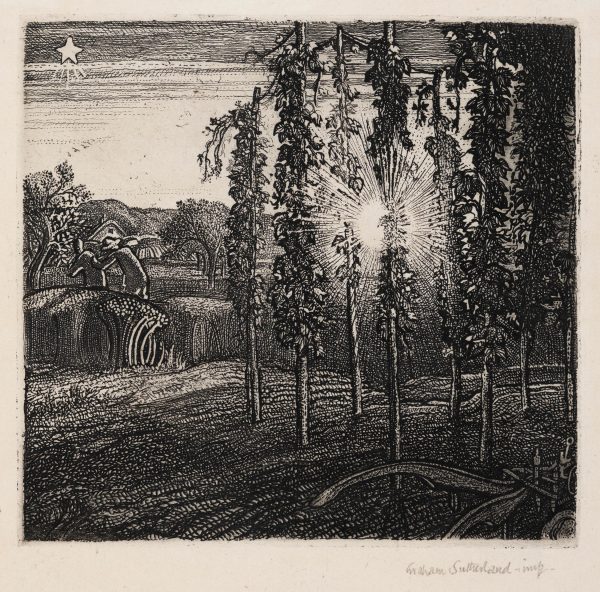
Sutherland O.M., Graham (1903 – 1980)‘Cray Fields’ (T.19 / C.27).Etching. 1925. Final State. Signed. This is a scene set on the River Cray near Farningham, Kent, close to Shoreham. The evening star rises over two hop pickers as the setting sun bursts through some hop-poles in the foreground. A celebratory print of great warmth, it was clearly inspired by Palmer’s ‘Herdsman’s Cottage’ (L.3).4.5×4.75 inches.
£2,750
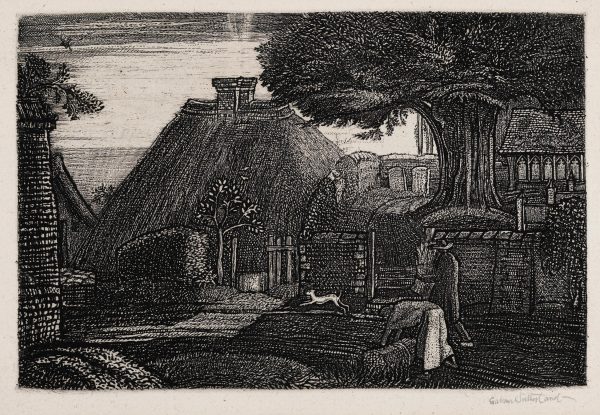
Sutherland O.M., Graham (1903 – 1980)‘St Mary Hatch’ (T.22 / C.28).Etching. 1926. Probably State V of V. Signed. This and ‘Lammas’ (C.23) are timeless idylls of English village life. Earlier states of this print bore a passage from Psalm 14 in Latin which read … ‘Lord, who shall abide in they Tabernacle? Who shall dwell in thy holy hill? He that walketh uprightly, and worketh righteousness’. The print was made while Sutherland was being inducted into the Catholic church. However, the inscription was presumably taken off to remove any sense of dogmatism and to allow the print the feeling of universal harmony with which it pervades.5.5×7.25 inches.
£3,750
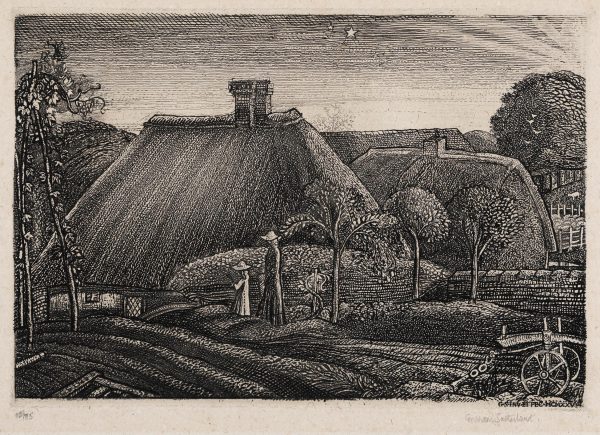
Sutherland O.M., Graham (1903 – 1980)‘Lammas’ (T.23 / C.29).Etching. 1926. Signed and indistinctly editioned 18(?)/85. Further signed and dated twice in the plate. State V of V. Inscribed, ‘Lammas / printed on handmade paper / Plate destroyed’. Lammas is celebrated on the 1st of August. Bread is made from the new crop of wheat and is blessed. The composition, which relates closely to ‘St Mary Hatch’ (C.28), conjures the same sense of pastoral timelessness. It includes a small reference on the right to Calvert’s ‘The Sheep of His Pasture’ (L.9b) and via Calvert, to Blake.4.25×6.25 inches.
£3,750
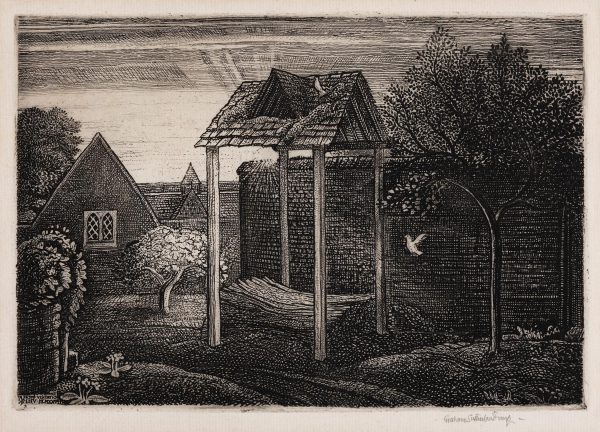
Sutherland O.M., Graham (1903 – 1980)‘May Green’ (T24 / C.30).Etching. 1927. Signed. Final state. Inscribed ‘May Green / 2nd State’. Sutherland and Paul Drury visited F. L. Griggs in late 1926. Griggs, at the height of his powers, instructed both young men in printing. His influence, as much as Palmer’s can be seen in this print which is at once spiritual and pastoral4.25×6.25 inches.
£3,500
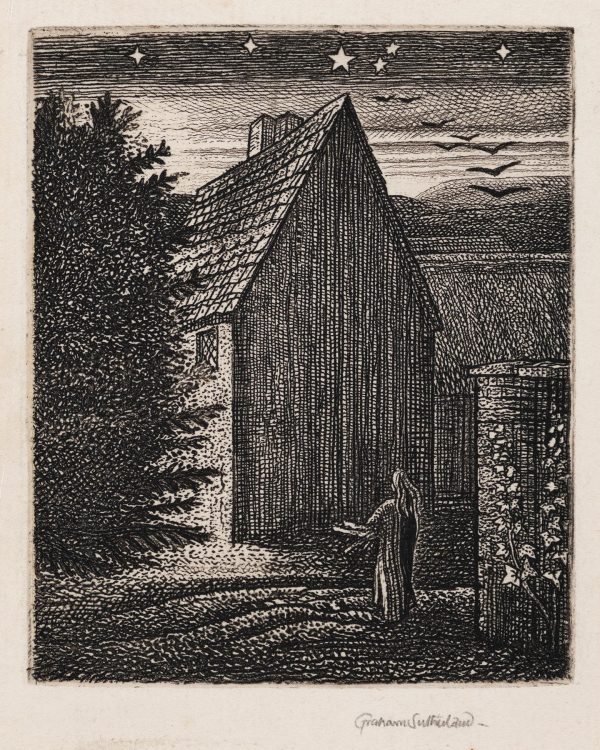
Sutherland O.M., Graham (1903 – 1980)‘Michaelmas’ (T.25 / C.31).Etching. 1928. Signed. State III of III. This little gem is another example of the combined influence of Griggs and Palmer. The failing light falling on the figure, the suggestion of smoke starting to rise from the chimney and the great sense of air over the distant hills all capture the pathos of Summer changing to Autumn.3.5×2.75 inches.
£3,000
Sold
A New Vision (1929-31)
1929 brought with it two catastrophic events; the death of Sutherland’s three month old son, and the Wall Street Crash. The first fundamentally changed Sutherland’s relationship to nature, the second tore the bottom out of the booming print market. In fact, both events had strangely positive effects on Sutherland’s art. Having already felt that his exploration of pastoral compositions had come to a natural end, he began to ‘extricate myself by climbing over the hedge and restudying nature’. His new works of 1929 contain a deeply modern sense of threat and foreboding that is far removed from the earlier works of idealisation. Then, in 1930, he created his great masterpeice, ‘Pastoral’ (C.36), which pointed to a new direction not just for his own art, but for British landscape art in general. ‘Garden’ (C.378), his final etching of this period, was not selected to be hung by the traditionalist committee of the R.E. who failed to grasp what Sutherland was now trying to do. With that, Sutherland made an almost complete break with etching.
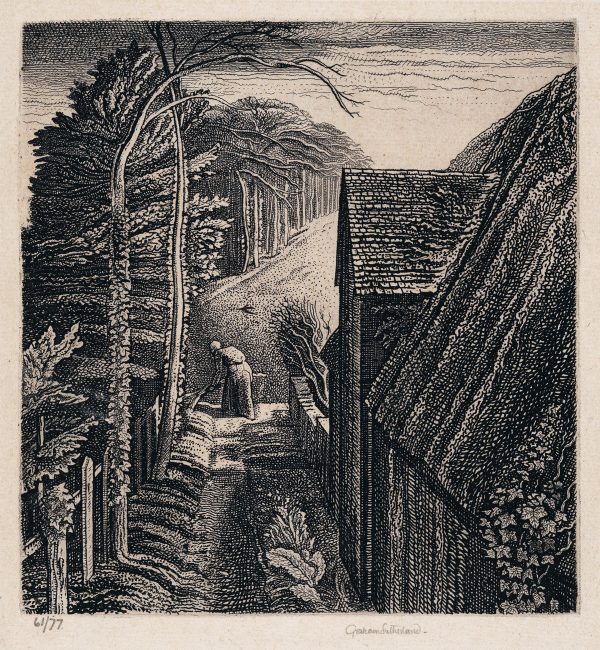
Sutherland O.M., Graham (1903 – 1980)‘Hanger Hill’ (T.27 / C.33).Etching. 1929. Final state. Signed and editioned 61/77. It is in this print that we start to see a change come about in Sutherland’s work. The warm light of his early pastoral works has become cold and hard. The composition is cramped and awkward, the trees are menacing. Uncertainty, even danger, are in the air.5×5.25 inches.
£3,500
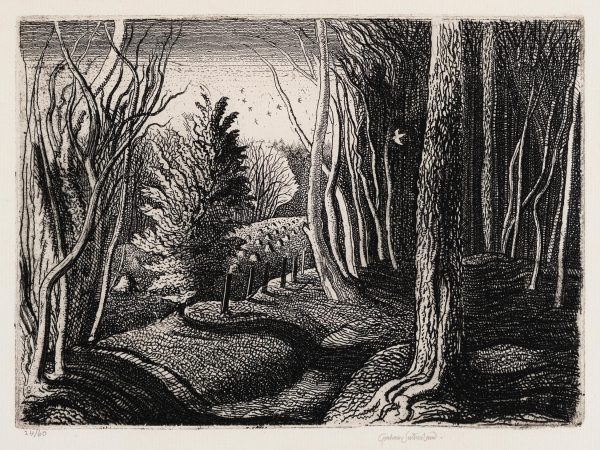
Sutherland O.M., Graham (1903 – 1980)‘Wood Interior’ (T.29 / C.34).Etching. 1929. State II of II. Signed and editioned 24/60. This figureless landscape is similar to ‘Hanger Hill’ (C.33) in feeling – at once beautiful, pastoral and foreboding. As the day ends, there is a sense of not knowing what might come next.4.5×6.5 inches.Framed: 12.5×13.5 inches.
£3,500
Sold
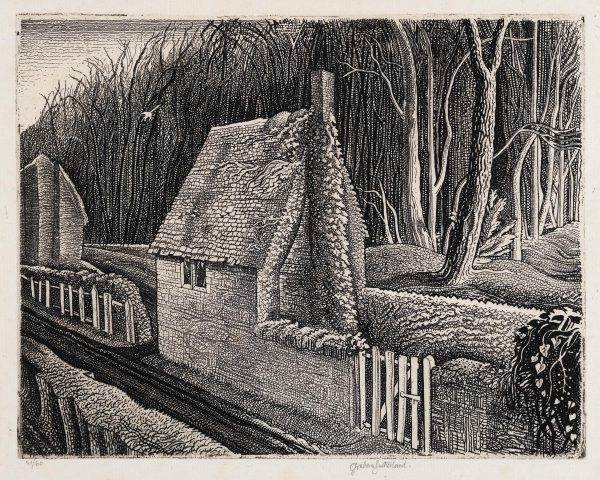
Sutherland O.M., Graham (1903 – 1980)‘Wood End’ (T.28 / C.35).Etching. 1929. Final state. Signed and editioned 21/60. Inscribed ‘Wood End’. Sometimes titled ‘Cottage in Dorset’, this is almost a pair to ‘Wood Interior’ (C.34). It is an exquisite print, but again without figures and the cottage seems abandoned. The hard, diagonal composition, leafless trees and dark wood create a sense of loss.5.5×7 inches.Framed: 5.5×7 inches.
£3,500
Sutherland O.M., Graham (1903 – 1980)‘Pastoral’ (T30. / C.36).Etching. 1930. Signed. One of five or six proofs printed in 1930. An edition of 57 plus 10 proofs was not printed until 1973. Provenance: the artist to Edward Sackville-West (1901-1965); inherited in 1965 by Eardley Knollys (1902-1991); inherited by Mattei Radev (1927-2009) (stock-book item 80); inherited by Radev’s partner, theatre designer Norman Coates as part of The Radev Collection in 2009; deaccessioned from The Radev Collection and acquired by Clive Parkinson in 2023. Exhibited: Pallant House Gallery, ‘The Radev Collection: Bloomsbury and Beyond’, Oct 2011 – Jan 2012. 5×7.5 inches. NOTE: THIS PRINT IS NOT FOR SALE.
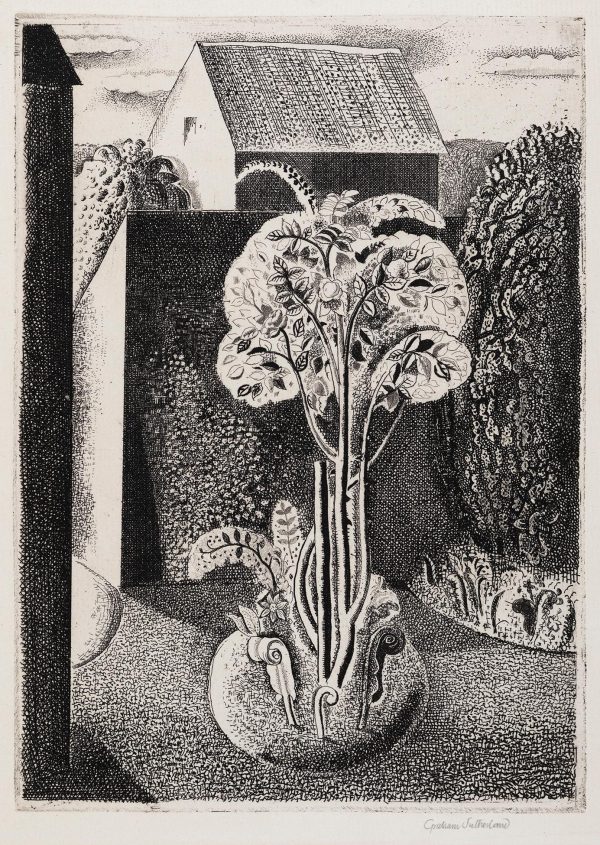
Sutherland O.M., Graham (1903 – 1980)‘Garden’ (T.31 / C.37).Etching. 1931. Signed. The setting here is Sutherland’s garden in Farningham, Kent. His other great etched work, he has taken another leap into the Modern with an almost surreal composition reminiscent of Paul Nash. The refusal of the R.E. to hang the work, and the shock that the print caused Griggs, led to Sutherland allowing his membership of the society to lapse. Disgruntled, but perhaps also sensing the natural end to which he had taken etching, Sutherland abandoned the medium in favour of painting.8.5×6 inches.Framed: 16×12 inches.
£12,500
Sold
Pembrokeshire (1935-38)
In 1935 Sutherland visited Pembrokeshire. The landscape there became a major source of inspiration for the rest of his life. In turn, his Pembrokeshire works of the 30’s influenced the slightly younger generation of artists who began making Neo-Romantic landscapes during WWII. Sutherland holidayed in Pembrokeshire with Oliver Simon, editor of Signature magazine, who commissioned him to make a frontispiece to its ninth edition. The two etchings Sutherland would make for the project, his first in seven years, were to be the last intaglio prints he would make until the 1970s.
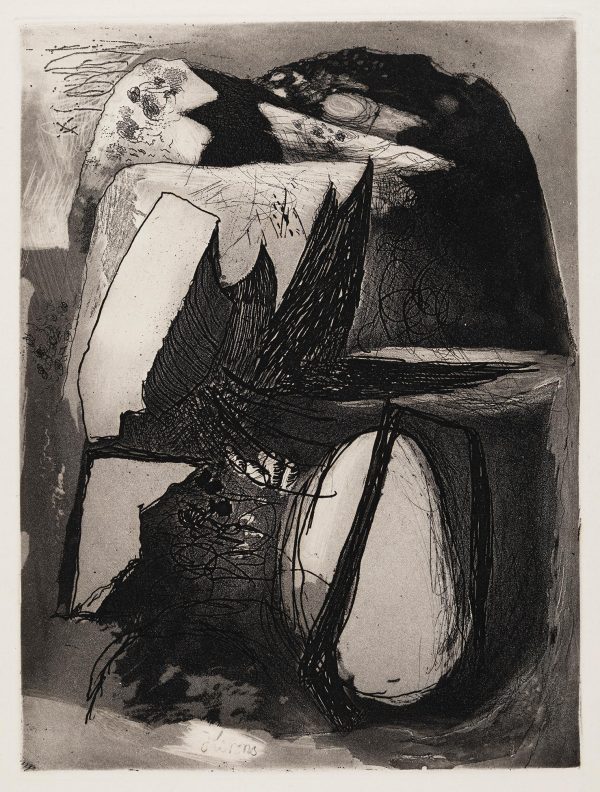
Sutherland O.M., Graham (1903 – 1980)‘Clegyr-Boia II; Landscape in Wales’ (T.33 / C.40).Etching and aquatint. 1938. As issued as the frontispiece to ‘Signature 9’, July 1938. Printed by Walsh of London and published by Curwen Press in an edition of 750. This painterly etching, with heavy use of aquatint, is a translation of Sutherland’s extraordinary landscape paintings of the ’30s into print. Given the success of the print it is surprising he did not take the medium up again. But, by then he had found his voice and was quickly being received as one of the great painters of the age.8×6 inches.