
EVELYN WILLIAMS
(1929-2012)
MASTER DRAWINGS
1974 – 1979
PRIVATE VIEW: Thursday 17th September 6-8pm
The exhibition continues until Saturday 3rd October
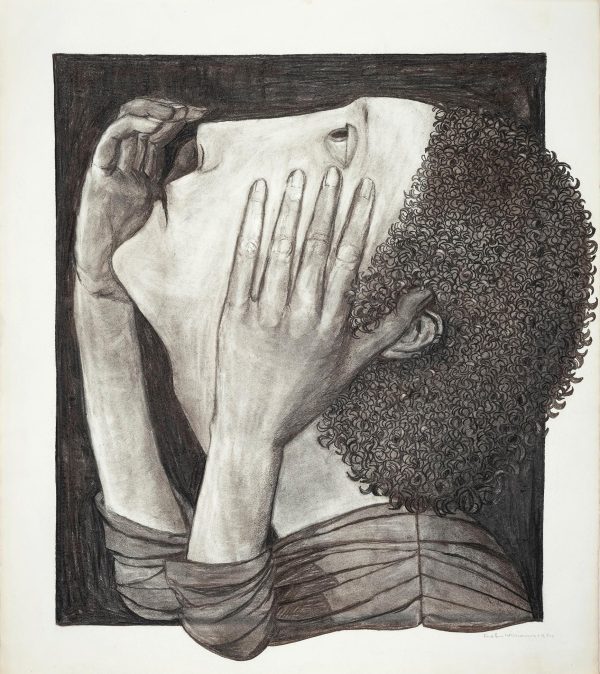
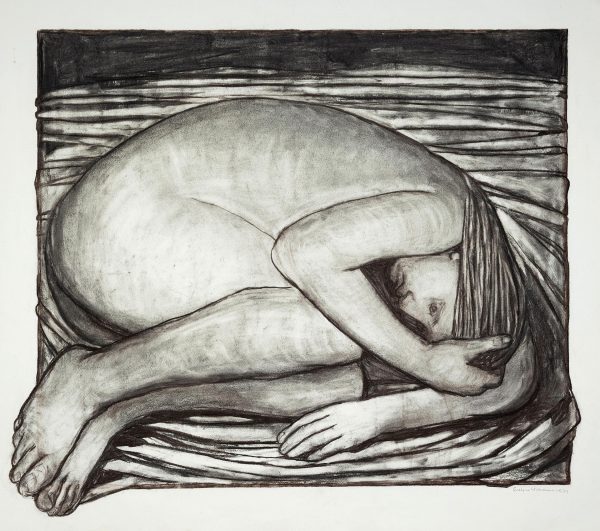
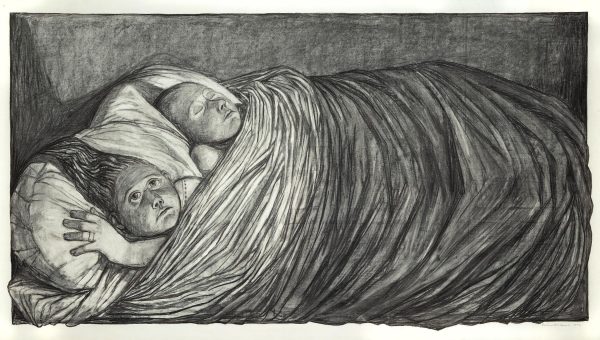
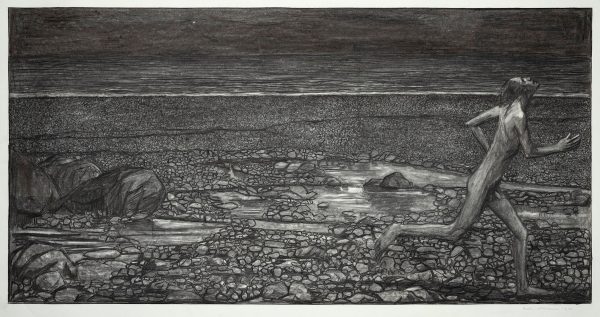
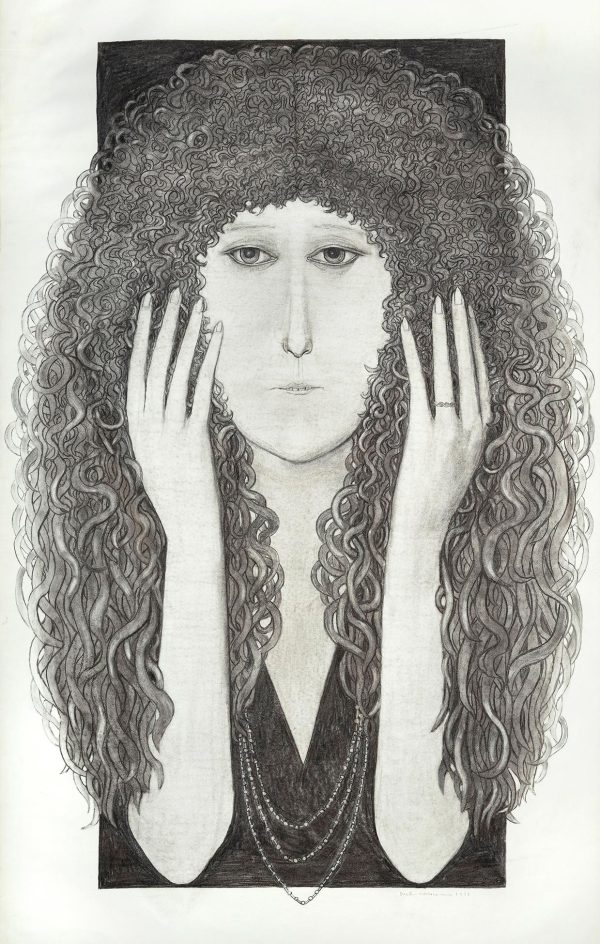
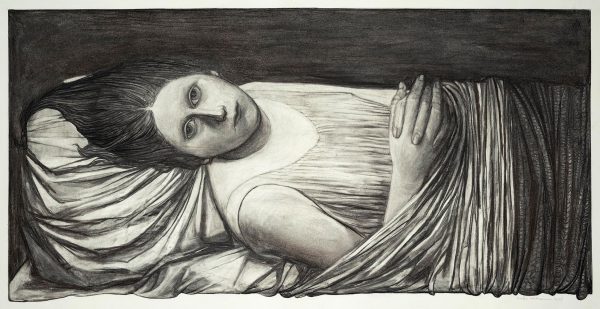
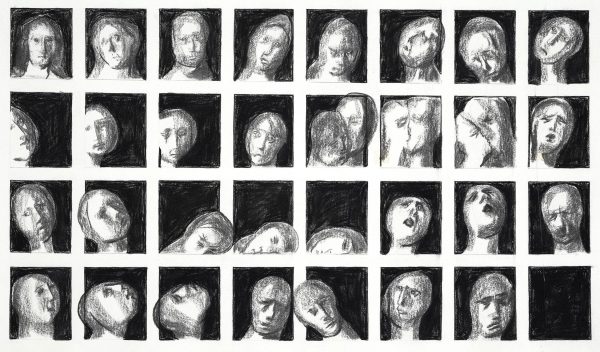
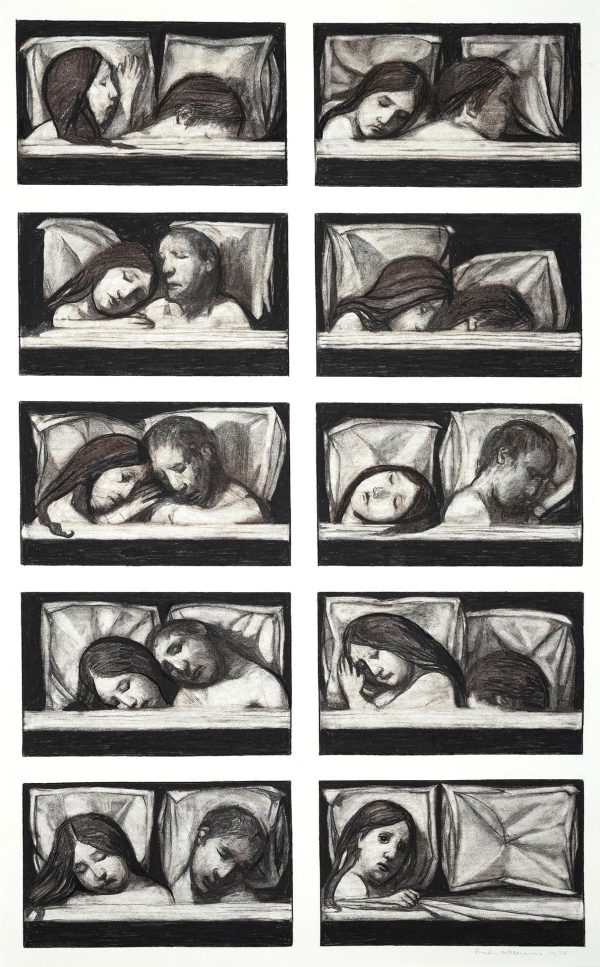
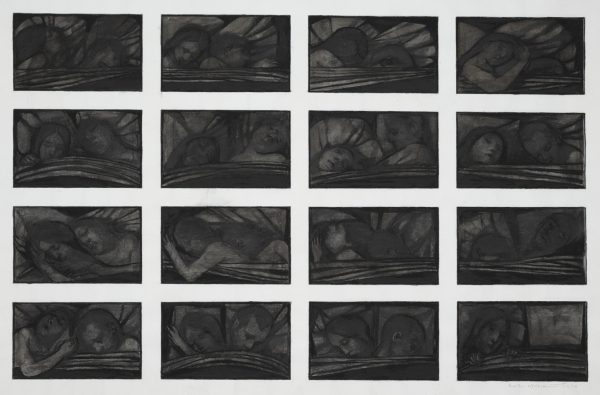
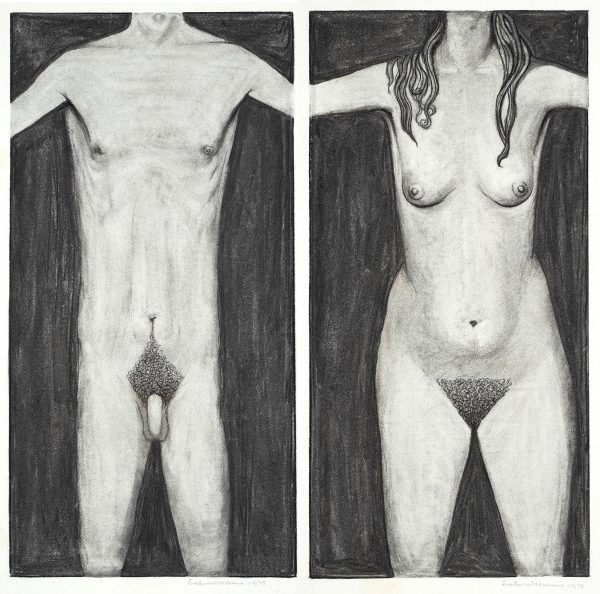
This exhibition of Evelyn Williams’ large drawings follows our 2008 exhibition of her paintings. It has been organised in collaboration with the Evelyn Williams Trust who are responsible for the care of Williams’ work but who also have a mandate to promote the Arts more generally. Their charitable work includes an annual ‘Evelyn Williams Drawing Award’, given as part of the renowned Trinity Buoy Wharf Drawing Prize.
EVELYN WILLIAMS (1929-2012)
Evelyn (Evie) Williams (1929–2012) was one of Britain’s most singular post-war artists, producing an extraordinary body of paintings, drawings and sculptures that explore vulnerability, endurance and the emotional complexities of the human condition. Her work draws on mythology, religion, medieval imagery and deeply personal experiences to create a visual language that is symbolic and psychological.
The emotional intensity of Williams’ work is inseparable from her childhood. Born in London, she was the second daughter of Jenny Williams, an opera singer, and Brendan Williams, a radical writer. Jenny had hoped for a son, and Evelyn’s difficult birth contributed to their strained relationship. From an early age, Evelyn was cared for by a local girl while Jenny pursued her singing career.
At the age of two and a half she was sent to Summerhill School, A. S. Neill’s experimental boarding school. While Summerhill’s progressive philosophy championed children’s freedom, equality and self-determination, its refusal to recognise the dependency of very young children left Williams with a profound sense of abandonment. She later recalled the experience as one of lasting loss, attending few classes and remaining largely silent until the age of four.
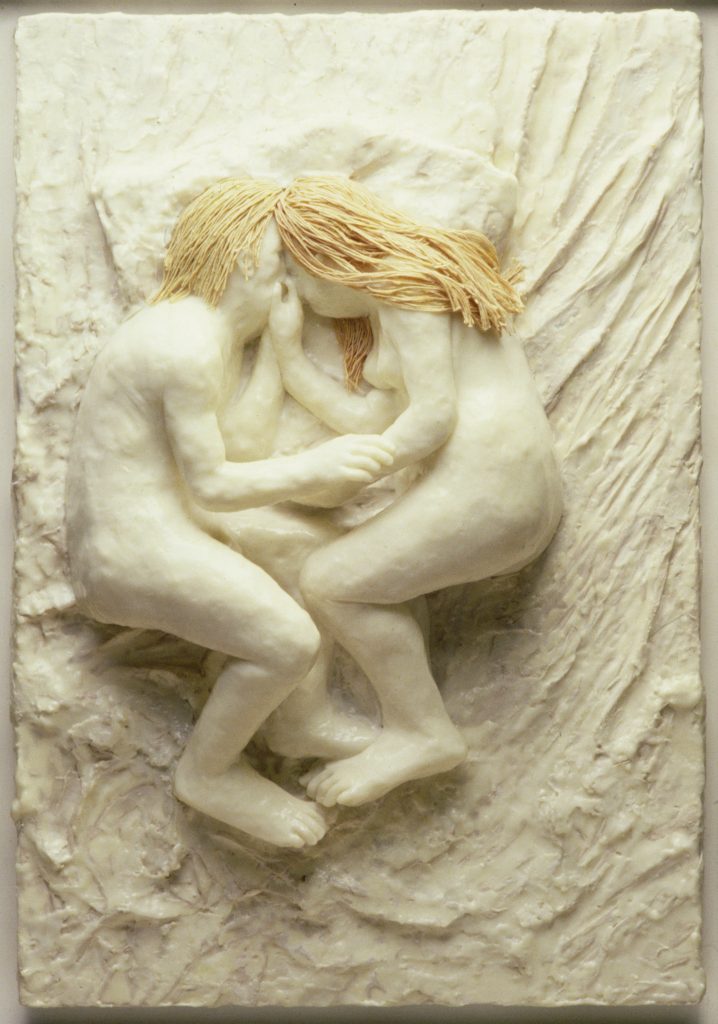
Williams entered St Martin’s School of Art in 1944 at the age of fifteen before studying at the Royal College of Art from 1947 to 1950, where she graduated with a First-Class Diploma and the E. Q. Henriques Prize for Drawing. Her painting Sick Child attracted widespread attention after surpassing works by established artists including Augustus John and Jacob Epstein in The Observer‘s exhibition of child portraits. From this, commissions for child portraits followed, including from the Rothschild family. However, Williams soon abandoned portraiture in favour of more personal and experimental three-dimensional works. She made reliefs in papier-mâché, and then turned to clay before moving on to wax and a modelling material sourced from Florence.
Williams forged an independent career at a time when the British art world was male-dominated. She disrupted expectations by winning the John Moores Sculpture Prize in 1961 with a papier-mâché work entered as a collage. A retrospective at the Whitechapel Gallery in 1973 confirmed her reputation, although critics often struggled to situate work. Throughout her career, Williams repeatedly expanded both the scale and ambition of her practice. Monumental reliefs shown at Riverside Studios in 1984 culminated in All Night Through (1984), now housed at Murray Edwards College, Cambridge, whose production permanently damaged her back. During the 1990s she had major exhibitions at the Graves Gallery, the Mead Gallery and Manchester Art Gallery.
Williams’ work has often been understood in relation to the sublime. Rather than the traditional idea of awe inspired by nature or the divine, her work locates the sublime within human experience. Her figures confront suffering, vulnerability and transformation, yet are equally defined by resilience, compassion and hope. Drawing on her own experiences of loss and emotional sensitivity, her drawings explore the complexities of what it means to be human.
“There is an uncertain land between what we call the real world and the other one, where we go to sleep. It’s a place where dangers hide seductively, where one could be struck forever”.
(Evelyn Williams)
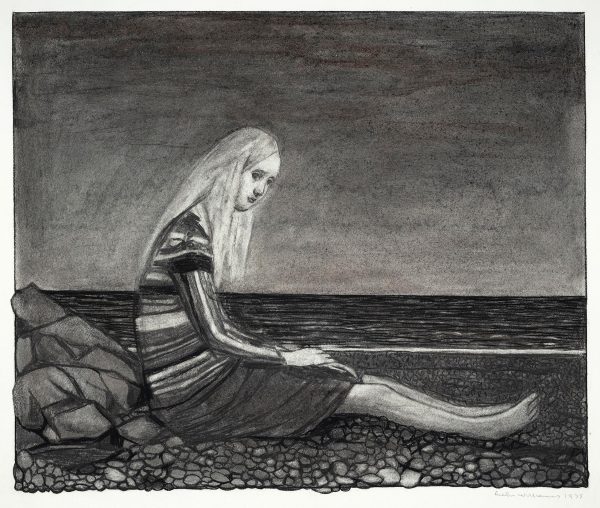
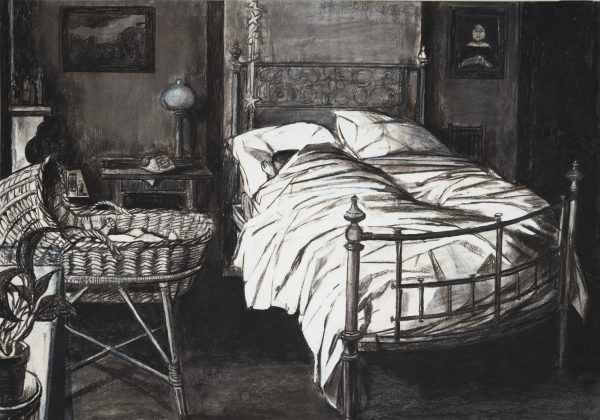
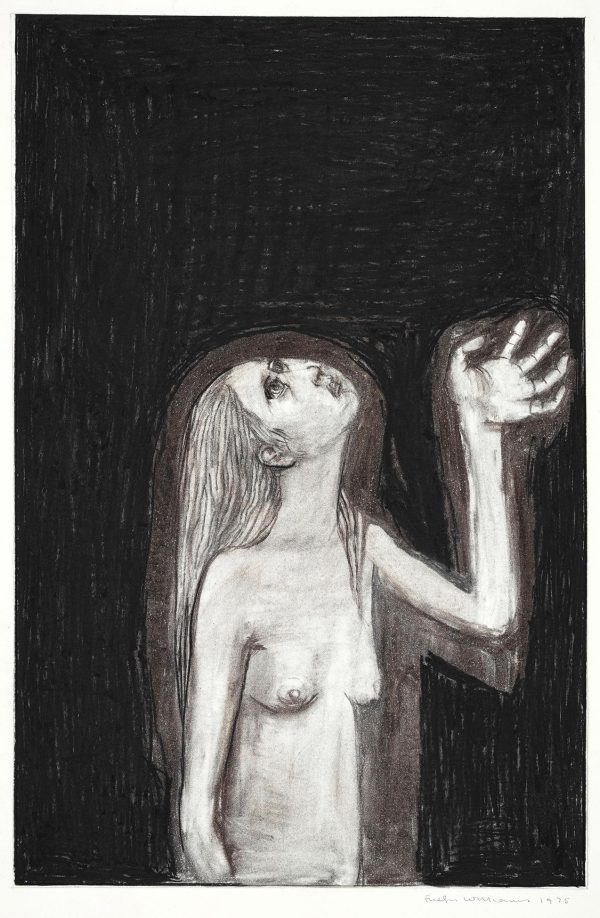
Evelyn Williams
Speech opening the inaugural Welsh Drawing Biennale in 1997
I often ask myself “What makes a good drawing good?” Many people much cleverer than me have tried to crack this one. I wrote once of its usefulness – “It can be an invaluable aid to memory, or to plan the construction of a work in any medium. Or a simple way to plug into the unconscious and introduce the humanity of man-made marks rather than those of a machine” I’ve discovered it’s not something easily learnt or taught. I know that before beginning a drawing, a leap of faith is necessary. And I believe that we need a very strong idea of what our intentions are, and why we are doing it.
When we draw, are we making a plan of intent, a map to guide us on a journey, a study of a detail to help out in a finished work? Is one looking at the surface of an object or trying to get to the very bones of it, or doodling – hoping it will all turn out right in the end? Is it a question of looking, or understanding? There must be a way of getting to the very essence of the tree or the person, of capturing its very aliveness, rather than just reproduce it, which a camera can do rather better than us.
I suspect that drawing is to do with tension, and making constant adjustments, one line from another. That is what drawing is. An ambition for a drawing would be of a force that builds as it travels across the surface of the paper, ending in an image that breaths. If it succeeds it is because of tension. If it fails it is because the line has become slack and when the line sags we are left with something that isn’t drawing – rather a vague shadow of what it might have been.
I believe objects, a flower, a portrait, contains a truth wrapped around by its appearance, and that what you see isn’t necessarily the truth at all. There are veils behind which there are more layers, more to discover, perhaps something quite different, and behind the layers, the kernel of the subject Only by stripping them away can the centre be discovered and the outside doesn’t describe that at all. Somehow we have to get rid of the clutter that nature presents us with – the irrelevancies – to stop thinking because it’s there it must be true – but to keep our eye on the idea, because it is the idea that is our humble, human contribution – our offering. So, If we could get back to the child in us and find that blind, unquestioning courage that children have, where there are no hesitations, where each mark follows the first, dictated by the logic of the drawing, where there are no fudges, no doubts. They see the world with a great clarity, whereas our eyes are so fatigued with looking we are losing the ability to see at all – we are being bombarded with images from all sides and now have to get back to seeing things absolutely straight – as a child does.
Good drawings, as presented to us by the old and the modern masters, are a constant inspiration, a guide to real quality, to truthfulness, an imaginative record of how man regards himself and his surroundings.
We are here to celebrate drawing and we are united in our appreciation of it. I do firmly believe that when the last man alive is sitting somewhere in a desert he’ll find a stick and draw a wonderful image in the sand.
As long as we continue to draw, that strange process that starts in the eye, through the brain, and down the arm to spill out of our fingertips, we can claim to have tried honourably to make some sense of the world we live in.
Evelyn Williams, 1997