
FLYING OFFICER PERCY DRAKE BROOKSHAW (1907-1993)
The R&R of an WWII RAF Aerial Photography Interpreter
Tunisia and Puglia, September 1943 – July 1944
These records of the seemingly charmed world of Pugliese wartime Rest and Recuperation must be considered in context. The Allies were forcing their way up Italy. It was the time of Monte Cassino and Anzio. Flying Officer Brookshaw’s daily work as an interpreter of aerial photographs, of which we get no hint, was crucial to that Advance. Consider the off-duty hours of soldiers and bear in mind the extreme contrast between the Front Line and life often only just behind it. Sunbathing, reading, letter writing (and painting) were the kind of things millions of families at home must have been wishing their combatant men were doing and, sometimes, they were. His image of his wife and baby son (p.1) at the end of a long, fragmented and dark tunnel is a reminder of what these men themselves were often thinking and feeling.
Brookshaw’s route to the interpretation of Aerial Photography was interesting and typical. Trained at the Central School of Arts and Crafts under John Farleigh (1900-1965), he specialised in Graphic Art and Illustration, in particular Poster Design. During the Thirties his illustrations were to be found in the ‘Radio Times’, the ‘Daily Mail’ and the ‘Sunday Express’ and, from 1928, he began a thirty-year series of posters for London Underground. In 1941 he joined the RAF and was trained as an Air Gunner however his training in the Arts decided his next postings. First, he was allotted the task of designing and supervising the camouflage of much bombed Manston Airbase in Kent and then he was then trained as a Central Interpretation Unit (‘CIU’) Air Photography Interpreter. As part of the Italian Campaign in September 1943 he arrived in Tunisia that month to join the North African Photo Reconnaissance Wing (‘NAPRW’) with which he moved to San Severo in Puglia on 9th December 1943. ‘NAPRW’ became ‘MAPRW’ (Mediterranean Allied Photo Reconnaissance Wing early in 1944. It was of paramount importance that aerial photographs could be processed and understood on the spot.
These Collages, Watercolours and Drawings were contained in a single album and are shown in sequence.
For further reading on WWII Aerial Photography Interpretation visit the NCAP website.
 Cover: ‘Self, San S. (San Severo), March (19)44’. Ink and watercolour. Signed, inscribed and dated. 12.5x16.5 inches. £575.See Verso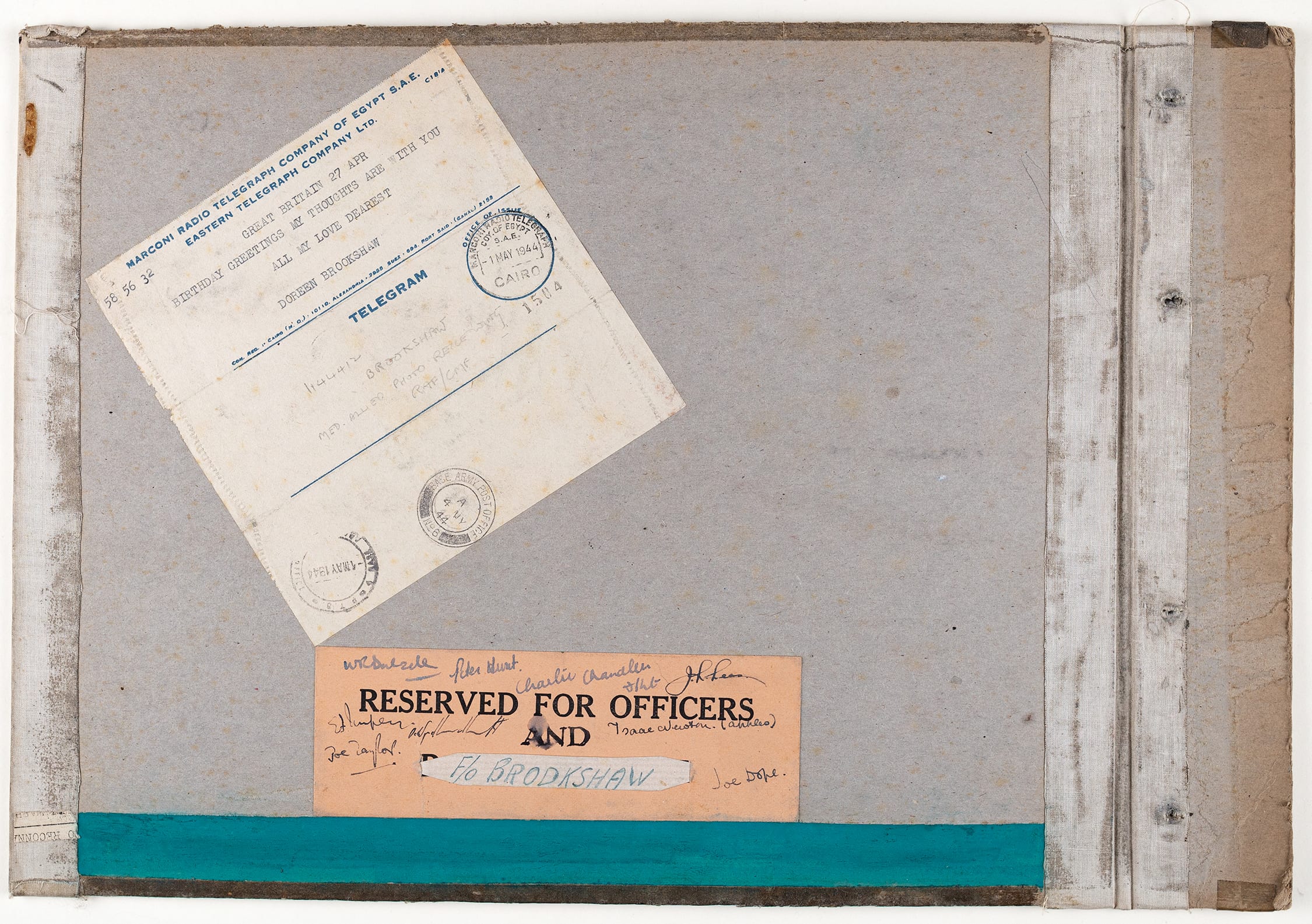
●
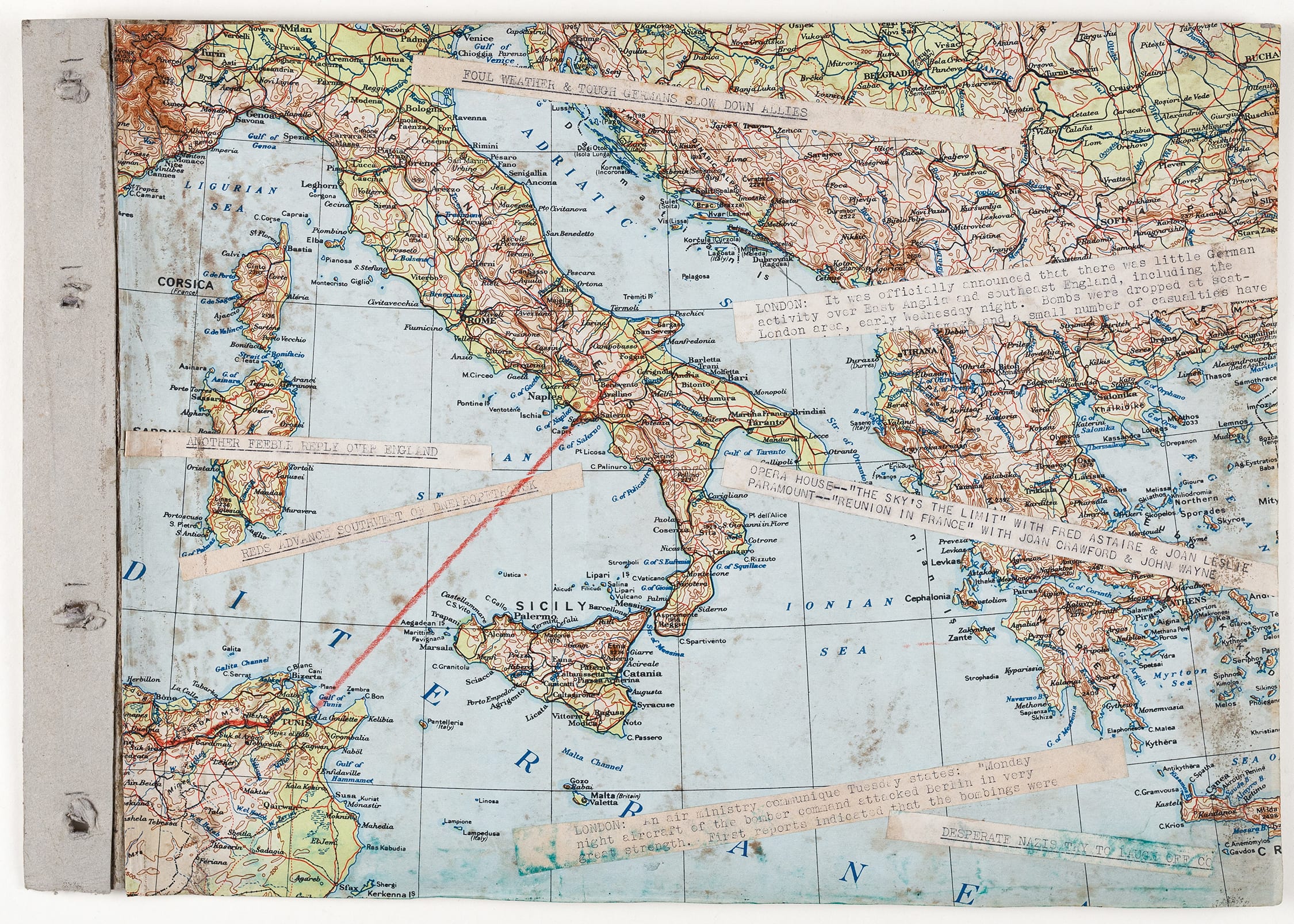 P.1 recto: Partial map of Tunisia and Italy with red crayon line marking Brookshaw’s journey by land and air from Tunis to San Severo, Puglia, Italy. Collage: 6 texts about the state of the War and ‘Opera House – “The Sky’s the Limit” with Fred Astaire and Joan Leslie. Paramount - “Reunion in France” with Joan Crawford and John Wayne’. The Opera House and ‘Paramount’ were in San Severo. A continuation of the map on the Inside Cover of Album 1. 12.5x16.5 inches. £475.See Verso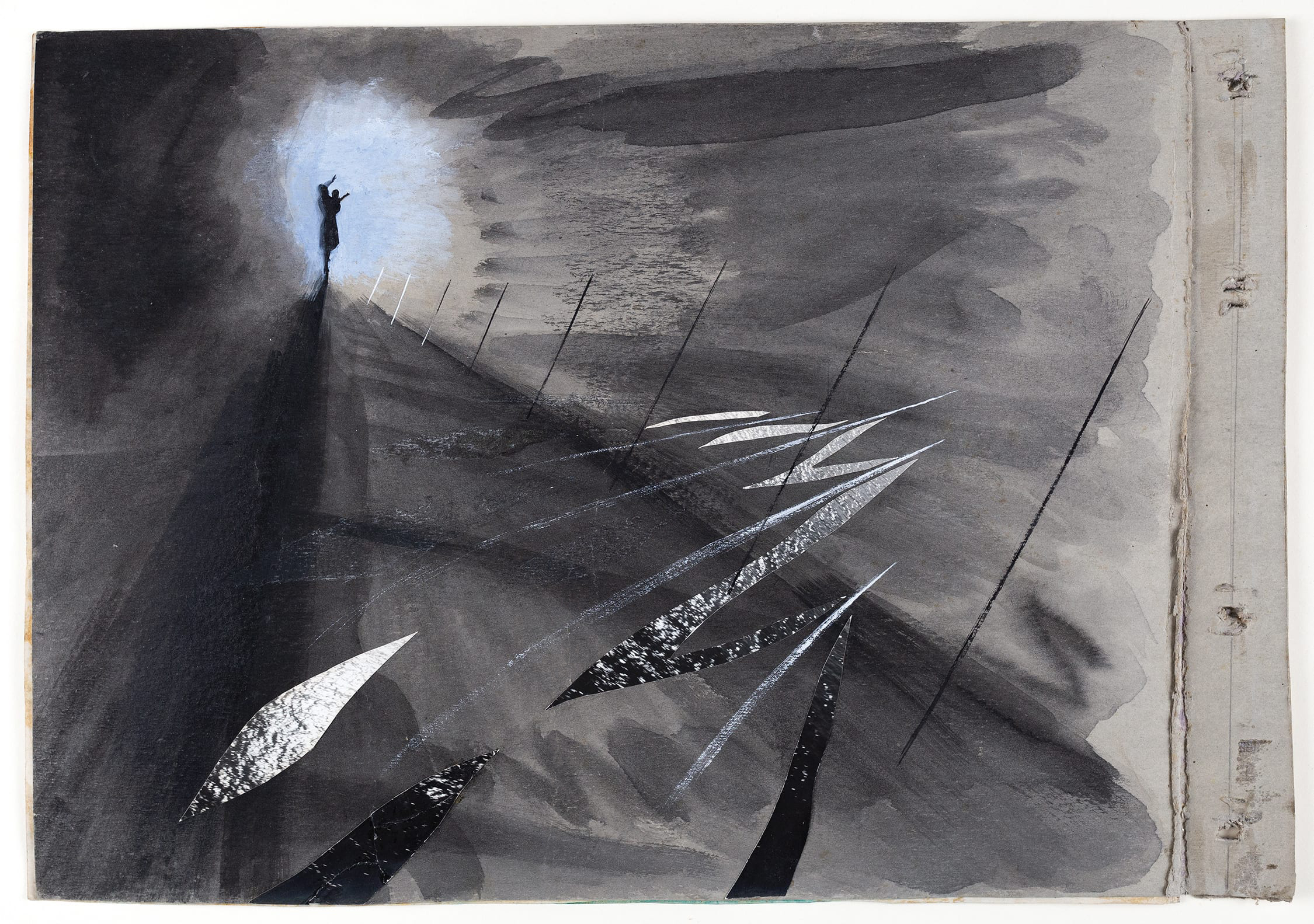
●
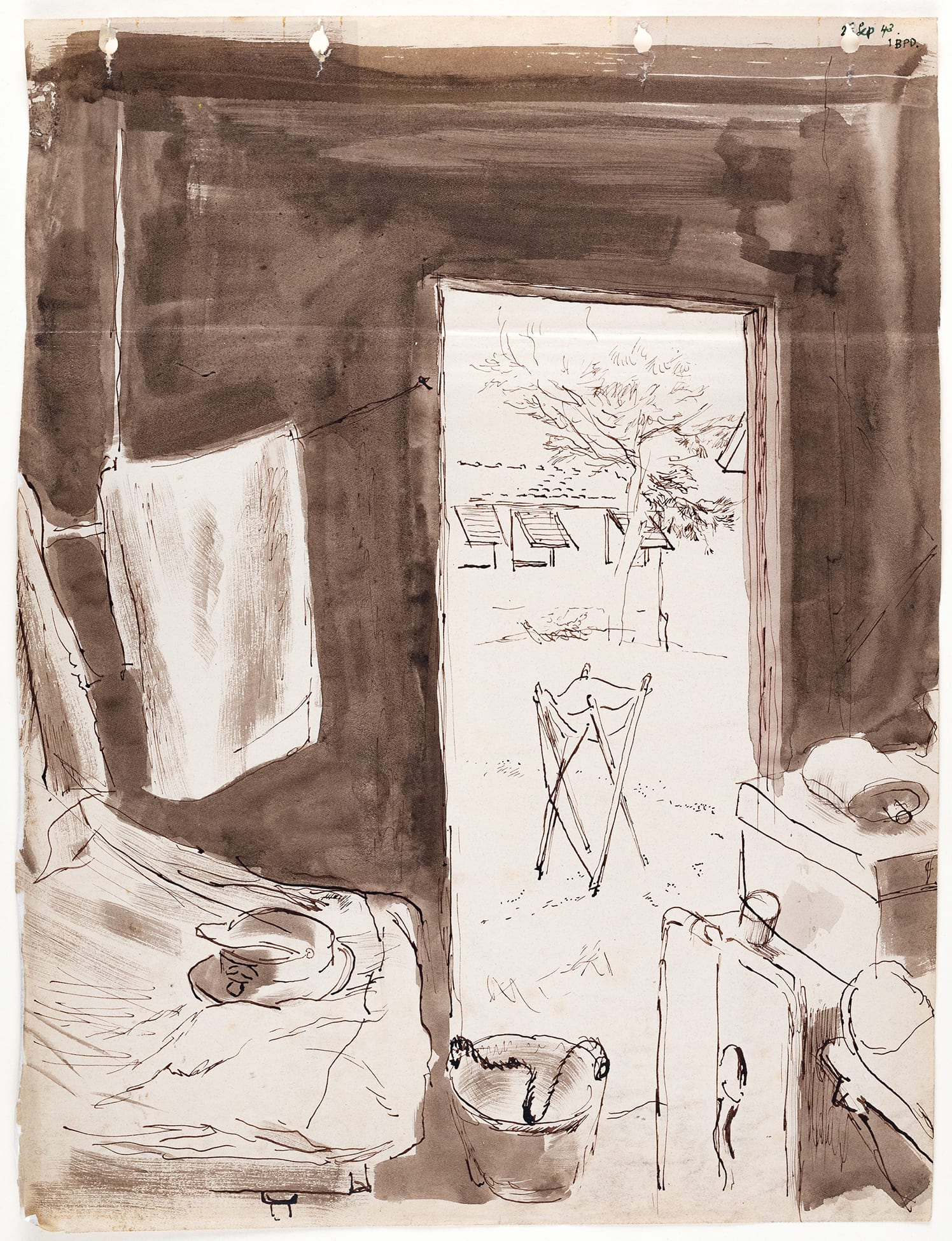 P.2: View from Brookshaw’s Hut, Tunisia. Dated ‘2? Sep.43’, 1943. Pen, brush and ink. 12.5x16.5 inches. £375.
 P.5: ‘Fort de l’eau’, Tunisia. 1943. Pen, brush, ink and watercolour. 12.5x16.5 inches. £575.
●
 P.7: View from Brookshaw’s tent, Tunisia. 1943. Pen, brush, ink and watercolour. 12.5x16.5 inches. £475.
●
 P.10: Writing by ‘Four Gun light’, ‘La Marsa’, Tunisia. 1943. Pen, brush and ink. Inscribed. 12.5x16.5 inches. £575.
●
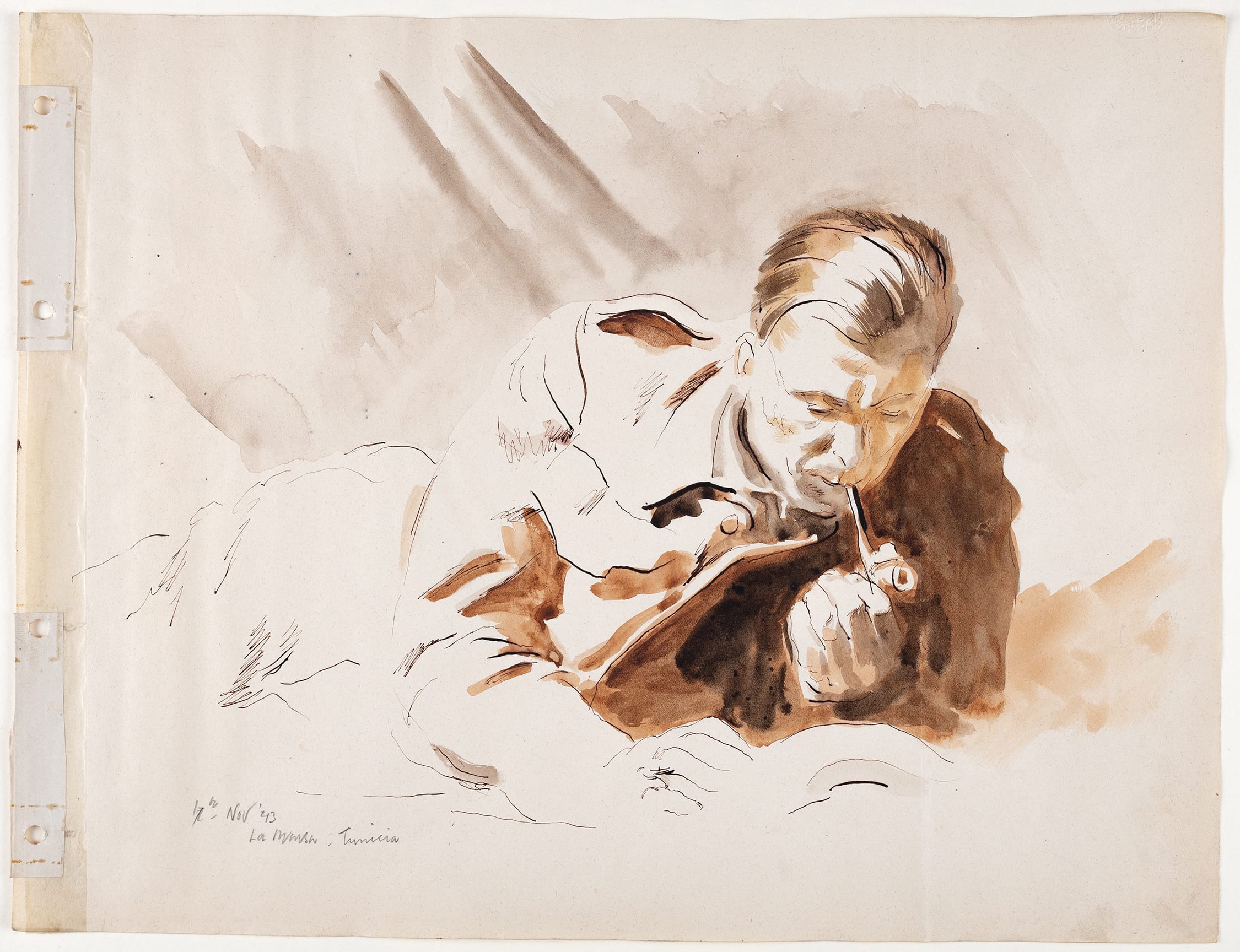 P.11: Smoking and reading, ‘La Marsa, Tunisia’. Pen, brush and ink. Inscribed and dated ‘17th November (19)43’. 12.5x16.5 inches. £475.
●
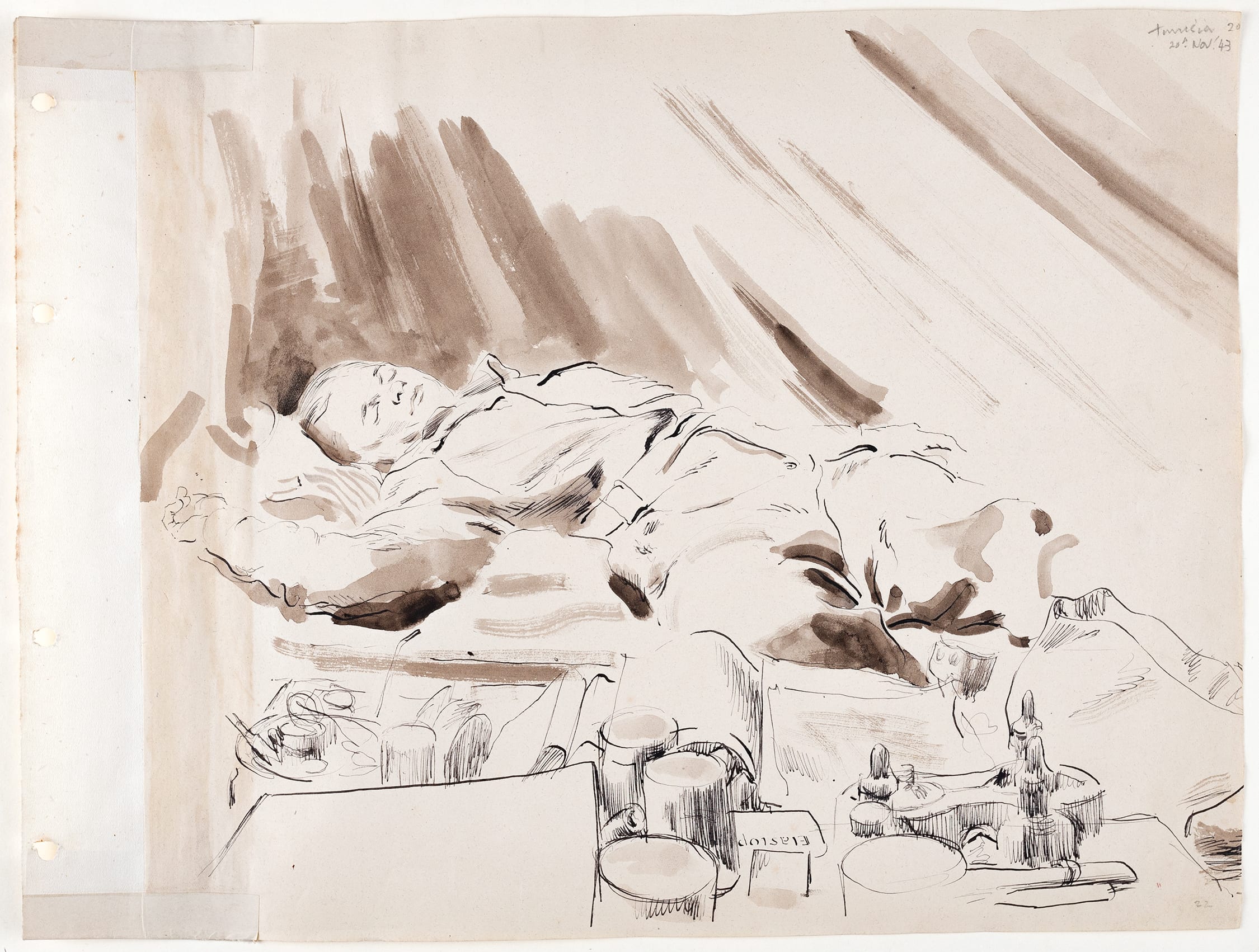 P.12: Sleeping Officer, ‘Tunisia’. Pen, brush and ink. Inscribed and dated ‘20th November (19)43’. 12.5x16.5 inches. £475.
●
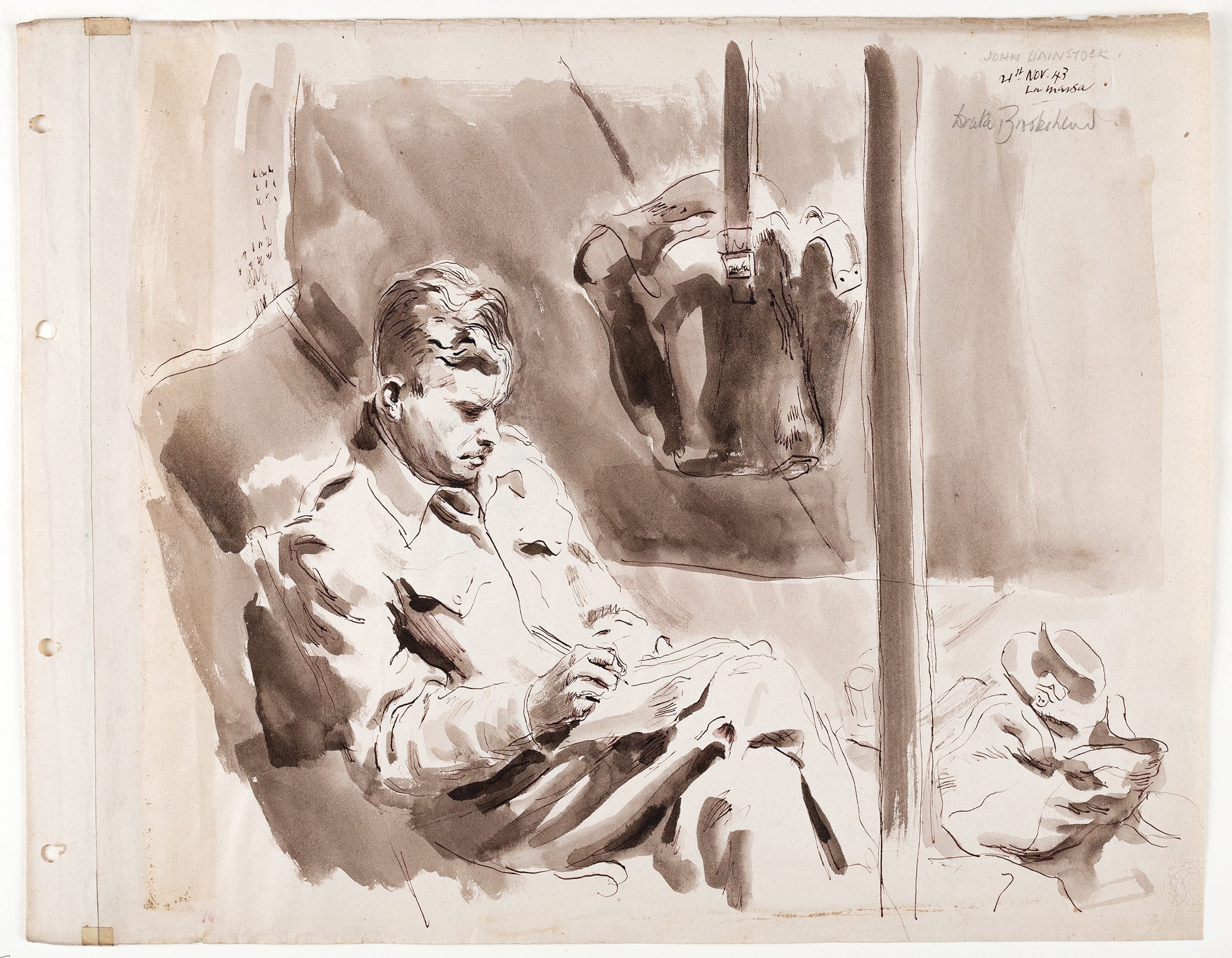 P.14: ‘John Hainstock, La Marsa’, Tunisia. Pen, brush and ink. Signed, inscribed and dated ‘21st November, (19)43’. 12.5x16.5 inches. £475.
●
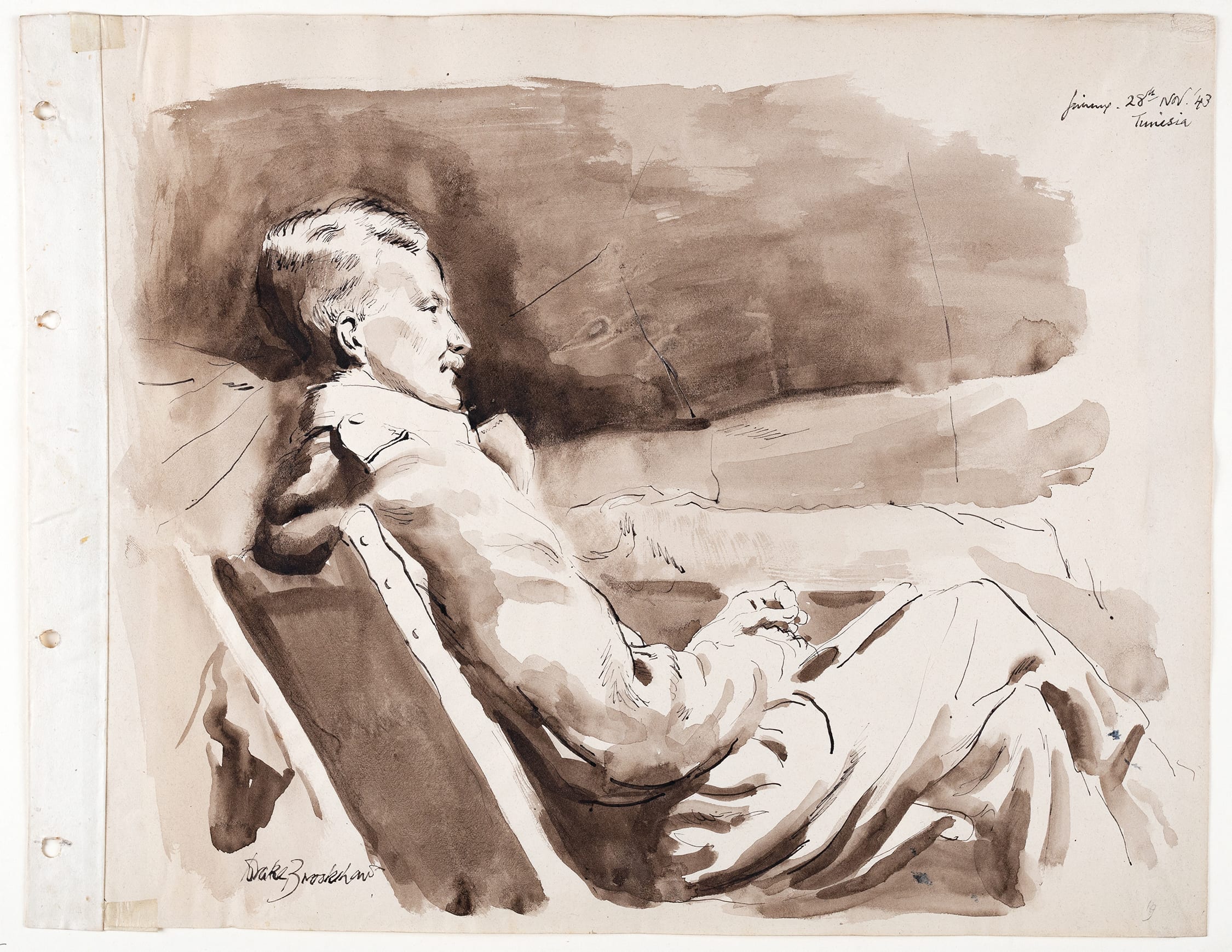 P.15: ‘(Jimmy?) Tunisia’. Pen, brush and ink. Signed, indistinctly inscribed and dated ‘28th November (19)43’. 12.5x16.5 inches. £475.
●
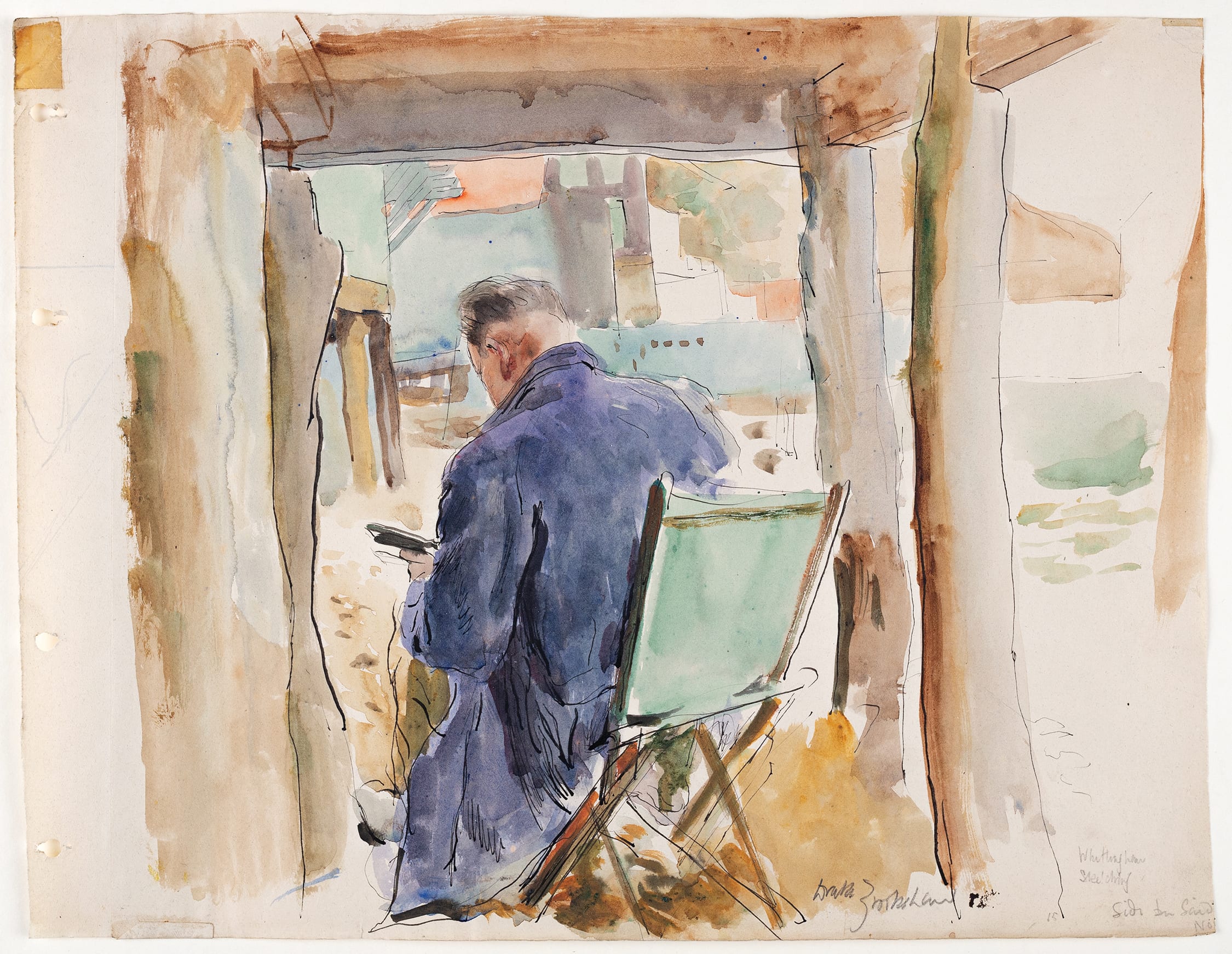 P.16: ‘Whitlingham sketching, Sidi bu Said’ (sic). Tunisia, 1943. Pen, brush, ink and watercolour. Signed and inscribed. 12.5x16.5 inches. £475.
●
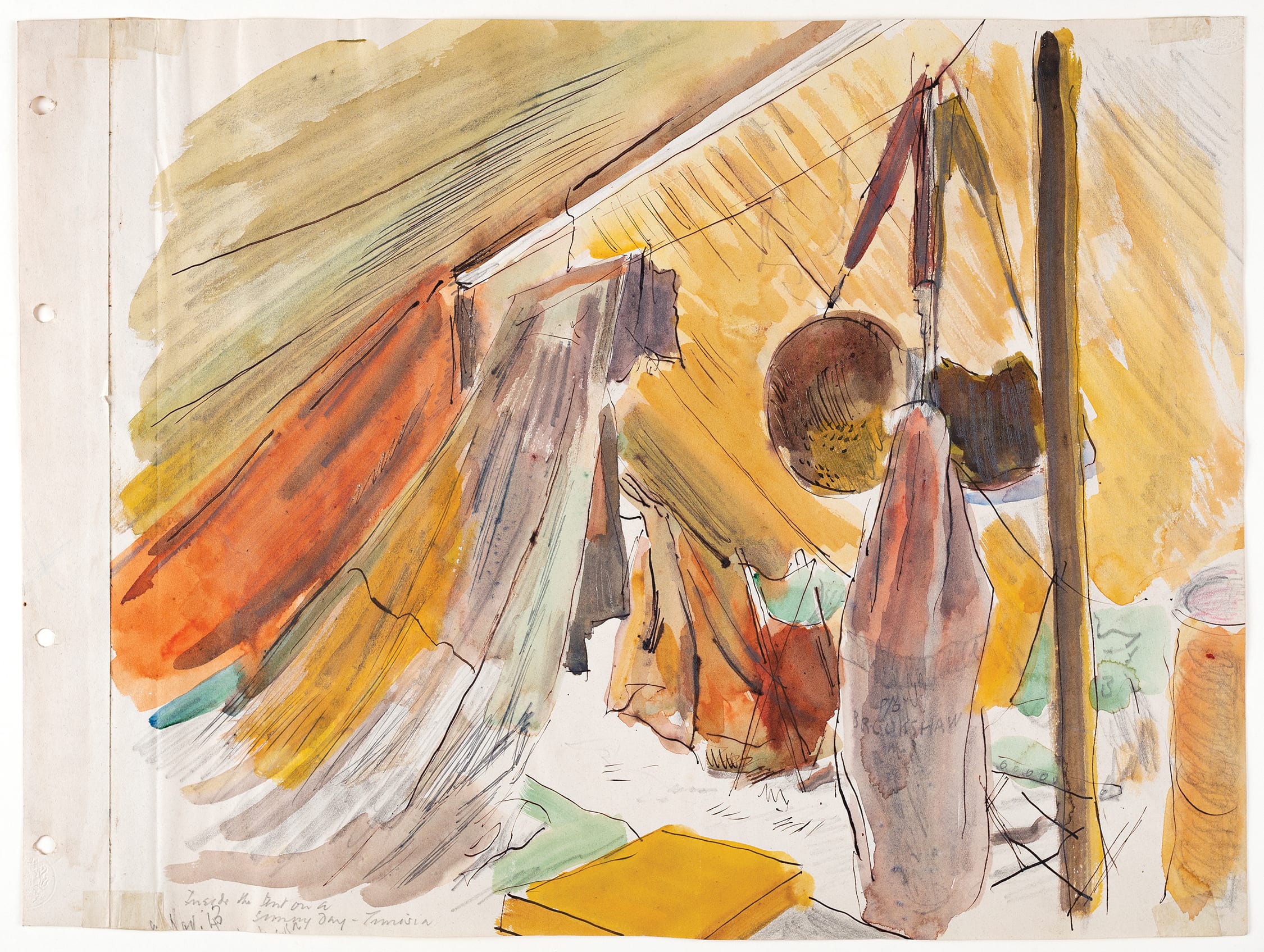 P.18: ‘Inside the tent on a sunny day / Tunisia’. Pen, brush, ink and watercolour. Signed. Inscribed and dated, ‘Nov. (19)43’. 12.5x16.5 inches. £575.
●
 P.19 recto: ‘Good bye N.A. / off at 09.40, 9.12.(19)43’. Collage of aerial photo (?Tunis) photos, newspaper, brush, ink and watercolour. Also inscribed ‘Down at 11.40 after a lunch of bread, butter, hard boiled egg and an orange’ at San Severo, Puglia. 12.5x16.5 inches. £475.See Verso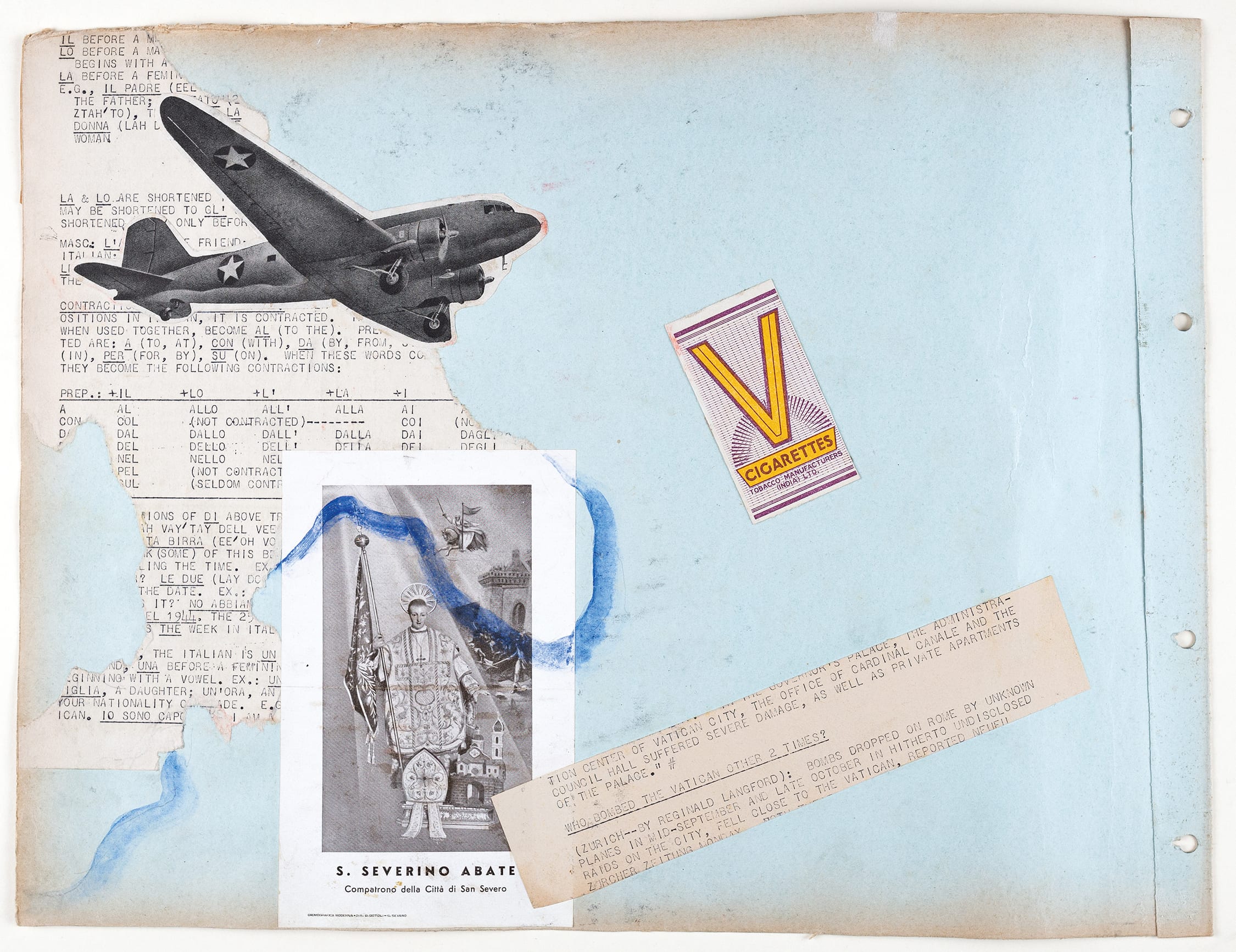
●
 P.20 Verso: ‘Sigarette / Vermouth / Signorino’.1943/44. Watercolour and ink with collage of Mussolini. Extensively inscribed. 12.5x16.5 inches. £375.
●
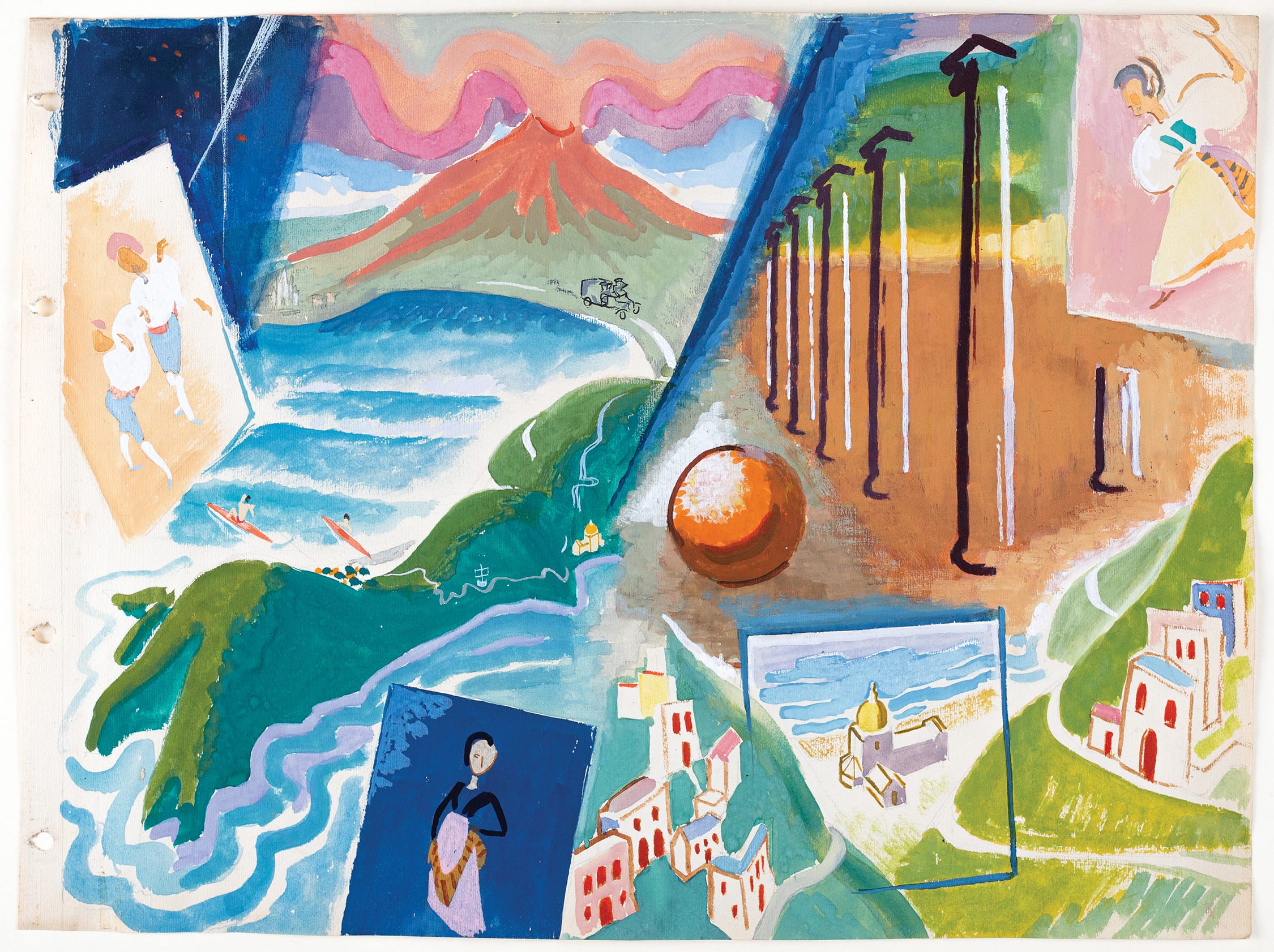 P.21: The Bay of Naples. 1943/44. Gouache. 12.5x16.5 inches. £375.
●
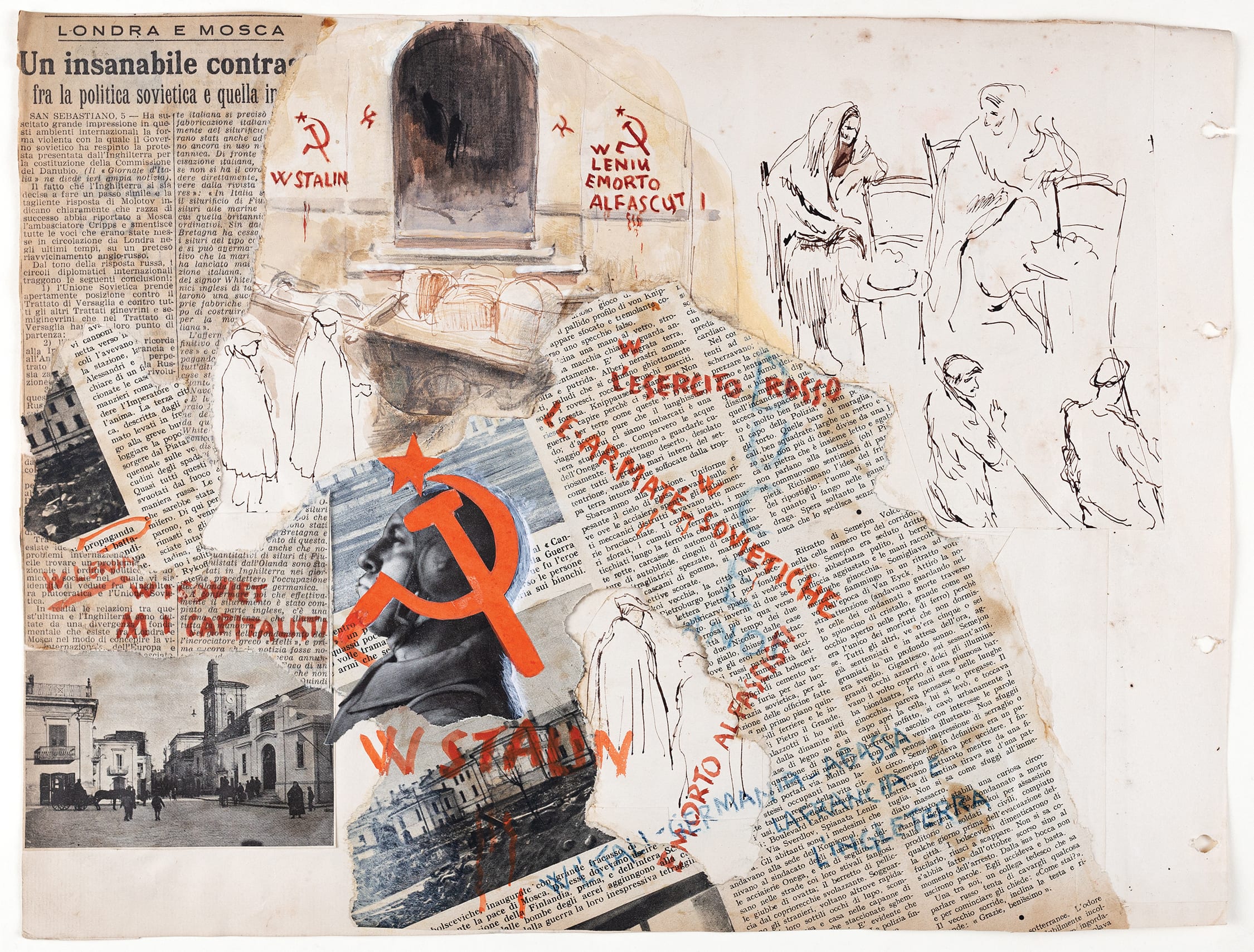 P.23 verso: Collage with newspaper, Communist graffiti, pen, ink and watercolour. San Severo, 1943. 12.5x16.5 inches. £375.
●
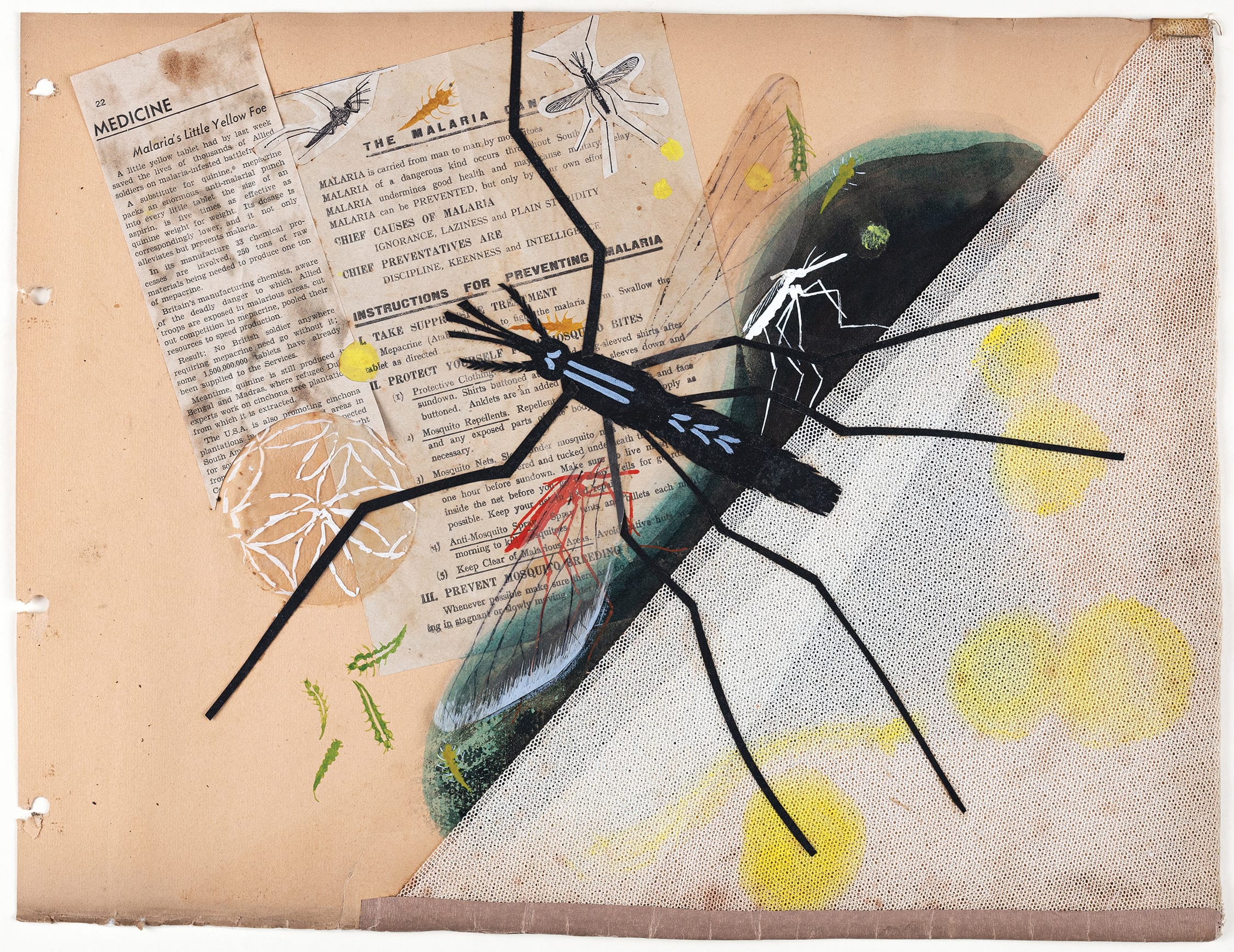 P.25: The Danger of Malaria: collage of documents, netting and gouache. San Severo, 1943. 12.5x16.5 inches. £375.
●
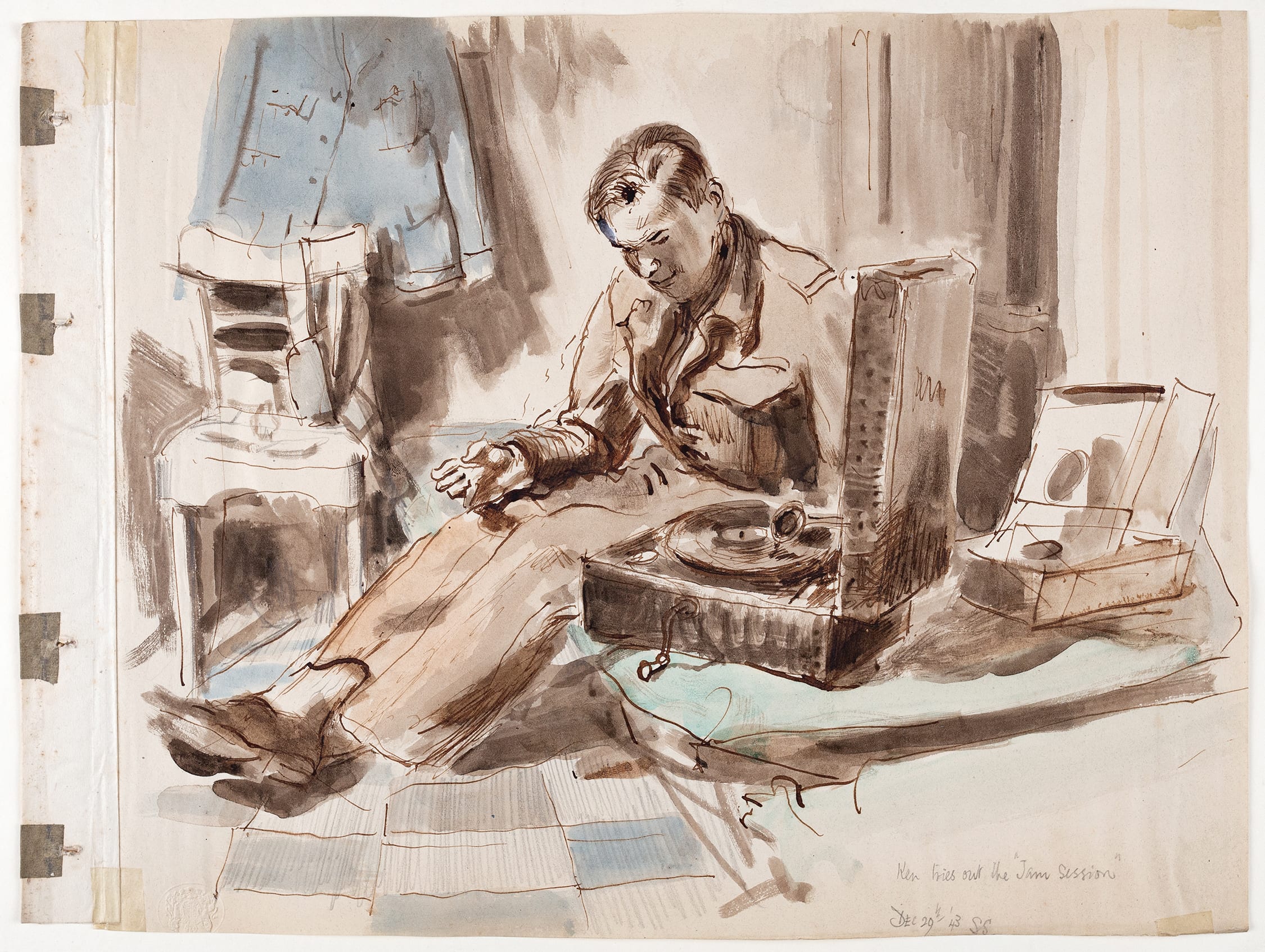 P.27: ‘Ken tries out the ‘Jam Session’. Pencil, pen, brush, ink and watercolour. Inscribed and dated, ‘Dec.29th (19)43, S.S.’ (San Severo). 12.5x16.5 inches. £475.
●
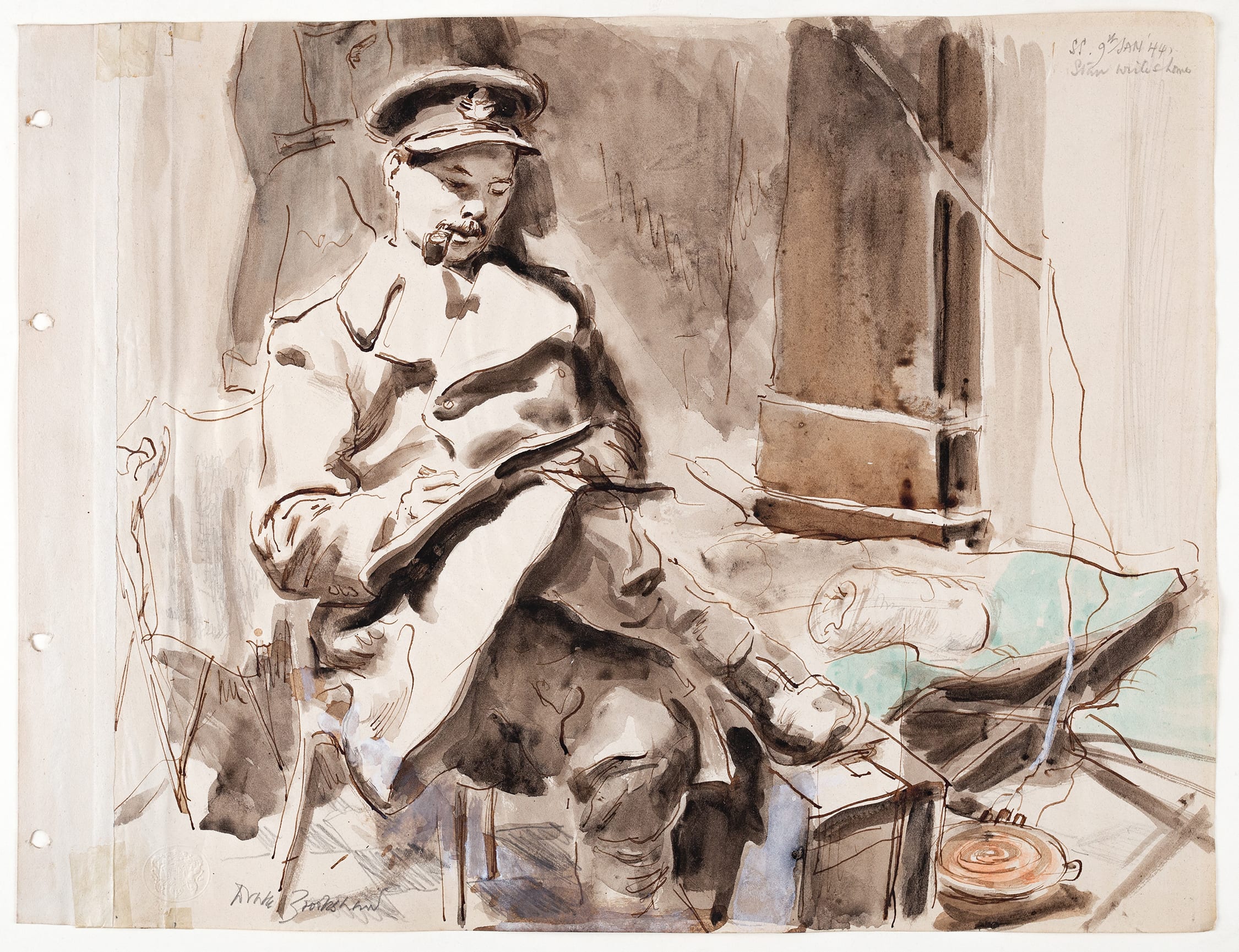 P.28: ‘Stan writes home’. Pencil, pen, brush, ink and watercolour. Signed. Inscribed and dated, ‘9th Jan.(19)44, S.S.‘ ( San Severo). 12.5x16.5 inches. £475.
●
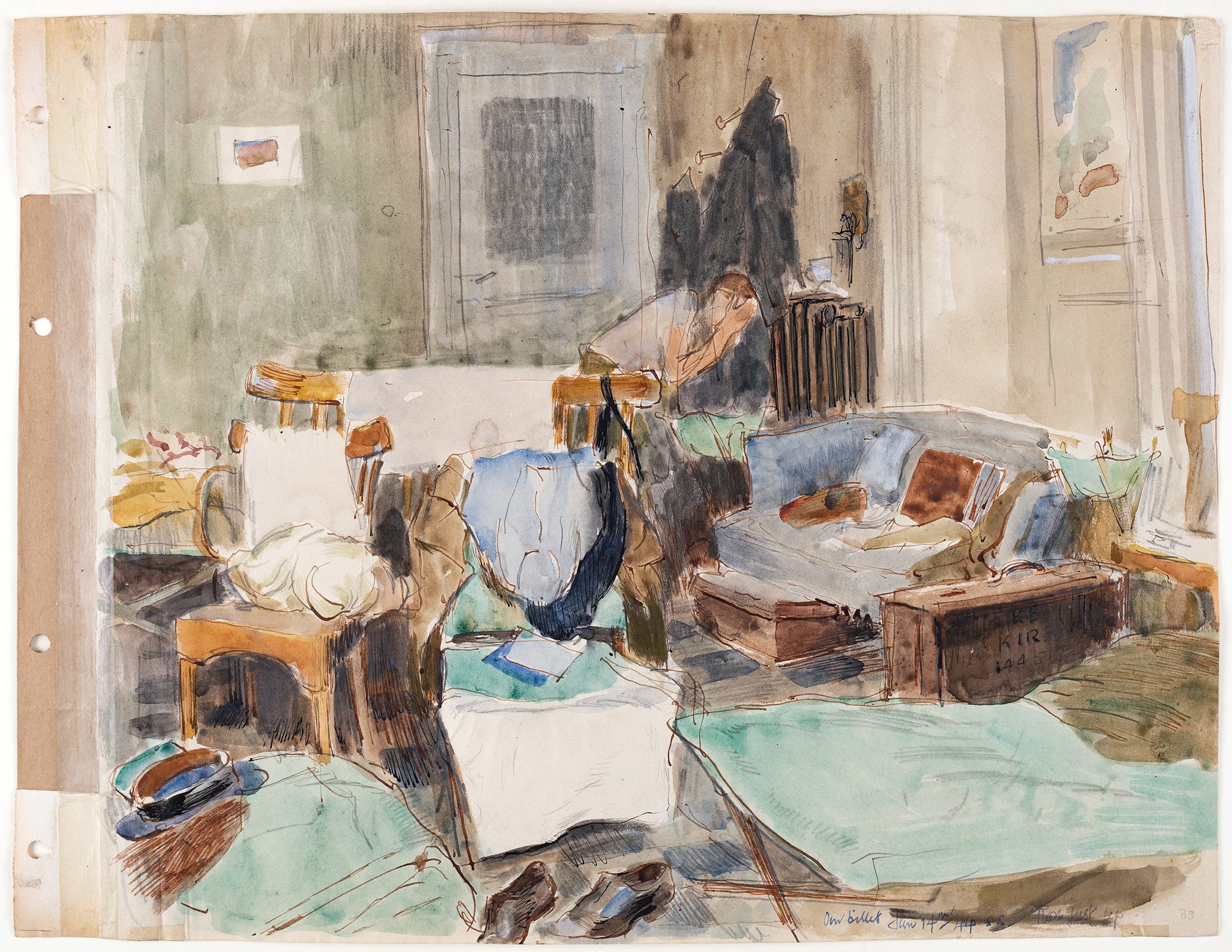 P.30: ‘Our billet – Ron just up’. Pen, brush, ink and watercolour. Inscribed and dated, ‘Jan.14th (19)44, S.S.’ (San Severo). 12.5x16.5 inches. £575.
●
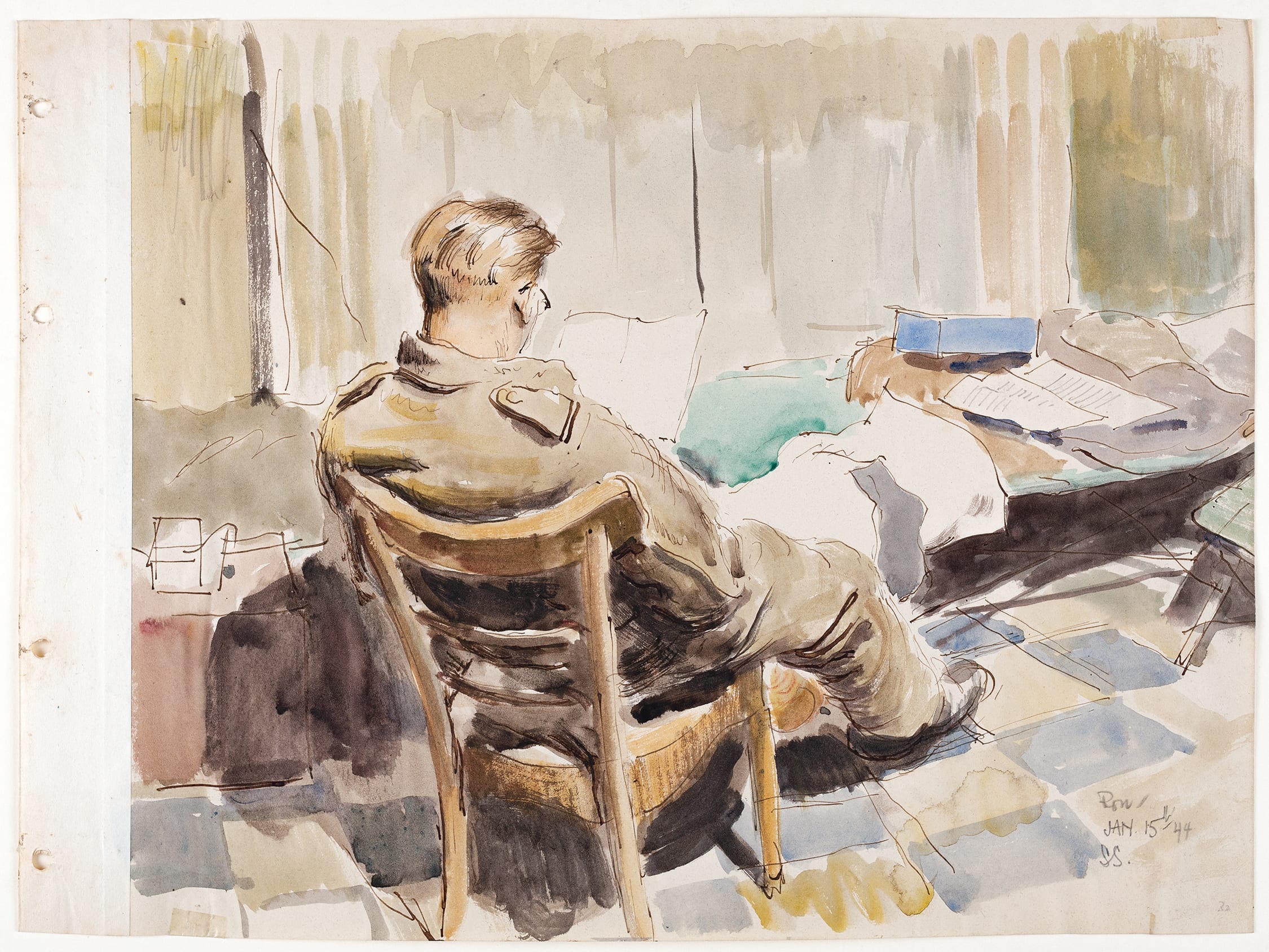 P.31: ‘Ron’ reading. Pen, brush, ink and watercolour. Inscribed and dated ‘Jan.15th (19)44, S.S.’ (San Severo). 12.5x16.5 inches. £575.
●
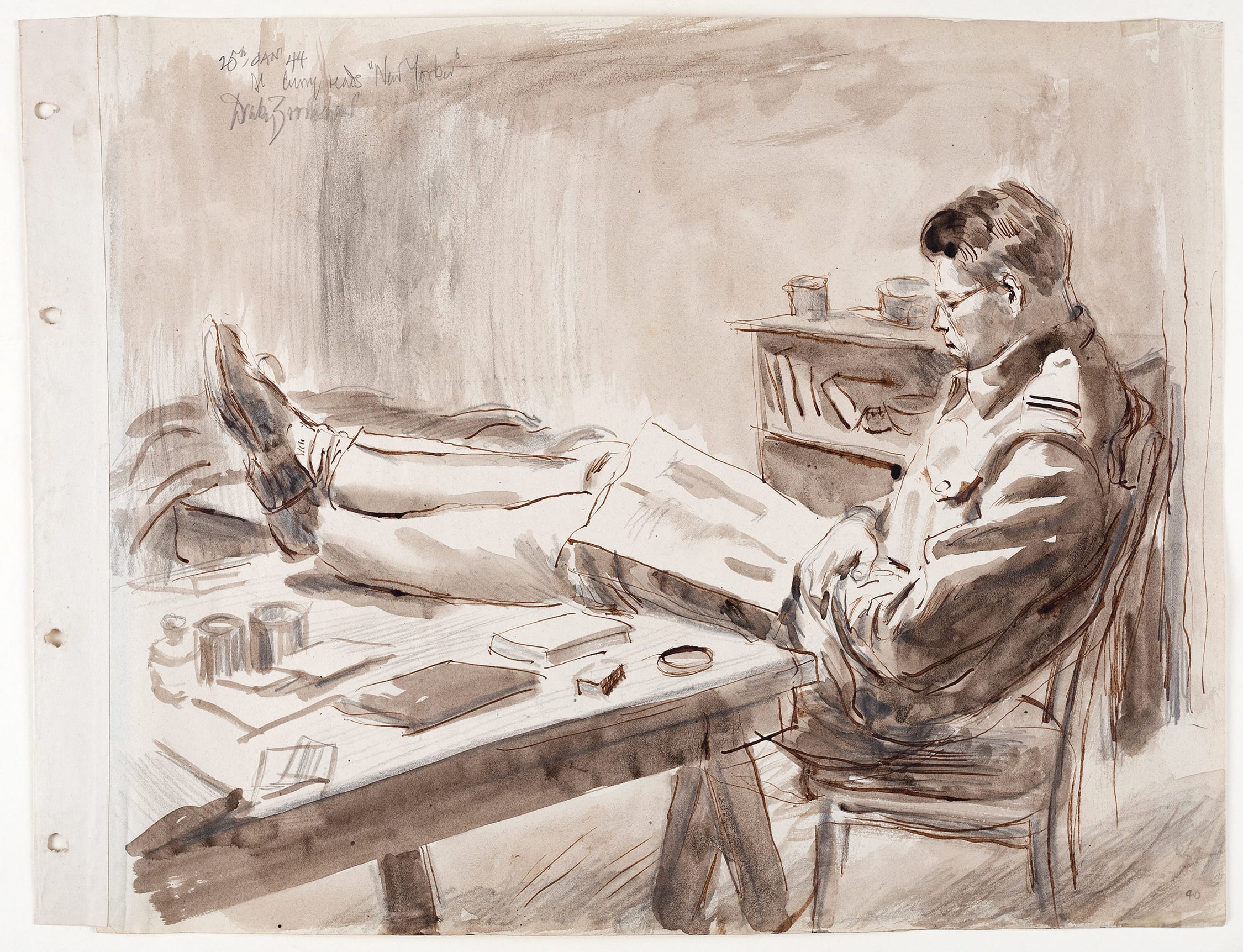 P.32: ‘…Curry reads ‘New Yorker’. San Severo. Pencil, pen, brush and ink. Signed, inscribed and dated, ‘25th Jan. (19)44. 12.5x16.5 inches. £475.
●
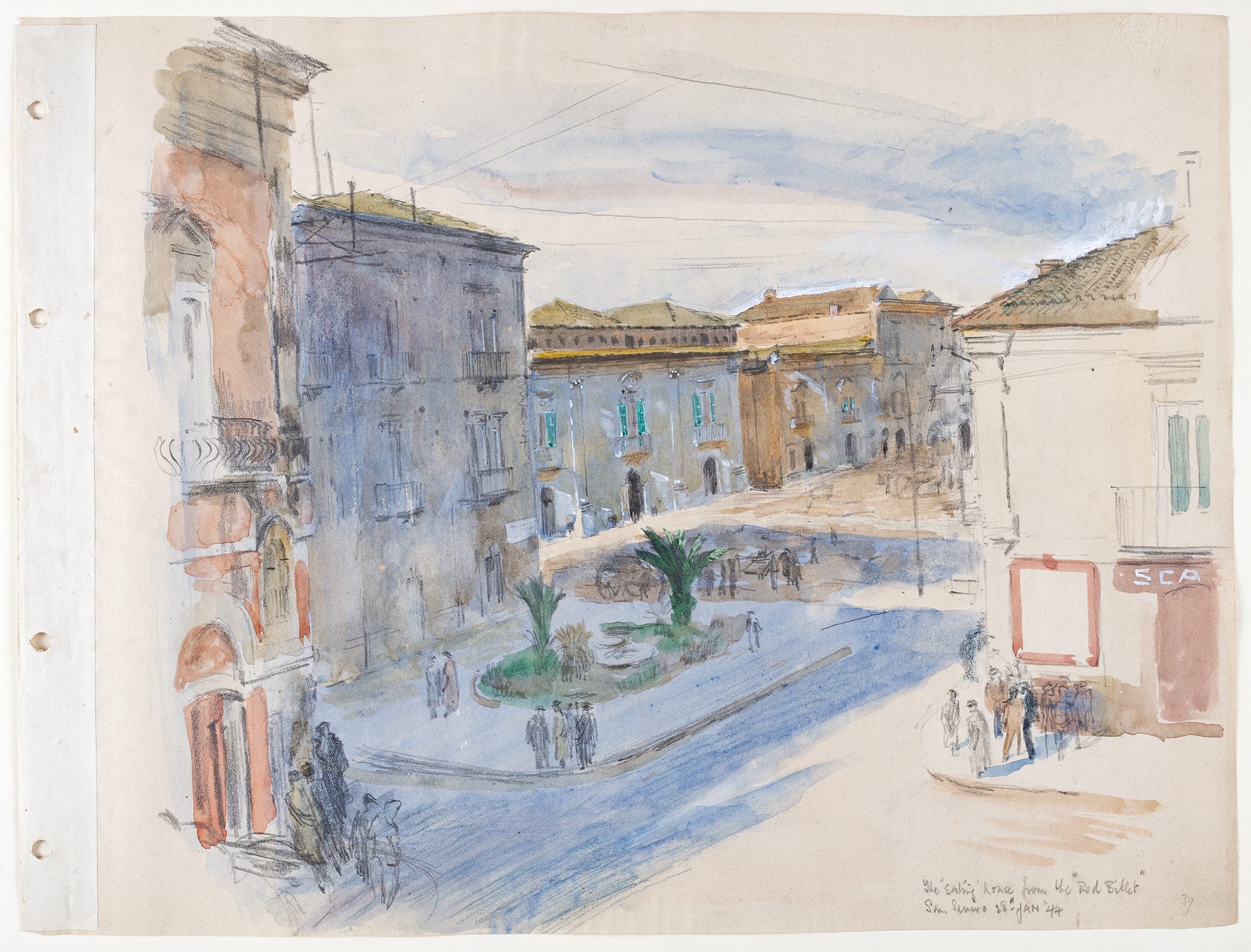 P.33: ‘The ‘Eating’ house from the ‘Red Billet, San Severo’. Pencil, brush, watercolour and gouache. Inscribed and dated, ‘28th Jan (19)44’. 12.5x16.5 inches. £375.
●
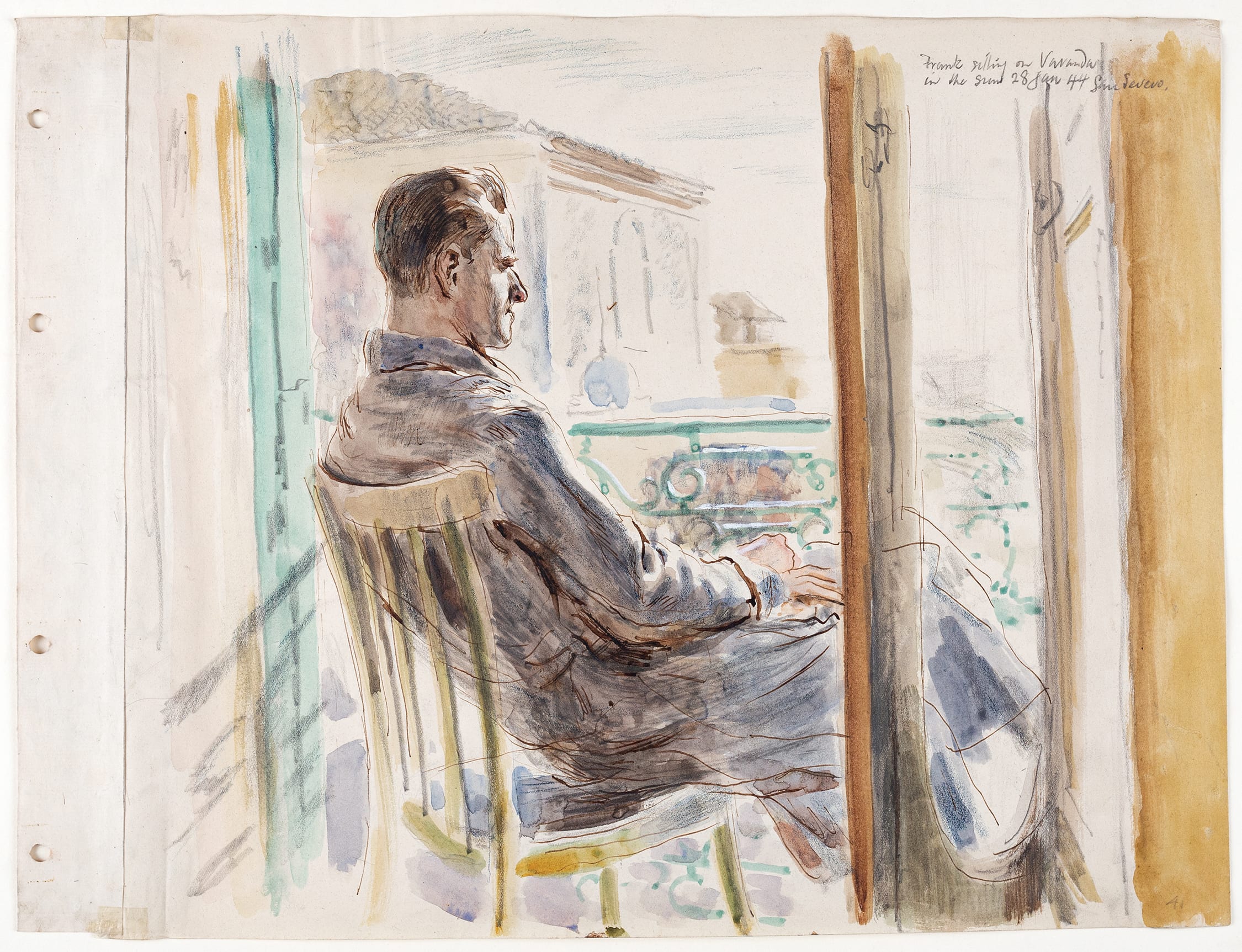 P.34: ‘Frank sitting on Varanda (sic) in the sun… San Severo’. Pencil, pen, brush, ink and watercolour. Inscribed and dated ‘28th Jan (19)44’. 12.5x16.5 inches. £575.
●
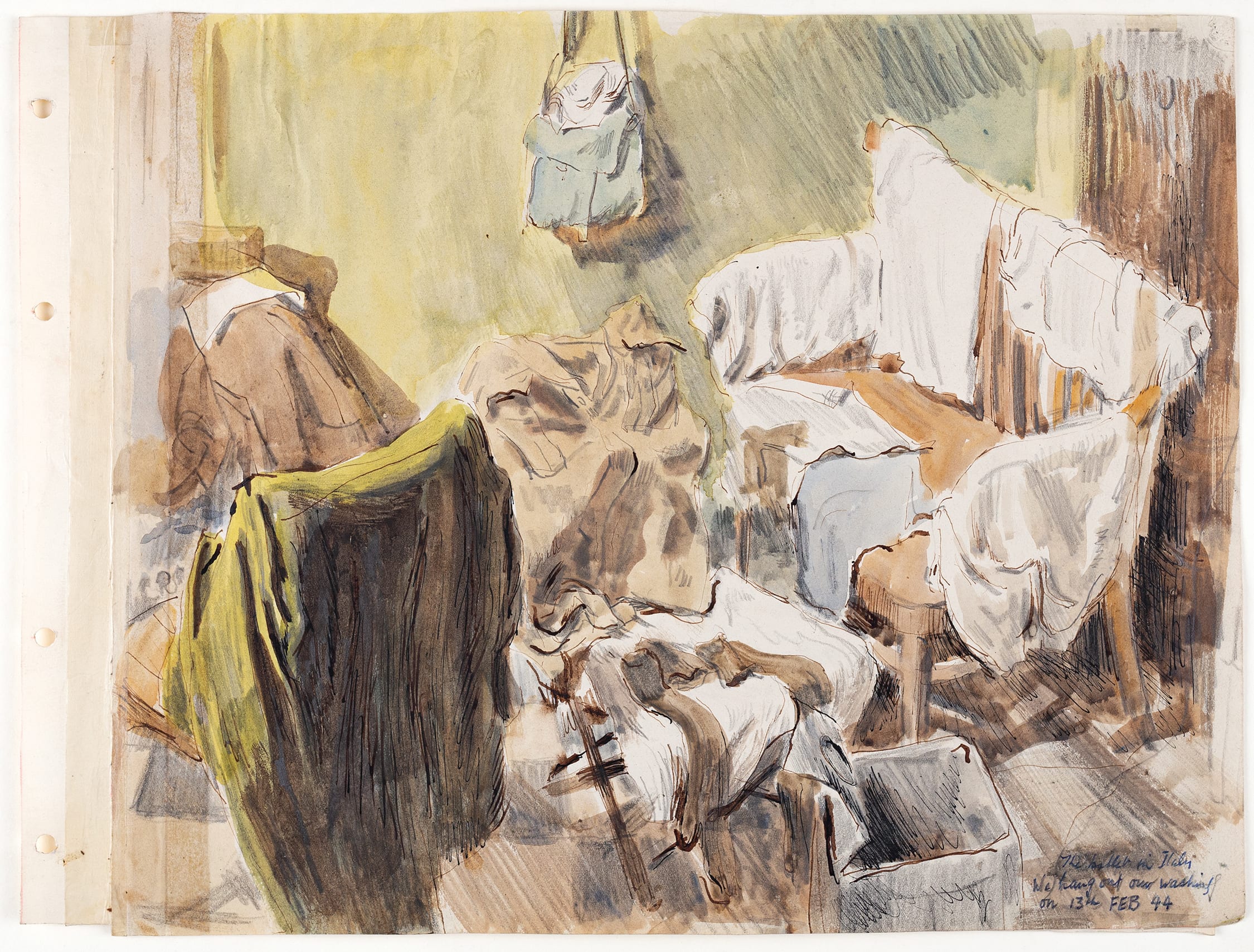 P.35: ‘The billet in Italy. We hang out our washing on 13th Feb. (19)44’. Pencil, pen, brush, ink and watercolour. 12.5x16.5 inches. £575.
●
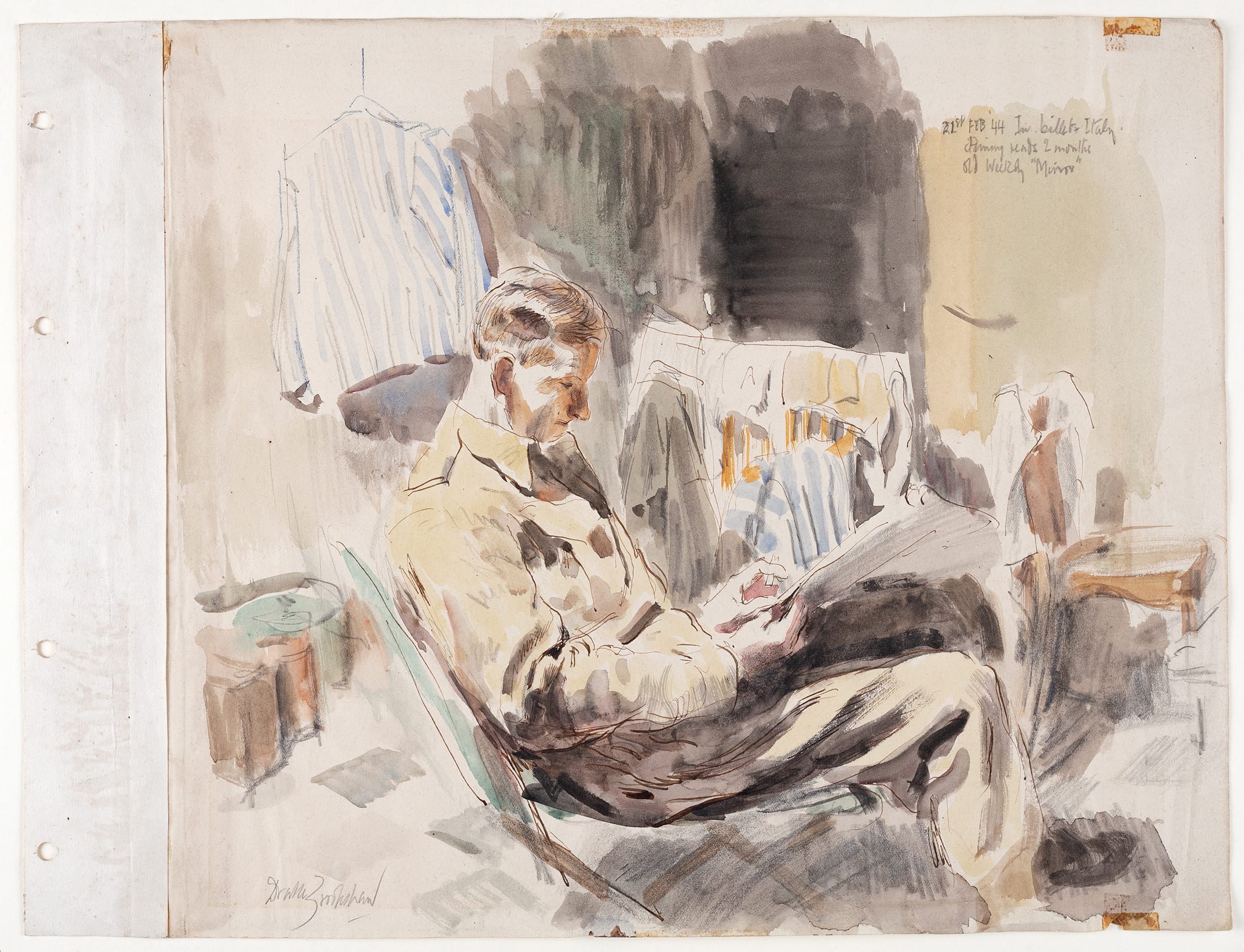 P.36: ‘In billets Italy, Jimmy reads 2 months old Weekly ‘Mirror’. San Severo. Pencil, pen, brush, ink and watercolour. Signed. Inscribed and dated ‘21st Feb.(19)44’. 12.5x16.5 inches. £575.
●
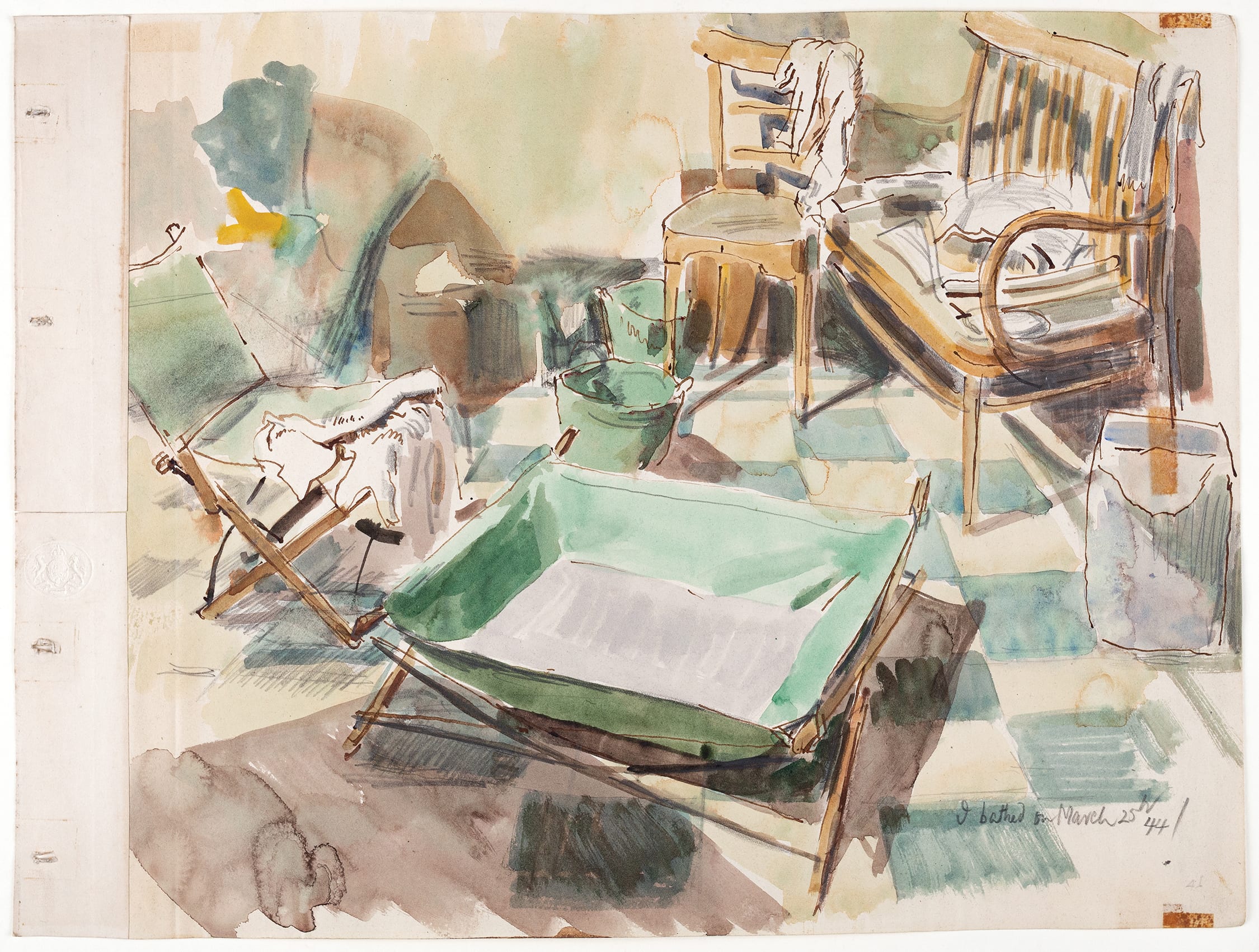 P.37: ‘I bathed on March 25th (19)44’. Pencil, pen, brush, ink and watercolour. Inscribed and dated. 12.5x16.5 inches. £575.
●
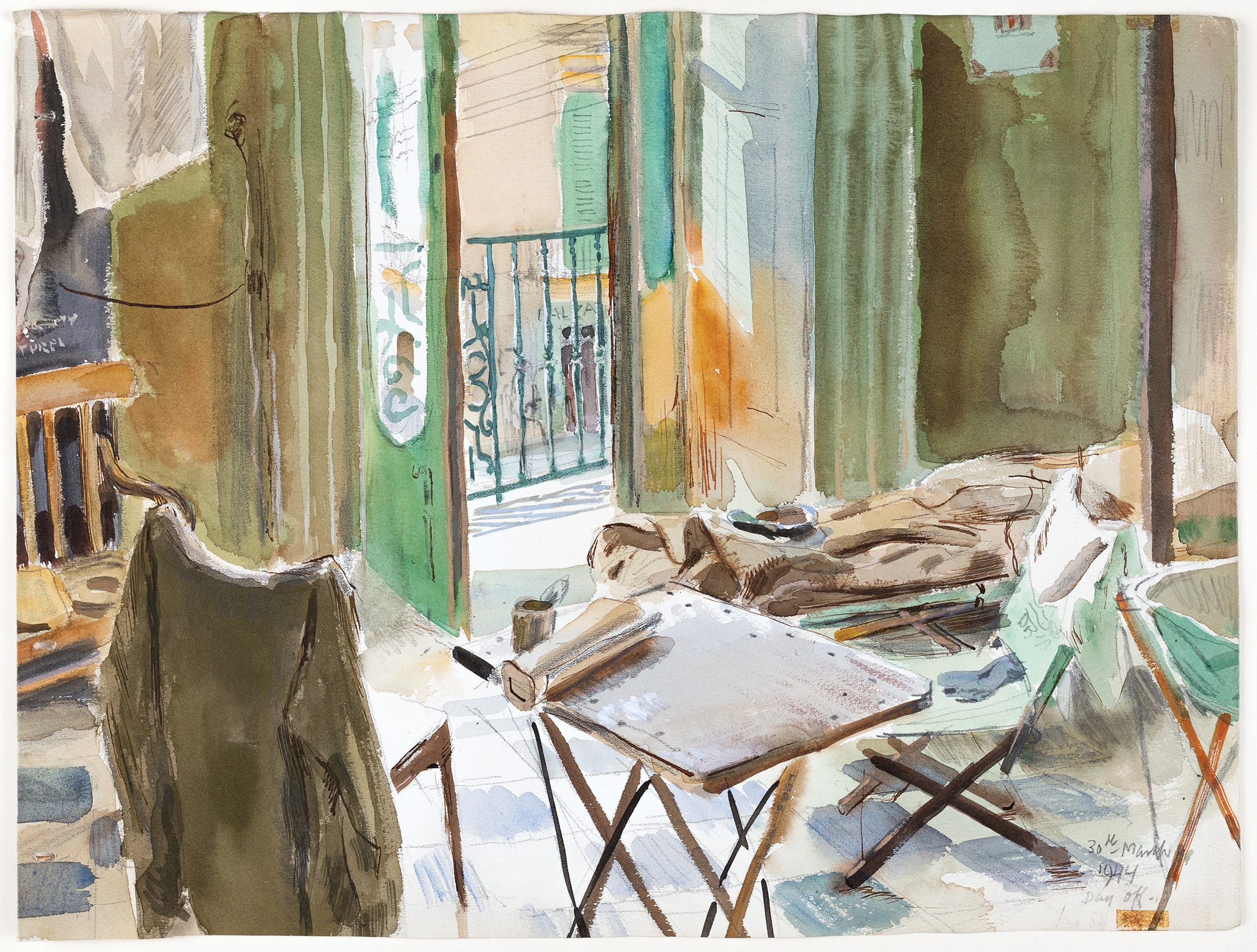 P.38: ‘Day Off’, San Severo. Pencil, pen, brush, ink and watercolour. Inscribed and dated, ‘30th March, 1944’. 12.5x16.5 inches. £675.
●
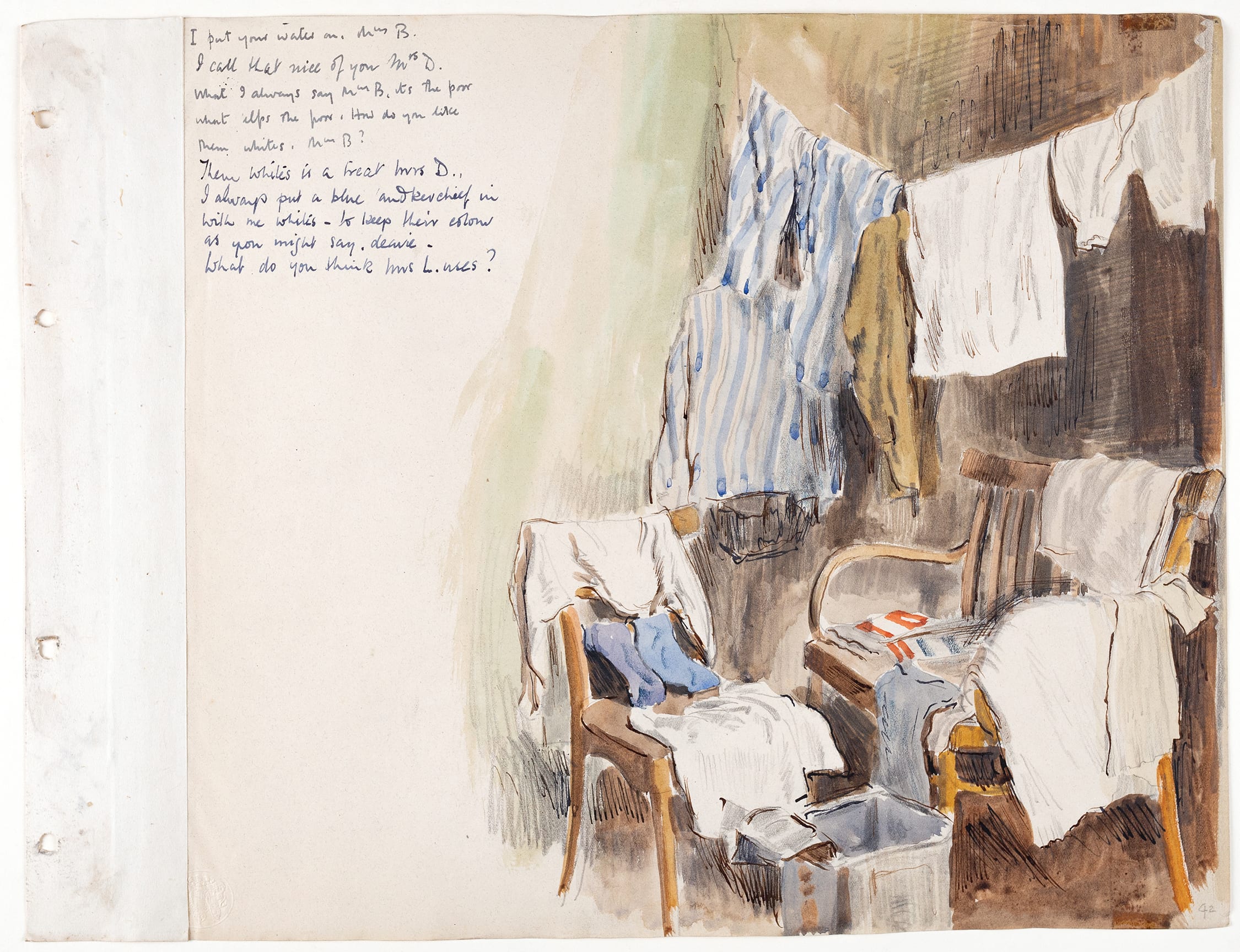 P.39: Washing drying, billet, San Severo. March/April 1944. Pencil, pen, brush, ink and watercolour. Inscribed in two hands: “I put your water on Mrs B” (?a.k.a Brookshaw) “I call that nice of you Mrs D” “What I always say Mrs B, it’s the poor what ‘elps the poor. How do you like them whites Mrs B?” “Them whites is a treat Mrs D. I always put a blue ’andkerchief in with me whites- to keep their colour as you might say, dearie. What so you think Mrs L uses?”. 12.5x16.5 inches. £575.
●
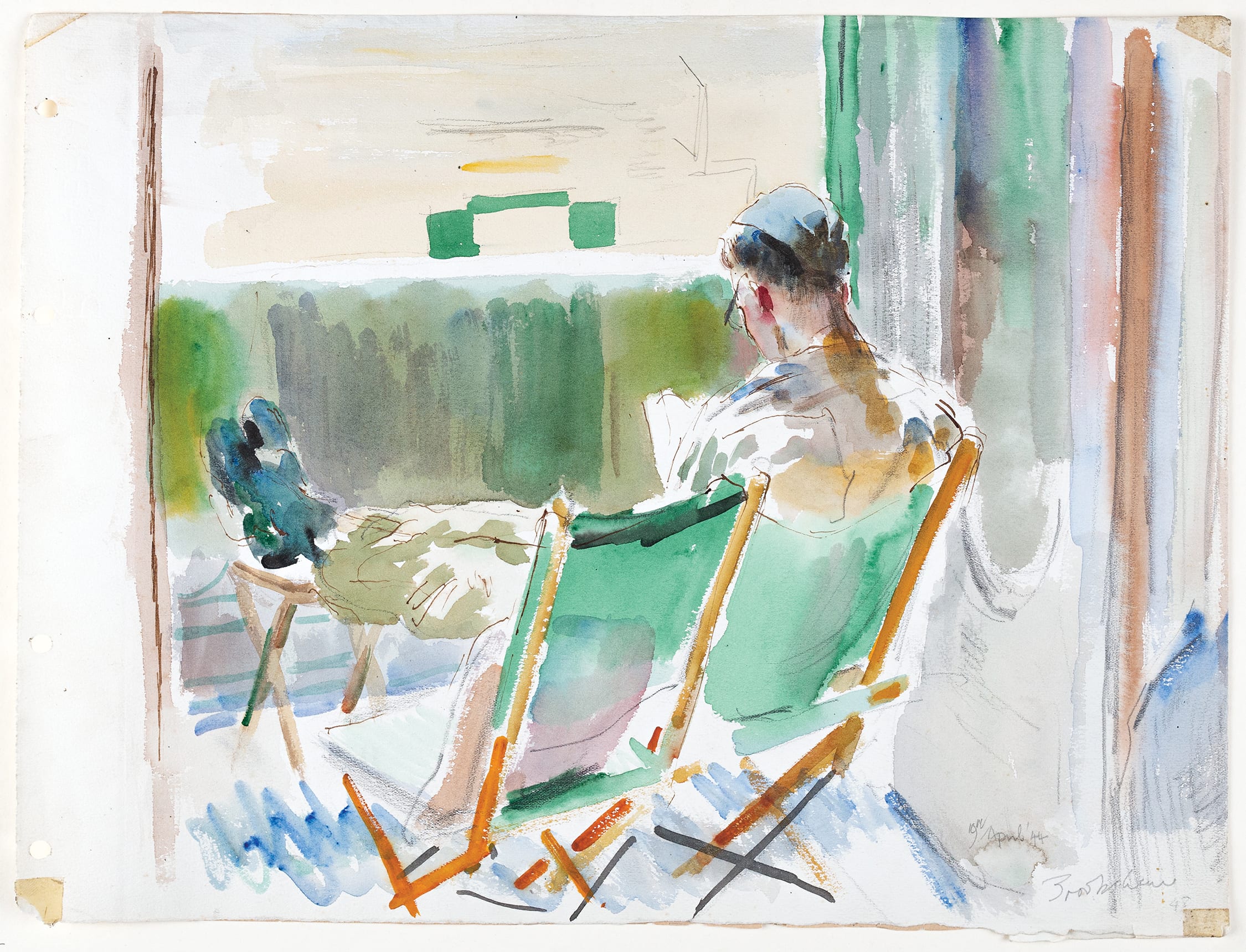 P.40: At the billet’s open window, San Severo. Pencil, pen, brush, ink and watercolour. Signed and dated, ‘19th April (19)44. 12.5x16.5 inches. £675.
●
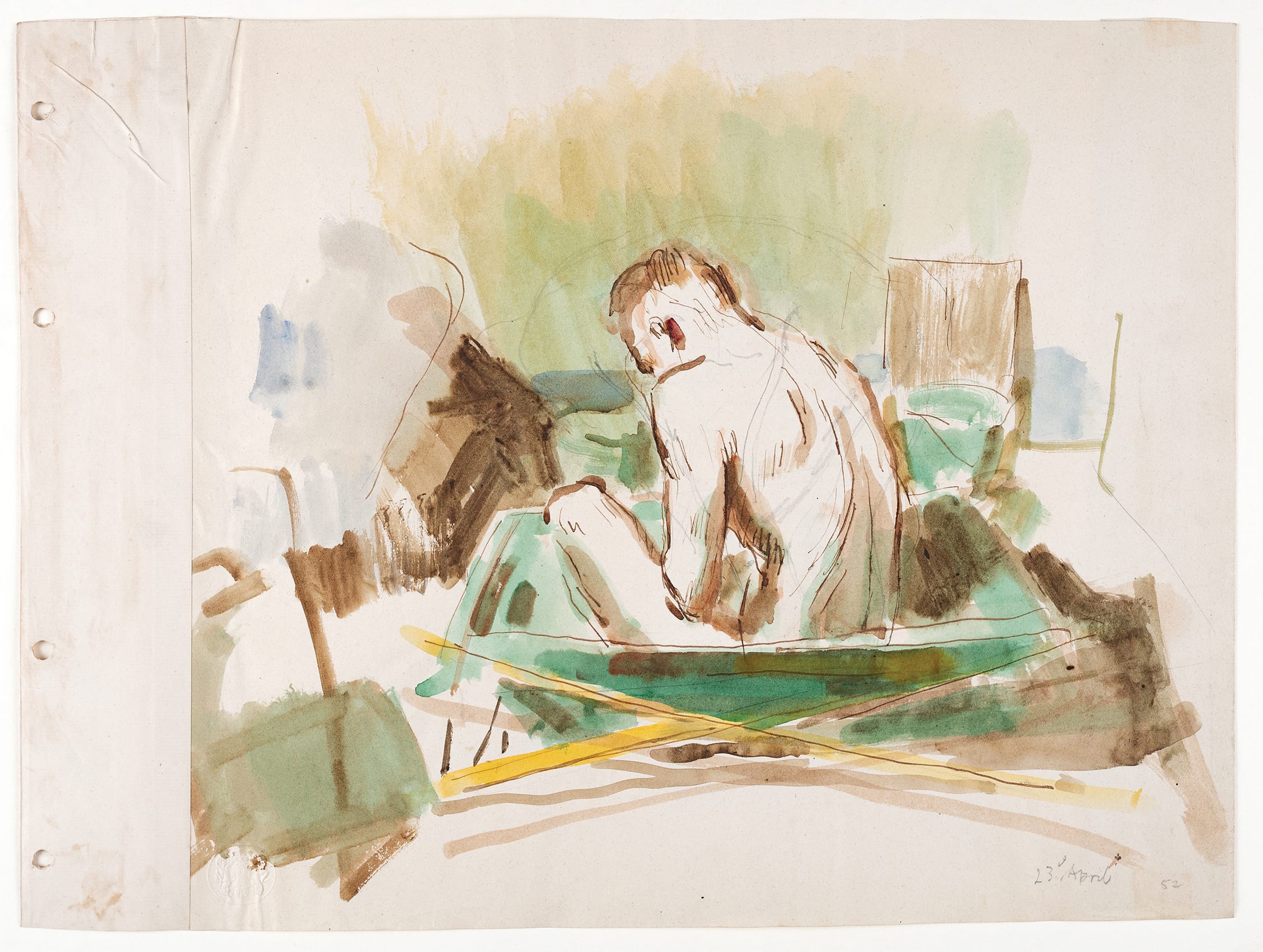 P.41: Bathing, billet, San Severo. Pen, brush, ink and watercolour. Dated, ‘23rd April’ (1944). 12.5x16.5 inches. £575.
●
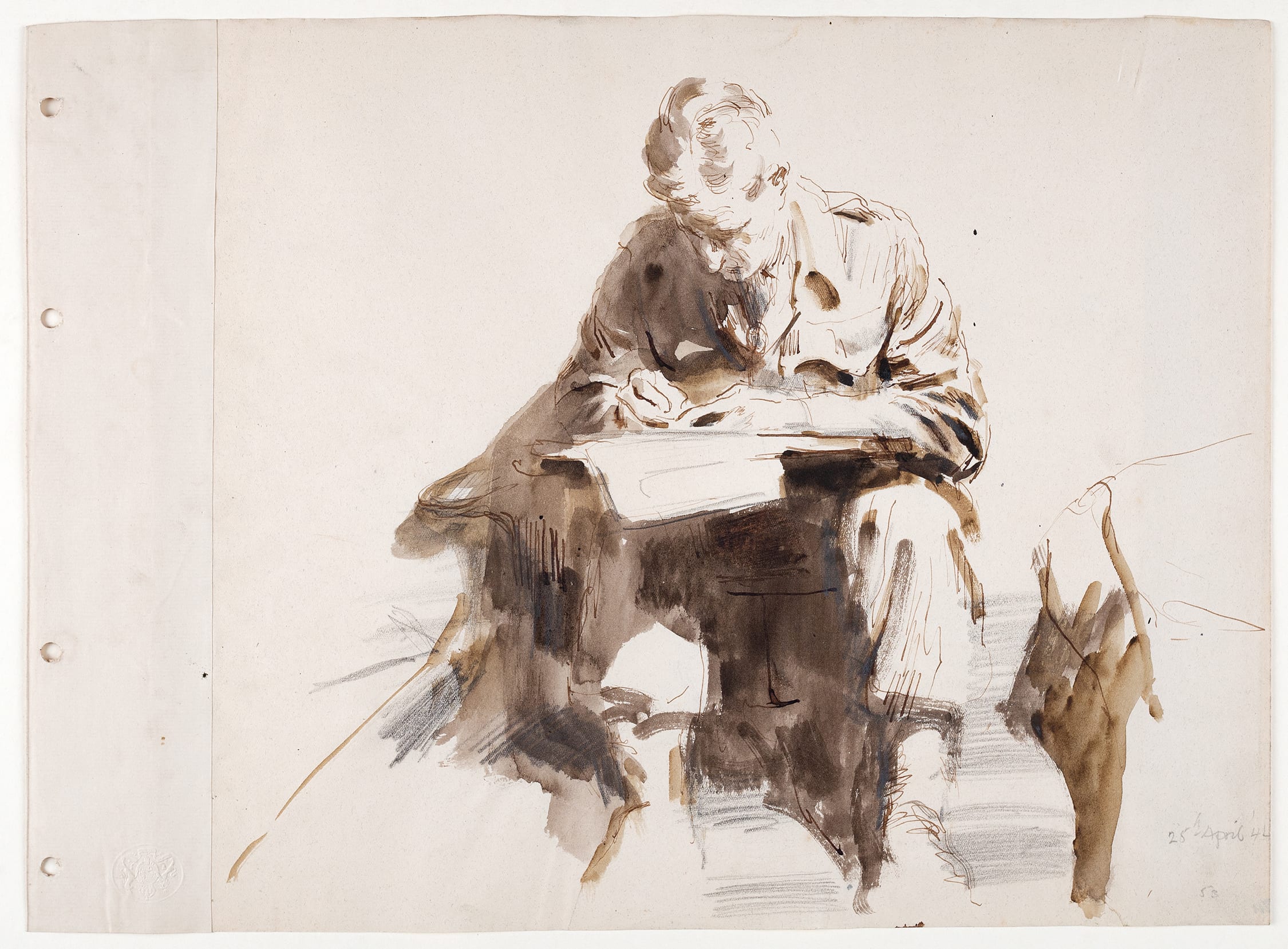 P.42: Letter-writing, billet, San Severo. Pencil, pen, brush and ink. Dated, ‘25th April (19)44’. 12.5x16.5 inches. £375.
●
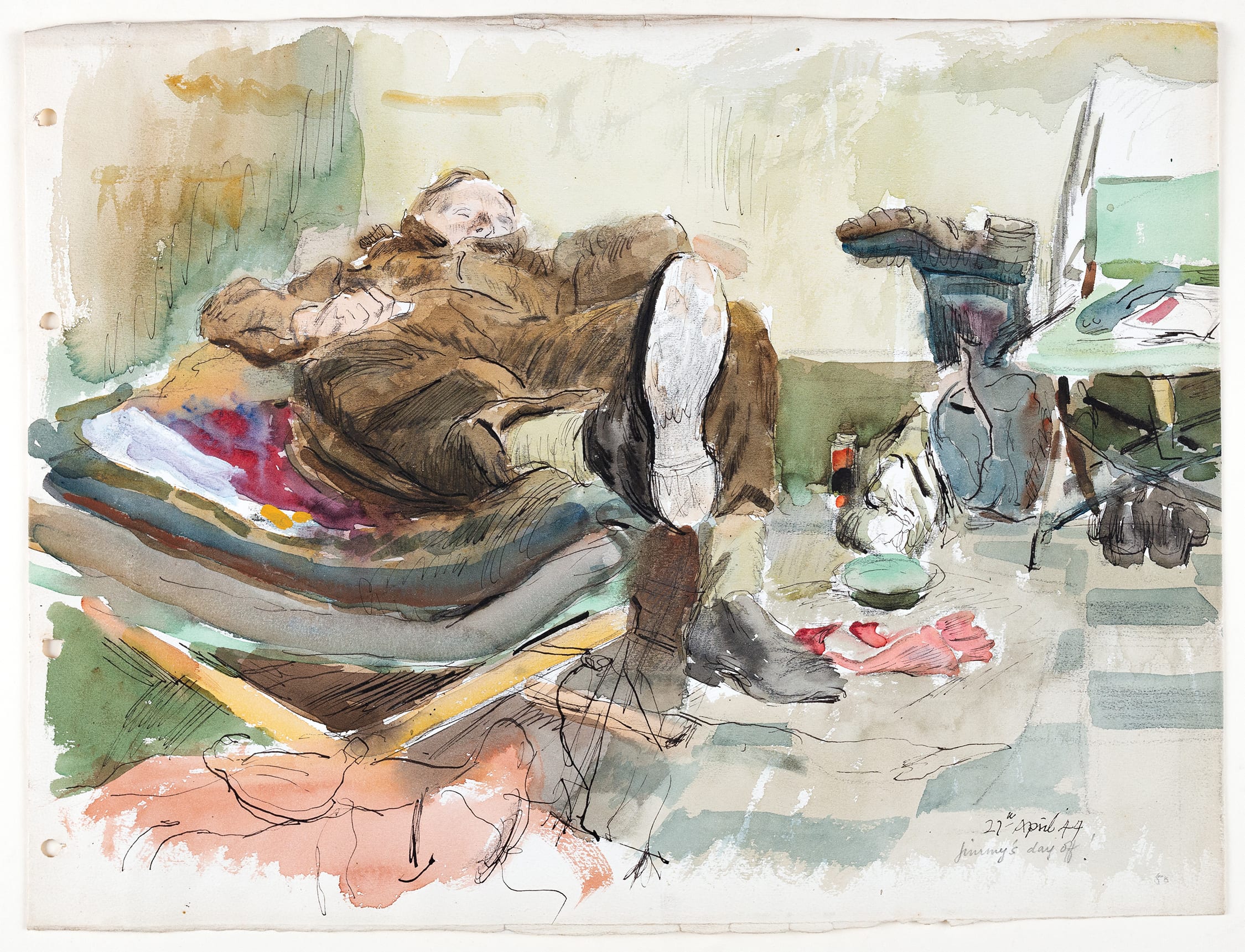 P.43: ‘Jimmy’s day off!’, billet, San Severo. Pencil, pen, brush, ink and watercolour. Inscribed and dated ‘27th April (19)44’. 12.5x16.5 inches. £575.
●
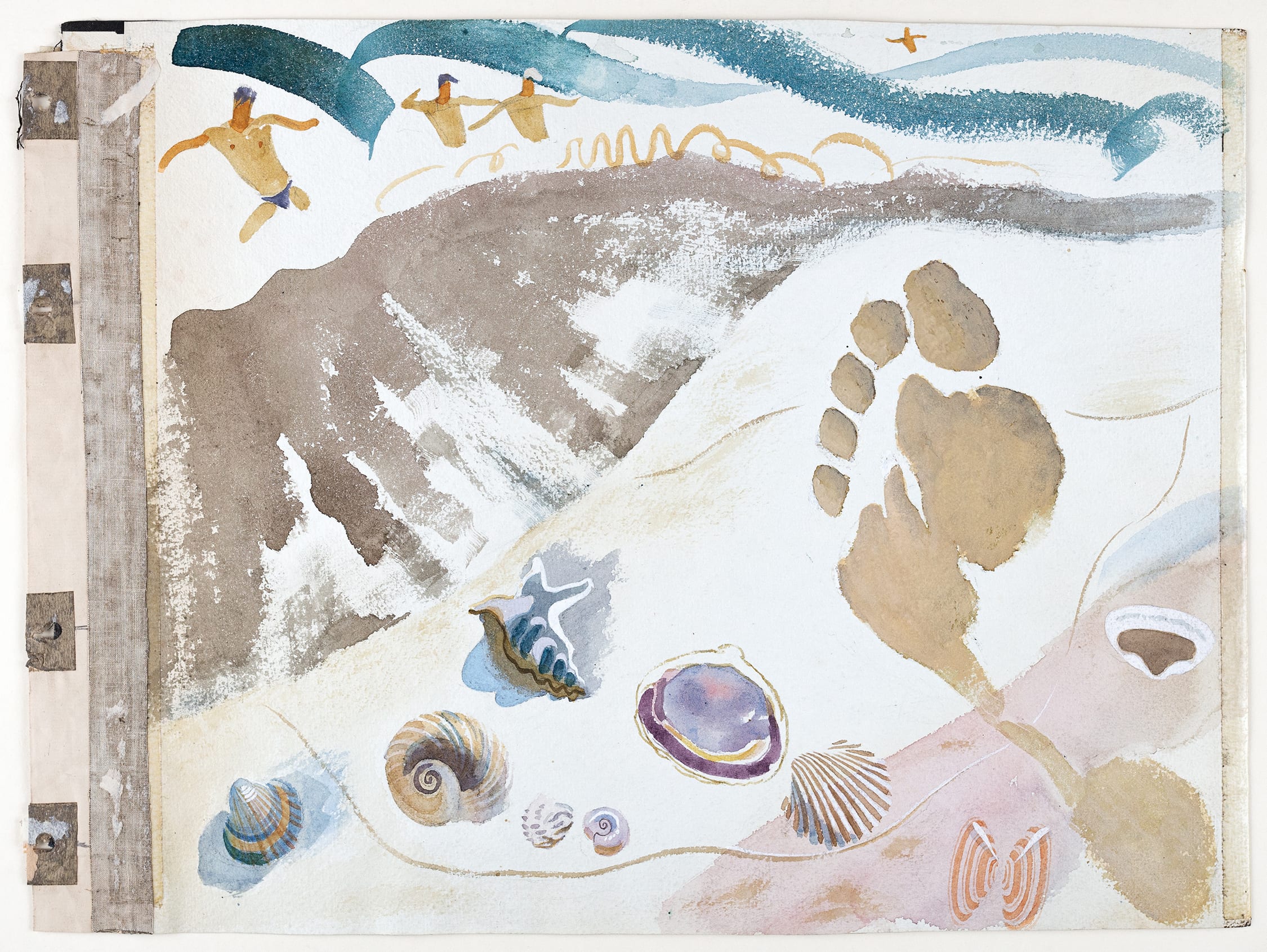 P.45 recto: Beach scene. Watercolour. 1944. 12.5x16.5 inches. £575.
●
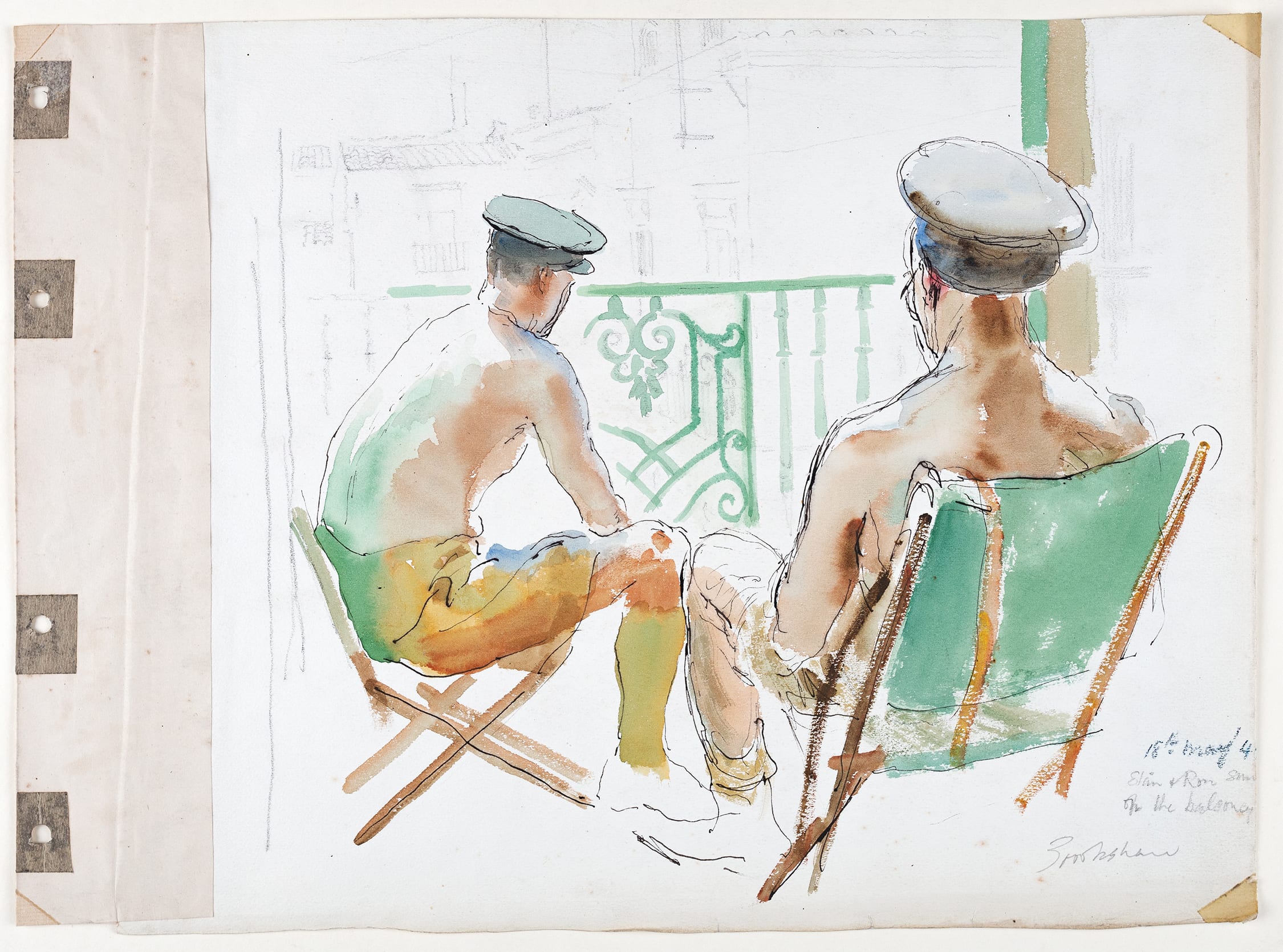 P.47: ‘Ron and Stan sunbathe on the balcony’, of the billet, San Severo. Pencil. Pen, brush, ink and watercolour. Inscribed and signed. Dated ‘18th May (19)44’. 12.5x16.5 inches. £675.
●
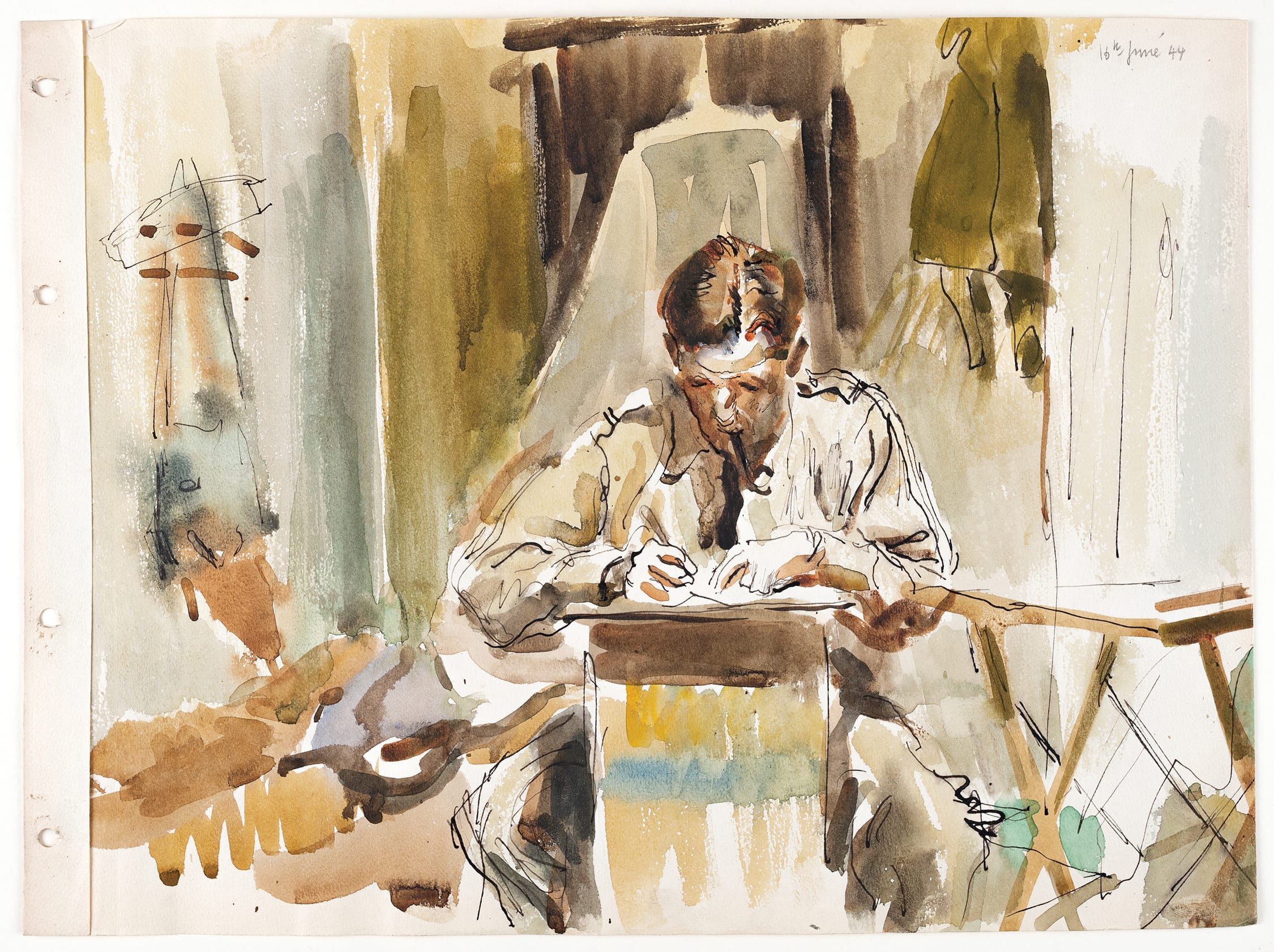 P.48: Letter-writing, billet, San Severo. Pen, brush, ink and watercolour. Dated, ‘16th June, (19)44’. 12.5x16.5 inches. £575.
●
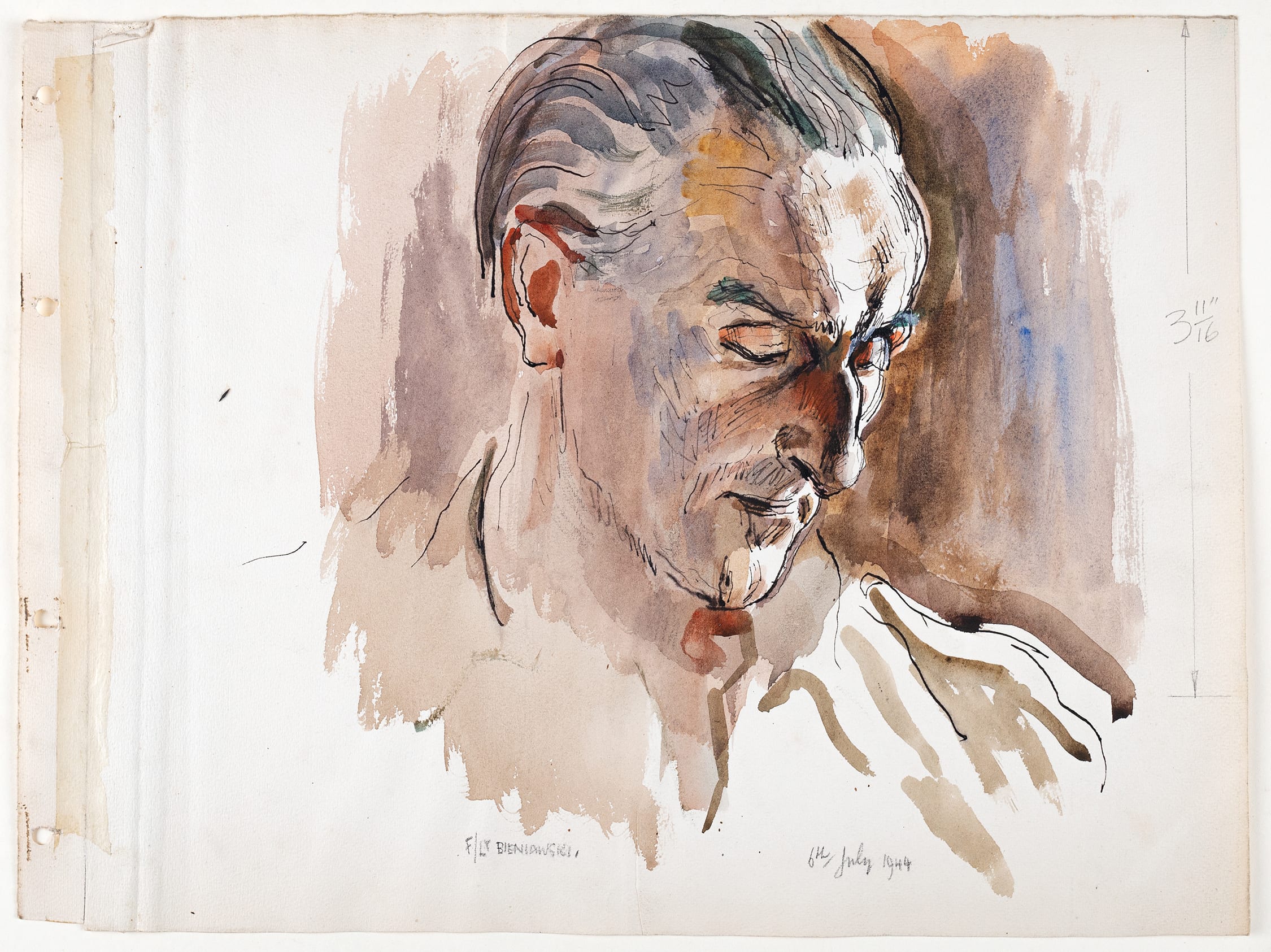 P.49: ‘F/Lt Bieniawski’. Pen, ink, brush and watercolour. Inscribed and dated ‘6th July 1944’. 12.5x16.5 inches. £375.
●
 P.50: Waiting Carrozze. Probably drawn from the verandah of the billet, San Severo. Dec 43-July 44 Pen, brush, ink and watercolour. 12.5x16.5 inches. £225.
●
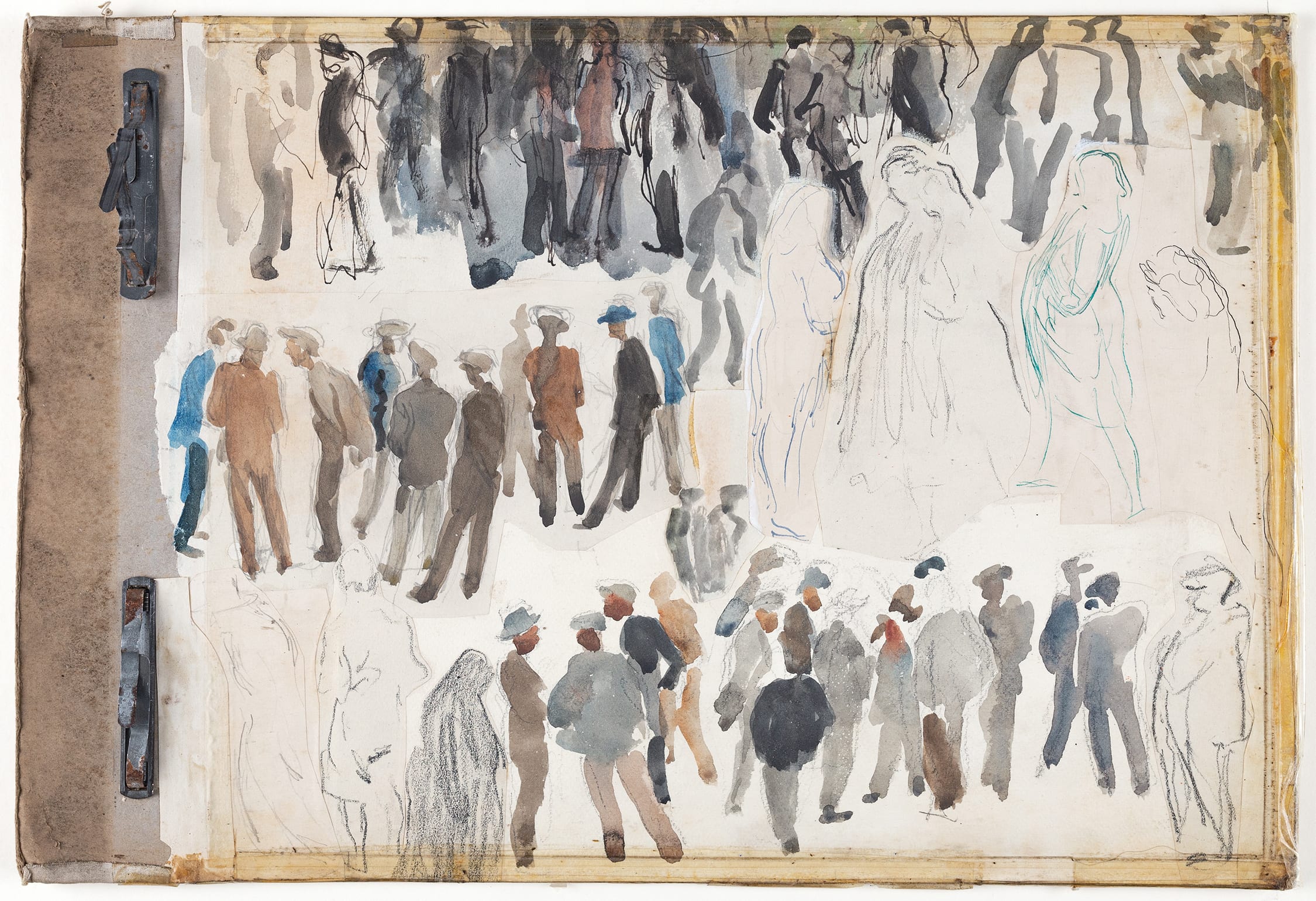 Inside back cover: Crowd, San Severo. Pencil, pen, brush, ink and watercolour studies probably made from the verandah of Brookshaw’s billet, San Severo Dec 43-July 44. 12.5x16.5 inches. £375.
●